

Mollie Shiflett ’26 is a double major in history and linguistics, not that she knows what to do with that. She is captain of Women’s Club Soccer Gold for the College of William and Mary and is an avid fan of most sports — except golf. Email Mollie at mrshiflett@wm.edu.
The views expressed in the article are the author’s own.
Equal opportunity in education is a joke. To be fair, I don’t have all of the data on this that I need to make a blanket statement about equal opportunity in all aspects of higher education, but I am familiar with one specific area, which — in my opinion — is a pretty good case study for this: law school.
I didn’t go into law school applications/the law school process expecting it to be cheap — let’s be clear — but the amount that they charge for everything is ridiculous. I honestly believe that if the Law School Admission Council could charge me for the air I was breathing while I took my LSAT, they would have. Hell, maybe they did, they don’t tell you what the fee is for.
I was doing the math with one of my friends, and when all is said and done, I will be spending over $1,600 on taking the LSAT and applying to law school: $200 for access to practice tests, $70 a month for a subscription that helps you break down and prepare for the LSAT, $248 for registering for the exam, $215 for the LSAC’s transcript reporting service and $45 every time they send that transcript and letters of recommendation to a school you’re applying to, on top of the application fee that that school charges.
And sure, there are discounts and fee waivers and things you can apply for, but the fundamental point is that learning, especially in a field which is so important to how our society functions, should not be so hard to get into from a financial point of view. I’m not trying to present this as if I’m the first person to ever discover that school is expensive; I’m definitely not, but since a new season of applications is upon us, it probably bears repeating.
And obviously, this cost is not just unique to law school. Applications to the Graduate School at Duke University are $105. It’s $75 for graduate programs at Virginia Tech. It all adds up. If you want to be a doctor, it costs $345 to register for the MCAT, $175 to apply to the first school and $45 for every subsequent application. It’s a racket.
I understand that education is a business in this country — and we can argue about whether or not that’s a good thing — and there are fee waivers and things to help those who can’t afford to pay all of these fees, but the fundamental issue is people go into these graduate and professional programs, just like they went into undergrad, because they wanted to make themselves better. But, most of the time, it feels like the education business is punishing people for wanting to continue learning or do something that will help people.
The idea of education is that it is necessary to society; it creates informed citizens and contributors. It seems a little ridiculous then that society can’t get out of its own way to make higher education accessible to everyone who wants it.
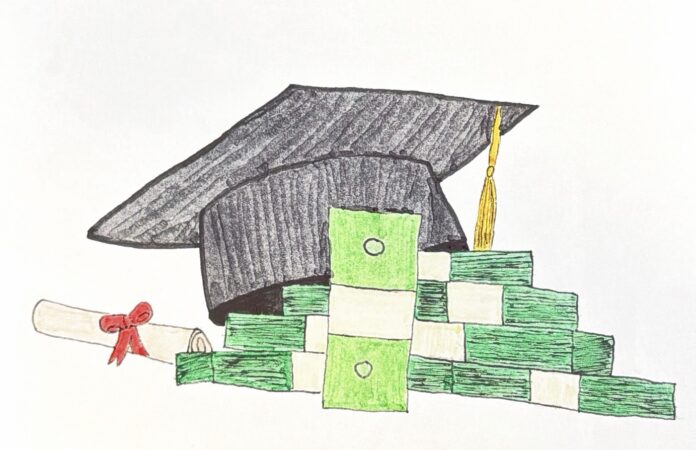
And obviously, it’s not just the cost of applying that’s prohibitive. The average cost of going to law school is $138,000, encompassing three years of education. The average cost of going to medical school is $59,000 a year for what is usually a four-year degree. And then, when you finish and are ready to take on the world with your new degree, the debt you’ll graduate with from law school is about $140,000 and more than $200,000 for medical school. Even getting a master’s degree can leave you with $90,000 in debt.
Probably the vast majority of people going to undergrad don’t necessarily plan on continuing their education, but those who do shouldn’t have to bankrupt themselves on top of their already expensive undergrad degrees. We live in a society that likes to say that if you work hard and do well, you can do whatever you want, but in many cases, that’s not actually true. The high costs in every facet of these graduate and professional degrees (especially when you take it in tandem with the cost of undergrad) doesn’t just limit some people’s post-grad plans, but it also limits us as a society because this system doesn’t seem like it always rewards those who deserve it the most, but those who can pay for it.