

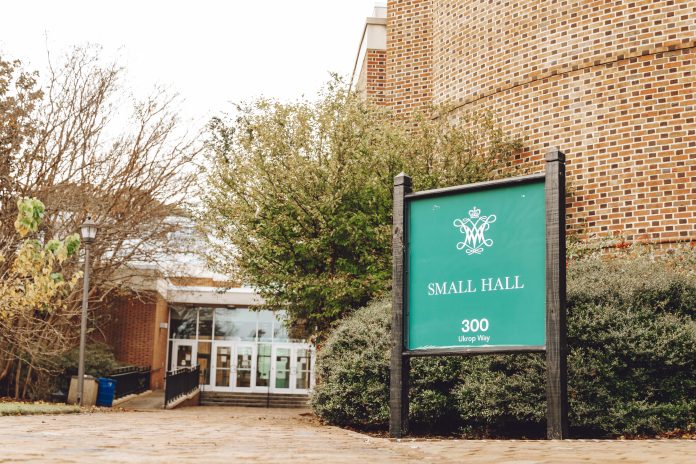
Wednesday, Nov. 12, the College of William and Mary’s John Quincy Adams Society hosted a talk with Ali Wyne, a political analyst and policy advisor. The talk discussed the state of diplomatic relations between the United States and various Asian countries, and emphasized the importance of diplomacy and prudent decision-making. The lecture focused particularly on China and the potential future of U.S.-China competition.
Wyne currently serves as a senior researcher and advisor at the International Crisis Group, having previously worked in analyst roles at the Eurasia Group and the RAND Corporation. He is also the author of “America’s Great-Power Opportunity: Revitalizing U.S. Foreign Policy to Meet the Challenges of Strategic Competition” and co-author of “Lee Kuan Yew: The Grand Master’s Insights on China, the United States, and the World.”
Wyne believes that competition between the United States and China will not “end” with a definite winner. Rather, in his view, both countries must learn to coexist indefinitely in a less contentious way.
“My basic view of the U.S.-China relationship [is that] America isn’t going anywhere [and] China isn’t going anywhere,” Wyne said. “We’re going to have to find some way of competing and coexisting at the same time.”
He also argued that American policymakers need to have a more measured view of China’s significance to meet this goal. Many people, he believes, fall into extremes of either over or underestimating China.
“If we’re going to compete effectively, if you believe that we are in a long-term competition that won’t have any definitive resolution, we need to make sure that we have a psychological temperament that is commensurate to the stakes in the longevity of that competition,” Wyne said. “China is poised to be an enduring competitor. It’s not two feet tall. It’s not 10 feet tall.”
Furthermore, Wyne notes that an easing of tensions between the United States and China is necessary because of the severity of any conflict that would break out between the two nuclear-armed superpowers. He emphasized that diplomatic coexistence is essential in ensuring both countries’ security.
“If the United States and China were to go to war, we’re not sure which country would win,” he said. “Whichever country would win would be blunted. Even if the United States were to win — and I think it would be a very pyrrhic victory — the United States would have incurred an enormous amount of damage. Stop saying or stop assuming that war is inevitable, because you lull yourself into a self-fulfilling prophecy that will indeed bring about that outcome.”
Wyne believes that both the United States and China have unique competitive advantages that are likely to remain in place, and that accepting those distinctions is a key step towards helping to stabilize the future of the countries’ relationship.
“We need to find a midway point between saying, ‘We have nothing to learn from China’ and ‘We have to out-China China,’” he said. “We need to be thinking about what our unique competitive strengths are.”
One of America’s greatest strengths, per Wyne, is its historical commitment to diversity and intellectual openness. He draws this idea from Lee Kuan Yew, the firstPrime Minister of Singapore.
“As long as the United States maintains its openness, openness to people, openness to ideas, openness to dissent and debate, I think that the United States will do okay,” Wyne said. “One of America’s core advantages — maybe its principal core advantage — is that the United States can draw on the talents of roughly 8 billion people. China can draw on the talents of 1.4 billion people.”
Beyond the context of international relations, Wyne also discussed the importance of discourse, humility and curiosity in one’s personal life and the modern political environment.
“We don’t even know what’s going to happen tomorrow, let alone next month, let alone six months from now, let alone a year from now,” he said. “When I think about how many beliefs I once had that didn’t stand the test of time, it’s a very, very long list. We need to be very, very humble about the limits of our understanding.”
Lucas Bickham ’29 found Wyne’s focus on social interaction rather than pure policy to be unexpected and refreshing.
“What I expected was a very political focus, and I was surprised to see that he talked a lot about humility and empathy,” Bickham said. “That was definitely one of my biggest takeaways, and I realized that he has a very good point and that empathy plays a very big role in politics.”
Afterwards, Wyne said that the primary takeaway is the very concept of challenging one’s views and consistently exposing oneself to new ideas and people.
“If you convince yourself and/or believe that you are all-knowing, you’re going to close yourself off to dissent, you’re going to close yourself off to rebuttals, and you’re going to deny yourself learning opportunities,” he said.
He practices this openness himself by visiting colleges, which he believes allows him to escape the Washington, D.C. “bubble” and face new ideas and questions from students.
“I think it’s important, especially for people in D.C., to get out of D.C,” Wyne said. “Thinking in D.C. can sometimes get stuffy, can sometimes get insular. I find that when I visit colleges and universities, I pick up so many fresh questions, so many fresh insights. I learn so much. There’s a whole wealth of knowledge and perspective to be gleaned and gained and absorbed if you make the effort.”
Wyne acknowledged that challenging oneself intellectually can be difficult, but that if approached empathetically and genuinely, it can be immensely valuable.
“Seek out people who disagree with you, seek out people who challenge you, and who do so from a place of curiosity, from a place of empathy,” Wyne said. “What I find really gratifying about it is that it’s rare in the hyperdigital age, and because it is rare and people are not expecting intellectual empathy, when you extend that olive branch, you can talk with just about anybody.”
