

This article contains discussions of sexual assault.
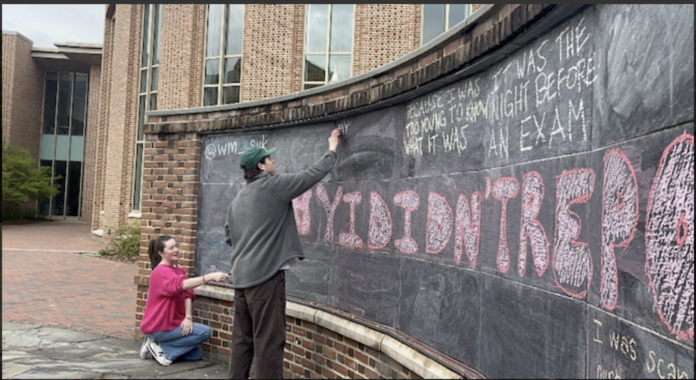
Wednesday, Nov. 19, the Innocence Club and Someone You Know held the event “Beyond Justice,” an educational talk focused on reshaping understandings of the American incarceration system and its relationship to sexual violence.
The Innocence Club is the College of William and Mary’s undergraduate branch of the nationwide Innocence Project nonprofit. The nonprofit works to exonerate those incarcerated with false convictions, advocating for proper DNA testing and other forms of post-conviction relief.
Someone You Know is a peer-based organization working to prevent sexual violence through education and advocacy. The organization presents to clubs on campus on a range of issues, including how to support survivors of sexual violence, the importance of bystander intervention and healthy masculinity, analyses of violence-supportive culture and guides for the Title IX process.
The presentation featured a history of the American incarceration system and key exoneration cases. After the presentation, attendees discussed how the criminal justice system and sexual violence are interconnected.
A key focus of the event was the importance of racial justice in the carceral system. Black Americans represent 14% of the United States population, yet make up 41% of the prison and jail populations nationwide.
Terrence McDuffie ’27, president of the Innocence Club, presented on the lives of two wrongfully convicted Black men, Levon Brooks and Kennedy Brewer. Both men were convicted of perpetrating sexual violence, despite forensic evidence to the contrary.
The two case examples portrayed how sexual violence sentencing and punitive measures can cause harm in society when the human dignity of each person is not respected, and the justice system relies on racial biases.
Erin Reiley ’27, recruitment chair for SYK, spoke about organizing an event focused on the intersectionality of sexual and gender-based violence and the justice system.
“Something that’s particularly pertinent in sexual violence advocacy right now is how sexual and gender-based violence interacts with the carceral and punitive systems,” Reiley said. “That’s something that a lot of people aren’t super educated on beyond basic concepts.”
Reilly noted that in her role at SYK, she hopes that further collaborations will expand knowledge across campus of the effects of sexual and gender-based violence on all groups of people.
“We really want to broaden that education and experience that people have with it, especially considering how sexual and gender-based violence affects people differently based on different facets of their identity coming from marginalized groups — sexuality, race, etc.,” Reiley said. “We want to spread our advocacy to as many avenues of campus as we can, and working with the Innocence Club is a great opportunity for that.”
It was important to several Innocence Club organizers to collaborate with SYK because of their goal to broaden education about the carceral system.
Sydney Shoulders ’26, outreach education chair for Innocence Club, emphasized the need to shift conceptions of sexual and gender-based violence to one that encompasses incarcerated survivors.
“There are a lot of narratives about what a perfect survivor looks like, and that person is not typically someone who is incarcerated,” Shoulders said. “It’s really important to think about harm happening in places where we don’t want to think about it.”
Over the past semester, Innocence Club has worked to highlight various legal inequities in the United States justice system. Saturday, Nov. 8, the club partnered with the College’s Fighting for Immigrant Rights and Equity Club for a collaborative UndocuAlly training.
“Immigration is not a criminal offense, yet in this country right now we are treating it as though it is one,” Shoulders said. “I think it’s important to, if for no other reason, just say that and make a space for that and talk about why exactly it’s wrong.”
Ava Reed ’28, programming chair for SYK, spoke on the importance of understanding those connections and the difficulty in transitioning from punitive measures to restorative justice.
“When you’re talking about restoring justice, it’s not something that automatically makes you feel good,” she said. “Sometimes you want to inflict a type of harsh punishment onto someone else, and it’s an understandable human emotion.”
Reed explained that while it might be instinctive to punish those who commit serious offenses harshly, it is important to remember that the human dignity of those involved needs to be upheld.
“However, that doesn’t negate the fact that human dignity needs to be at the utmost standard for both the survivors and those who are incarcerated,” Reed said.
For Reed, this way of thinking is not limited to just the incarceration system; it is a mindset for understanding justice. Reed parallels the injustices stemming from a focus on punitive measures with the problems within the Title IX process.
Title IX is a federal law that prohibits sex-based discrimination in education programs and activities that receive federal financial assistance. This prohibits sex-based discrimination, specifically sexual harassment and assault, at almost all universities in the US.
At the College, the Title IX office in the Department of Compliance and Equity stipulates adherence to both the Title IX and Discrimination policies. If policies are violated, students and staff can submit a report to initiate a preliminary investigation of any potential discrimination.
After the evaluation has started, survivors of sexual and gender-based violence or harassment can receive supportive measures. Later on in the process, punitive and disciplinary measures can be put in place.
For Reed, the current system of support for Title IX is not enough. Reed underlined the need for more transparency and a focus on restorative justice in the procedure — for the good of both the survivor and perpetrator.
“Stop stigmatizing the conversation about it, and start hiring more people to be in the Title IX process,” Reed said. “I feel that in a university, if they wanted to, they would. It’s not something that they care enough about.”