

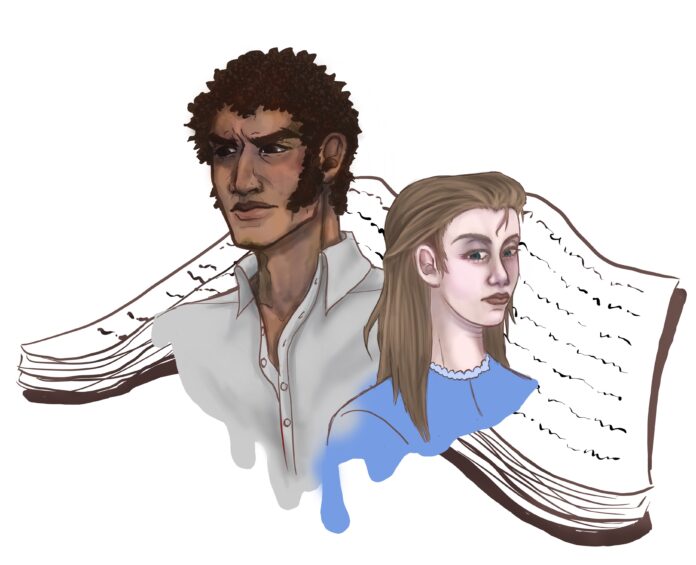
The 2026 adaptation of Emily Brontë’s “Wuthering Heights” opens with a staged hanging designed to be jarring and psychologically loaded. The scene almost primes viewers into a world desensitized to violence and trauma, following Brontë’s original themes.
As the film continues, viewers observe the eerie and vast moors against the interiors of Wuthering Heights and Thrushcross Grange estates, creating contradictory, but striking settings. The camera beautifully captures stars Jacob Elordi and Margot Robbie’s longing glances.
Yet, as the story unfolds, the symbolic weight of the hanging scene falls flat. The hanging is referenced again, but its connection between Catherine and the book’s deeper, more emotional arc gets lost. The boldness of the beginning scenes give way to a more digestible story between main characters Catherine Earnshaw and Heathcliff’s tragic romance.
Directed by Emerald Fennell and starring Robbie as Catherine and Elordi as Heathcliff, “Wuthering Heights” chose ambitious Hollywood figures for the film’s ambitious aesthetic.
The risks appear to have paid off commercially, grossing over $26 million worldwide within its first 24 hours in theaters.
Critics, however, find the storyline borders on a more lush romance, similar to Netflix’s “Bridgerton,” with a period setting made to feel ‘campy’ by the modern soundtrack.
Fennell’s creative freedom in regards to the storyline has been quite controversial.
Like many earlier adaptations, the 2026 version focuses exclusively on the first half of Brontë’s novel: Heathcliff and Catherine’s childhood bond and Catherine’s ultimate decision to marry Edgar Linton. The second generation – Hareton, Cathy Linton and Linton Heathcliff – and their traumatic storylines described in the second half of the novel are absent.
The rest of the article contains spoilers.
In Brontë’s text, Heathcliff’s trauma turns into a long game of manipulation that spans decades. Without the second generation, the story becomes a tragic romance instead of a revenge story. Several critics note that compressing such a layered novel into a singular love story takes away much of its intellectual depth.
The film’s marketing leaned into sensual imagery, and the trailer featured hypersexualized flashes that created early traction for the movie. In the final cut, these moments are common but surprisingly brief, arguably more present for shock-value than essential to the narrative. They add to a greater tone of chemistry but no intellectual complexity.
Isabella Linton’s storyline, for instance, takes a more overtly deviant turn, intensifying the sexualization of the narrative. Brontë’s novel presents Isabella’s marriage to Heathcliff as abusive and cruel, but the film amplifies more sensational scenes that are uncomfortable and seem to distract viewers from Heathcliff’s genuine cruelty.
One of the film’s more successful elements is Robbie’s portrayal of Catherine Earnshaw. Robbie leans into Cathy’s selfishness, volatility and social ambition. At times, it’s hard to sympathize with her as a tragic heroine, but Catherine in Brontë’s original work is not a tragic angel either. This film adaptation made her prideful while displaying her social aspirations as she plots her alliance with Edgar Linton.
Her death scene, however, which included a montage of childhood scenes with Heathcliff, appears to be one of the character’s more sympathetic moments. Their relationship from youth to end gives the movie its climax and emotional weight.
While Catherine retains her complexity in this adaptation, Heathcliff arguably loses much of his own.
In Brontë’s novel, Heathcliff is an obvious outsider, described as dark-skinned. This distinction is central to his psychology and alienation as Hindley Earnshaw abuses him due to social prejudice and class hostility. All of these elements fuel his rage and desire for revenge, which impacts all elements of the novel.
Elordi’s Heathcliff is unmistakably white, which the public has criticized since the original casting release. He is portrayed as impoverished and emotionally neglected rather than racially discriminated against. The film could have commented on systemic prejudice, but instead opts for more generic cruelty that landed flatly.
Many critics feel as if the film missed an opportunity to explore race, class and belonging, which could have deepened its modern relevance.
While physically fitting the brooding romantic archetype, Elordi’s portrayal has been described as subdued and dull. Brontë’s Heathcliff is more manipulative and frighteningly volatile. Whether this stems from the actors’ performance or deliberate choices is debatable, but the difference is noticeable.
An almost unnoticed shift in the adaptation lies in Nelly Dean’s character. In the film, Nelly acts as a direct influence on Catherine and Heathcliff’s separation.
In a key scene, she is aware Heathcliff is listening and deliberately frames Catherine’s words negatively, after Catherine had admitted to loving Heathcliff more than Linton.
In both the movie and the book, Catherine tells Nelly that marrying Heathcliff would “degrade her socially,” but Heathcliff overhears only part of her confession. The film redistributes the blame from Catherine’s choice and Heathcliff’s ego to impulsive decisions and Nelly’s deliberate manipulation. While Nelly influences events and narrates the entire storyline in the movie, the film makes her much more complicit and even includes a scene of her receiving Catherine’s forgiveness on her deathbed.
This adjustment arguably adds to an overall tragic story that romanticizes Heathcliff and Catherine’s story even more.
Catherine and Heathcliff’s dynamic is also completely reshaped. In Brontë’s original text, Catherine and Heathcliff never even have a confirmed physical affair after her marriage. Their connection is emotional and obsessive, and their tension is psychological. Their initial separation is completely their own, stemming from pride, ego, social ambition and class dynamic.
By making Nelly a plot catalyst and leaning into heavy graphics, the film loses the novel’s original, internally-driven plot.
Brontë’s novel is deemed a classic, and it continues to inspire. If “Wuthering Heights” is reduced from a generational story into a streamlined tragic romance, is that simply the cost of translating a dense novel into a two-hour film? Or is it reflective of a broader cultural preference for marketable appeal over intellectual challenge?
Film as a medium requires compression and most subplots do not survive, but Brontë’s novel was never meant to be easily digested.
When adaptations oversexualize characters, viewers are offered something more consumable. Was this a missed opportunity for Fennell to make a social commentary on race and class? Do modern adaptations assume viewers cannot comprehend depth? Or, do viewers prefer it that way?
“Wuthering Heights,” the movie, is a hit. It is ambitious and emotionally resonant. But it still calls into question our modern appetite for complexity. Do audiences still crave the sharpness of a classic, or is the pretense of sophistication enough to sell?
