

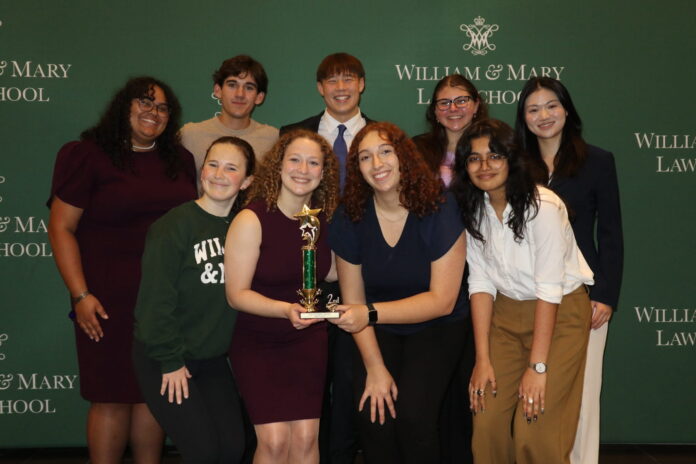
The College of William and Mary’s collegiate mock trial team is a space for future law students, those with debate and speech experience and even students with a flair for theater to learn the flow of a courtroom while competing up and down the East Coast.
The current team has 24 members split into A, B and C teams, but that number is not set in stone. Tryouts are composed of two parts — a speech about a topic of your choice and an improvisation piece. Although a portion of club members were in high school debate or speech, prior experience is not necessarily an indicator of success in college mock trial.
“Some of us did mock trial in high school, but, genuinely, some of the best people I know just started in college,” Mock Trial president Miriam Antony ’26 said. “It’s really just, can you speak? Can you speak well, and can you learn to speak?”
Each team has captains who lead the other members through the process and offer guidance. For club member Matthew Lee ’29, his captains were great mentors and helped show him that being successful in mock trial is about specific traits that can be learned and practiced.
“Skills that I can tell pay off for the good attorneys and witnesses are confidence in yourself and your answers,” Lee said. “You can be saying the complete wrong thing, but as long as you’re pretty confident, the judge is going to side with you most of the time.”
Lee added other qualities that captains like to see in competitors.
“I would say grit. It’s a lot sometimes, but it’s worth it, you know, of course it’s worth it,” Lee said. “They want to see that you can be loud and quiet, that you can, I guess at times, not be embarrassed. Because if you’re a witness, sometimes you’re asked to do funny characters.”
Competitions are set up in the style of a courtroom. Members have different roles during competitions, such as attorneys and witnesses, that require specific performance skill sets.
“You have expert witnesses that are there to break down complex subject matters. So a doctor, for example, might take the stand and explain how the person in the piece died; they died due to a heart attack, or x-y-z,” Mock Trial member Timmy Tasler ’26 said. “Then you have your more sympathetic witnesses that are designed to make the general courtroom very sad, just cry, tug at their heart strings and that’s the emotional appeal they bring. In each witness archetype, there is a lot of acting that goes into it.”
Dedication to the craft and hard work to memorize lines is an important part of Mock Trial, but levity can also be found in the courtroom. Being able to embody different personalities is an integral trait that the club looks for in members.
“I think theater kids really do thrive when they apply for Mock Trial, get in and and they’re like ‘Wait a minute, I can just go on the stage, crack jokes and be this really funny character?’ It’s like, yeah, that’s a lot of what Mock Trial is, believe it or not,” Tasler said.
The fall semester serves as a time for new members to learn the ins and outs of mock trial while seniors perfect their craft. The club switches up teams temporarily in a “trial by fire” challenge before the competitive season, which starts after winter break.
“Everyone’s roles get mixed up and you do a tournament in a shorter turnaround than any of your other tournaments, just to try new things. And then spring season, we restack, our teams get reshuffled, new captains, new roles, et cetera. And those are your competitive teams,” Antony said.
Two teams from the College recently finished competing at the American Mock Trial Association Regional Tournament, which was hosted here on campus. The teams are now preparing for the Opening Round Championship Series, the next level of the competitive spring season. Competitions at other schools happen over the course of a weekend, and, outside the structure of four rounds in two days, provide lots of quality bonding time for the teams.
“Typically, we leave Friday evening, spend the night in an Airbnb with the entire team and get team dinner. It’s a fun time,” Antony said.
During the competitive season, all teams around the country work on the same case distributed by AMTA. While studying the same facts as peers nationwide forges connections with students from other schools, working with the same content for months at a time presents its own set of unique challenges.
“In addition to the four rounds you do in a weekend, you’re probably doing scrimmages with your team. You’re probably practicing the script itself, your scripts alone. And so, fatigue can be a real thing where if you’re playing the same role over, over and over again, it can be hard to do that,” Tasler said. “It can be hard for a judge if a judge is like, ‘Oh my God, I’ve already heard this case.’ But especially as a competitor to stay fresh.”
Despite the hours of work that go into preparing cases, Lee has developed a sense of teamwork from his first semesters on the team.
“Mock Trial is a club that’s like, for you to be good, your teammate has to be really good. Witnesses and your other attorneys all have to work together to make a coherent flow. So teamwork and building team cultures is something that’s really important,” Lee said.
Regardless of conflicts that inevitably arise from going through high-stress experiences, team culture is an underrated benefit that Lee experienced from going through rounds with other students. The relationships made with teammates have proven to be just as valuable as the competition experience.
“For me, this was a bit more than a club; it was a group of people who are friends that I just did something really hard with,” Lee said. “But as long as you treat it like that, if you understand the culture of mock trial, you know it’s competitive, it’s really hard, but you are meant to build people up alongside you.”

ivermectin
ivermectin
sertraline ssri
sertraline ssri