

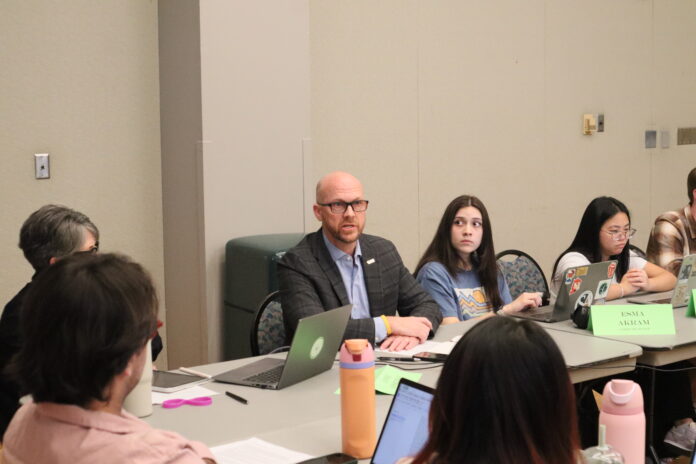
Tuesday, March 31, Associate Vice President of Public Safety Cliff Everton ’96 spoke to the College of William and Mary’s Student Assembly Senate about the increasing implementation of AI-powered public safety initiatives around campus.
This meeting followed a referendum election, where students overwhelmingly supported the College’s canceling its contract with Flock Surveillance. In the referendum election, 88.6% of students voted in favor of the cancellation, while 7% of students voted against and 4.4% of students abstained.
Flock is a company that specializes in automatic license plate readers. Many students at the College have expressed privacy concerns with such technology. Other communities across the country have also conveyed similar worries, pushing some cities to cancel their Flock contracts.
Monday, April 6, students will have the opportunity to vote on a separate referendum concerning ZeroEyes, a surveillance company that specializes in AI-enabled firearm detection. The College has an annual $82,600 contract to embed ZeroEyes software across as many as 400 on-campus security cameras.
Everton began by describing his experience in law enforcement. After graduating from the College in 1996, he worked for the United States Naval Criminal Investigative Service, a civilian federal law enforcement agency responsible for investigating criminal activities involving the Navy and Marine Corps.
Everton eventually transitioned away from NCIS and to his current public safety role at the College.
“I’ve been in law enforcement most of my life,” he said. “It’s been a wonderful homecoming in a lot of ways to come back to my hometown, but also the amazing university I was fortunate enough to graduate from.”
Everton emphasized the College’s open campus as a point of pride.
“It’s what enhances our ability to work, learn, teach or grow here — to flourish,” he said.
Everton said his work at the College centers on keeping campus an open space while mitigating any public safety risks that might come with that.
He moved to discussing the College’s relationship with ZeroEyes.
“ZeroEyes provides critical space and time for William and Mary PD to respond in the event of a firearm detection,” he said.
Everton said that the College landed on working with the company after reviewing similar options, determining that ZeroEyes would work best for campus security.
“We worked with other universities, engaged with industry and reviewed other potential tools in this space,” he said. “Other tech, frankly, was just not that effective.”
Everton explained that the College has received a few false-positive notifications from ZeroEyes since the beginning of the year. A false positive occurs when ZeroEyes alerts its customers to a potential firearm that either does not exist or does not pose a threat to the community.
“I can tell you right now that we’ve had five notifications since we went live in January of this year,” he said. “All of them were what we would call a non-lethal notification, where somebody is walking on campus with a mock-up of a musket or a Nerf gun.”
Everton said that he does not believe ZeroEyes violates any privacy rights.
“[ZeroEyes] cameras are based in locations around the campus and public spaces with no expectation of privacy,” he said.
Everton discussed the College’s use of Flock cameras around campus.
“We’ve had two significant crimes occur on campus that we have solved because of that technology, including a predator that was from outside the area that was on campus,” he said.
Everton shifted to a broader discussion of why the College sees these technologies as important for public safety.
He asked how many people in the room had been directly impacted by gun violence or who knew of someone impacted. Roughly a third of attendees raised their hands.
“When I was here at William and Mary, very few of those hands would have been raised,” he said.
Everton touched on his personal experience with gun violence. His middle son, a senior at Old Dominion University, had to enter lockdown following the recent shooting.
“I am now part of the long line of parents that have received that text or that phone call,” he said.
Everton said that the College is trying its best to proactively prevent something similar from happening. He expressed hopes to assemble an advisory body on public safety, where students could directly voice their opinions on initiatives such as ZeroEyes and Flock.
Everton said that the College is committed to opening a Flock transparency portal. These transparency portals detail data retention and sharing policies, the number of Flock cameras used by a particular police department and the number of license plate scans a department’s Flock cameras perform per month.
Everton also said that his team is designing an Frequently Asked Questions page regarding campus public safety initiatives for the College’s website.
Everton expressed hope toward public safety being a collaborative effort at the College.
“At William and Mary, there is no ‘you’ versus ‘them,’” he said. “It’s just us. It really is. We’re one community.”
Once Everton concluded his initial remarks, the floor opened up to questions from the senate.
Sen. Jason Zheng ’26 asked Everton how his public safety team plans to continue building trust with the student body following the referendum election.
Everton said he plans to continue engaging in conversations with relevant stakeholders, including students. Some of his public safety counterparts at universities across the country have refused to have similar discussions, he noted.
Sen. Danny Otten ’23 Ph.D. ’27 asked Everton why the College only recently publicly recognized its relationship with ZeroEyes.
Friday, Dec. 19, 2025 the College posted about campus police testing the ZeroEyes system, though the company is not mentioned by name. In a separate email to community members of the College, Everton wrote that the school had a weapons detection system, but he did not explicitly name ZeroEyes.
Everton said that not mentioning ZeroEyes in university communication was an unintentional decision. He hopes to focus communication efforts on broad modernization efforts and not any particular technology.
“I don’t want it to be a distraction just talking about technology,” he said. “It should also be about the modernization efforts, the investments in town and the other things that we’re doing.”
Sen. Neha Baskar ’29 asked Everton if he believed the College continuing to operate with Flock and ignoring the student referendum results would further degrade community trust.
Everton reiterated his willingness to have conversations with students. He said that the College does not intend to consider any student referendum results in its decision-making, whether on Flock or ZeroEyes.
“Are we going to go back and open up gaps that we think we might have helped close? No,” he said.
Sen. James Holden J.D. ’27 mentioned a report from the Richmond Times Dispatch, which found that many Virginia police departments have failed to comply with the statewide law regulating Flock by allowing out-of-state and federal agencies continuous access to their data.
The Richmond Times-Dispatch also discovered that some police departments regularly keep their Flock data beyond 21 days. These actions are explicitly prohibited under Virginia law.
“Clearly, the law enforcement agencies across this state are not fully complying with [Virginia law],” he said. “[Their actions] include allowing the thugs of ICE to kidnap our neighbors, friends and family.”
In the past, Immigration Customs and Enforcement has widely used Virginia Flock data to conduct immigration enforcement. ICE has also illegally accessed Flock data in Richmond to conduct its operations without the immediate knowledge or permission of city police.
Everton said that the William and Mary Police Department is aware of these situations and is looking into the issue.
Otten asked about a claim Everton made about ZeroEyes that argued the software does not collect personally identifiable information. Otten pointed out that ZeroEyes can collect images of the faces of students or community members on campus, regardless of whether there is a weapon present.
When the ZeroEyes software believes it detects a weapon, it takes a screenshot of its security camera footage and sends the photo to its verification team. ZeroEyes says that it will store the image regardless of whether an actual weapon was detected, per its website. These captured images could include the faces of individuals.
Everton said that taking images of people’s faces was not the main purpose of the ZeroEyes software.
“I don’t believe ZeroEyes is taking constant images of people,” he said. “It’s an object detection tool.”
Everton said that the detection images ZeroEyes collects could amount to personally identifiable information.
“Could it be personally identifiable information? If it’s the right quality, close enough, potentially,” Everton said. “But like Flock, [ZeroEyes] anonymizes data.”
Sen. Brooks Alderman J.D. ’26 questioned the trustworthiness of ICE and federal law enforcement in complying with Virginia’s laws on privacy.
“What concerns me is that from what I have seen from this federal government, I do not trust them to follow the law,” he said. “Even if there’s no way for them to legally access this data, this information, I don’t trust that they wouldn’t break the law to access it.”
Everton said that federal immigration enforcement told the College they had no intention of being present on campus unless an international student broke the law.
“We have contacted ICE ourselves, to go, ‘Hey, do you guys have any interest in coming here?’” he said. “And we’ve received assurances all along that no, they have no interest in that. [ICE coming to campus] would be a very limited instance of an international student that, in the rare circumstance, violated the law and is losing their visa and would have to leave the country.”
Everton said he understands that no technology can be entirely effective.
“We can do everything we think is right, and some things can still happen,” he added.
While Everton said that the College does not immediately plan to reverse any public safety initiatives that have already been implemented, he hopes to continue engaging in active dialogue with students.
“We’re not going to always agree; we’ve got to be okay with that,” he said.
After over an hour of questioning, Senate Chair Mayer Tawfik ’27 ended the conversation with Everton, who was willing to stay briefly. Otten’s motion to extend the debate failed to pass.
Everton concluded by encouraging students to continue speaking out on issues important to them.
“Please continue to use your voice,” he said. “Let’s ensure we continue the conversation and knock down barriers.”
CORRECTION (04/06/26): Article was updated by Naman Mishra, News Editor, to clarify that, when debate was ended, Everton offered to stay for a short additional period.
