

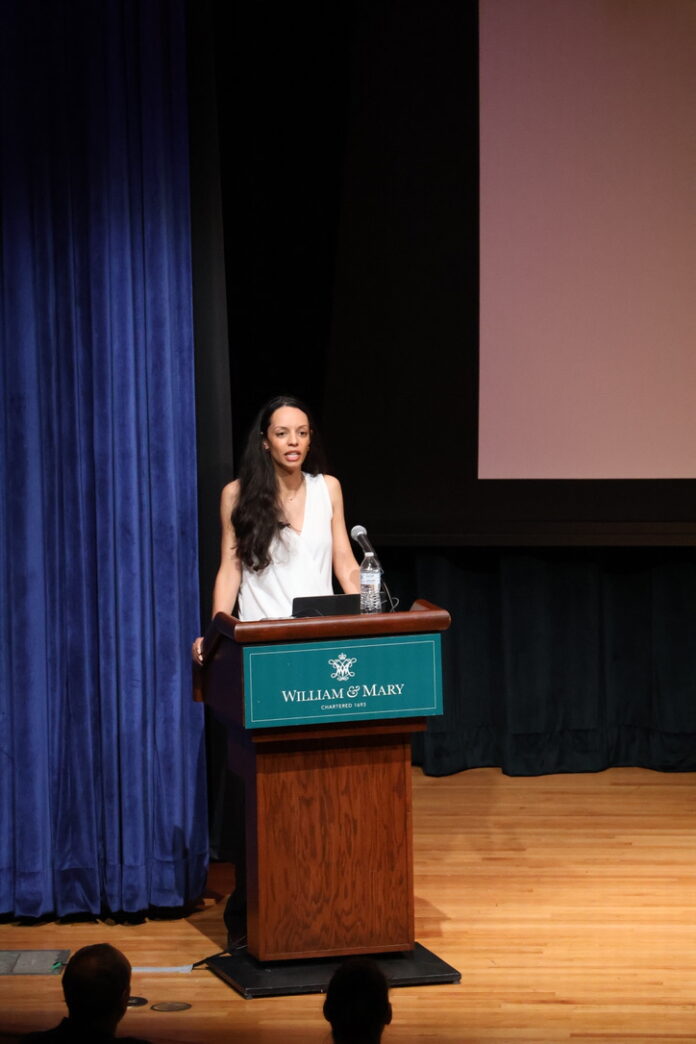
Thursday, April 2, The Atlantic staff writer Caitlin Dickerson delivered a lecture in the Sadler Center’s Commonwealth Auditorium. Organized by Alma Mater Productions and sponsored by the Roy R. Charles Center, the College Center for Liberal Arts, the Dean’s Fund and the Hispanic studies department, the event centered on Dickerson’s experience covering immigration in America.
Dickerson received a Pulitzer Prize in 2023 for her story “We Need to Take Away Children,” which details the first Trump administration’s family separation policies. She began her talk by speaking on her personal experience documenting immigration in the United States.
“You can think that you understand the experience of migration, but there’s really no substitute for seeing it yourself,” Dickerson said.
She recounted her time spent in migrant encampments along the U.S.-Mexico border. Dickerson said that these camps were exposed to the elements and that many children did not have access to education.
Dickerson explained her work in the Darién Gap, showing photos of migrants’ journeys across the stretch.
Despite the harsh conditions she described, she interspersed stories of hope, one being about a child in a refugee camp excited to take a photo with her.
“Even in the most difficult circumstances, there is a lot of joy in my work as well,” she said.
Dickerson emphasized historical continuity throughout the lecture. Dickerson began by asking the audience to identify the origin of quotes describing immigrants as, among other things, “immoral” and “vile.” Replies from students included a murmured “Stephen Miller” and a more full-throated “Trump.”
Dickerson then revealed that she had pulled the phrases directly from early-20th-century nativist political cartoons, highlighting the language’s familiarity to modern ears.
“I try to fold in history when I can,” she said. “It really helps us better understand the stories that we’re seeing unfold.”
Despite this, Dickerson ended the lecture portion by reflecting on the current administration’s immigration enforcement techniques.
“[U.S. Immigration and Customs Enforcement’s] restrictive border policies are novel,” Dickerson said. “[ICE immigration] sweeps have involved racial profiling, which the [U.S.] Supreme Court deemed legal in some circumstances. [ICE is] prioritizing spectacle over safety, and so you’re seeing clashes in the streets, and they’re escalating conflicts with protesters.”
She concluded by stressing journalism’s role.
Journalists are meant to leave readers “armed to participate in our political debate, in our democracy informed, rather than just guessing,” she said.
Afterward, Dickerson sat down with Hispanic studies associate professor John Riofrio for a moderated discussion on human nature, increasing disregard for human rights, historical turning points and government transparency. This was followed by several questions from the audience.
Dickerson responded to a question about the discomfort of seeking the truth as an advocate.
“We’re all part of how this constellation of democracy functions,” Dickerson said. “Discovering an uncomfortable truth can only further recommit us to the issue because it reminds us of how incredibly important it is.”
Dickerson also noted student journalism’s role in the democratic process.
“Student journalism is so essential,” she said. “I mean, universities themselves just call out for so much reporting. No one’s better positioned to understand that than the students themselves.”
Riofrio, who was principally responsible for initiating contact with Dickerson via email, said that she was enthusiastic about holding the talk.
“She responded almost immediately,” he said. “I mean that day. She was like, ‘Hey, I’d love to do this.’”
Riofrio said he was satisfied with the turnout and students’ participation.
“I love doing this kind of thing,” he said. “I mean, you get to work with people across campus, and then to see it this full tonight was amazing.”
Maria Haddad ’26, who currently serves on AMP’s Impact Committee, echoed a similar sentiment.
“We had close to 250 people,” she said. “It felt like everybody walked away with something. Whether it was her talk about activism or the human impact, her talks resonated with at least one thing for every person.”
Attendees, such as Liyana Mohammed ’27, who chairs AMP’s Impact Committee, noted the emotional aspects of the talk.
“I started tearing up a little bit,” she said. “I think it really put into perspective the issues that are going down there for families and children who are trying to migrate for a better life.”
