

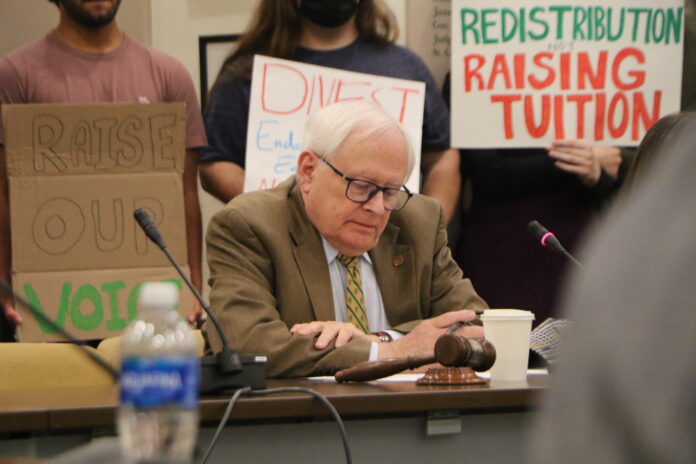
Wednesday, April 22 to Friday, April 24, the College of William and Mary’s Board of Visitors met for its final meeting of the 2025-26 academic year in Blow Memorial Hall. The Board held several committee meetings regarding topics such as admissions, faculty teaching, student health and wellness, public safety and athletics. The Board also held a public hearing on a potential tuition increase, inviting students to comment. The Board later voted to increase tuition by 2.9% while also raising fees, housing and dining rates.
Public Hearing on Undergraduate Tuition
Thursday, April 23, the Board of Visitors held a public hearing on undergraduate tuition. Student protesters gathered in the room for the meeting, silently holding signs calling on the Board not to adopt a tuition increase and to divest from Israel.
Rector Charles E. Poston J.D. ’74, P ’02, ’06 opened the meeting by reminding Board members about the considerations they must weigh for undergraduate tuition.
“Our responsibility as a board is to weigh what it costs to deliver an excellent education within our commitment to make that education accessible and affordable,” he said. “The hearing directly from students, family, faculty, staff and members of the public is essential for that work.”
Executive Vice President Mike Todd presented the College’s budget and the tuition and fees proposal.
Todd explained that the College relies on money from students for a significant portion of its funding.
“Our tuition, fees, auxiliary revenues — all of these — drive the operation budget,” he said. “Nearly 70% of our operating budget is derived from student dollars.”
Todd outlined the proposed tuition increase, which would range between 0% and 3.5%. He explained how a 3.5% tuition increase would amount to around $1.6 million in new revenue for the College, raising costs for in-state students by $671 and for out-of-state students by $1,571. On the other hand, keeping tuition flat would decrease the College’s revenue by $5.1 million.
Todd also discussed the proposed range for an increase in mandatory student fees. He explained that a 4% fee increase would generate roughly $1.6 million in new revenue for the College, increasing costs for in-state students by $292 and for out-of-state students by $316. Declining to raise fees would not generate any new revenue for the College.
Todd said that the proposed increase in costs for students would not account for financial aid, so actual costs may vary.
Todd concluded his presentation, and the floor was opened for public comment.
Charles McDaniel ’28 spoke first. He said he was unhappy with the College spending money on things he did not feel were necessary for students, such as Flock cameras or the implementation of Oscar, a system that uses AI image analysis to provide instructions on sorting trash.
“I don’t understand why I need an AI to tell me what my trash looks like,” he said. “We need to be focusing on [students’] education and not surveilling them.”
After the meeting, Executive Director of Media Relations at the College Suzanne Clavet contacted The Flat Hat and explained that the Oscar system was a part of a pilot program on campus. She said that no student fees or tuition dollars were used for the trash cans and that they were paid for with an Aramark sustainability grant.
McDaniel also expressed frustration with the West Woods housing delay and the upcoming closure of the Commons Dining Hall. He said that he was upset about graduating early because of the College’s high tuition cost.
“This summer, I’m staying here and I’m taking an online class that I’m paying thousands of dollars to take because I cannot graduate on time,” he said.
McDaniel asked the Board not to raise costs for students.
“I implore you to leave our tuition alone, to divest from death and to stop paying for the Flock cameras,” he said.
Lara Waldron ’26 said that the College’s high tuition cost has placed a financial strain on her family.
“It is a financial burden for me to continue attending this institution, and that burden has increased in the past years, especially [since] the economic situation of this country has changed for all of us,” she said.
She said that she hopes the College takes student feedback into consideration before raising tuition.
“It is our money and our time, years of our lives,” Waldron said. “So we need this to be our choice as well, if tuition is raised.”
Maria Haddad ’26 called on the College to use the endowment to lower costs for students, rather than raising tuition.
“The focus should be on education,” she said.
Haddad expressed frustration with how there is only one tuition hearing per year for students to voice their opinions.
“I do not understand the lack of transparency,” she said.
Grace Carryer ’27, president of the College’s Young Democrats club, came to the public hearing to protest. Wearing a keffiyeh, a Palestinian cultural scarf, and holding a sign that said “RAISE PAY, NOT TUITION,” they explained that they are concerned about a tuition increase hurting the ability of lower-income students to study at the College.
“There are a lot of students who are extremely smart who choose not to come here because of the price,” they said.
Carryer said that they want their tuition dollars to be spent more on financially supporting professors and other campus workers.
“I want my tuition dollars to be used to support the people in my community,” they said.
Student Assembly President Nico Giro-Martin ’27 said that he attended to hear directly from students.
When asked about the protesters who attended the meeting, Giro-Martin said that he appreciated students voicing their budgetary concerns.
“A beautiful aspect of these public hearings is allowing anyone to come, especially the protesters,” he said. “They had their full right to protest. It was nice to see students be confident in a space with people who have power.”
Friday, April 24, the Board voted to increase tuition by 2.9% in 2027 and 2028. Fees were increased by 2.6% for 2027 and by 3.5% for 2028. Housing and dining prices will be increased by 6.5% and 6.0% in 2027 and 2028, respectively. These changes will increase the total cost of attendance from $43,087 in 2026 to $46,825 in 2028 for in-state students and from $69,356 to $74,606 for out-of-state students.
Committee on Academic Affairs
Thursday, April 23, the Committee on Academic Affairs heard presentations from Vice Provost for Enrollment Strategy Lisa Keegan, professor of psychological science and Provost Liaison for Academic Innovation Joshua Burk, professor of law and Associate Provost for Faculty Affairs and Development Iria Giuffrida and Provost Peggy Agouris.
Keegan provided information regarding the College’s most recent admissions cycle, which she said signaled strong enrollment.
“I’m delighted to share that we’re in a very strong position with respect to enrollment right now,” she said. “We are 79% of our way to meeting our class pool of 1,650.”
Keegan said that the College has seen an increase in deposits from both in-state and out-of-state students, as well as students from underrepresented groups.
“We’re running ahead in deposits in both in- and out-of-state,” she said. “Out-of-state is up about 7%. We’re up 4% overall.”
Data provided by Keegan stated that total first-year applications were 3.21% higher than the previous year, with 6.8% and 17% increases in Early Decision I and II, respectively. Applications from international students declined by 32%, and those from first-generation students increased by 7.6%.
Keegan said that the College has made efforts to attract more out-of-state students through scholarships and financial aid and that these programs have seemed to be effective thus far.
“I’m actually thrilled to see that we are running so far ahead in out-of-state deposits,” she said. “Part of that is a test pilot that we’re doing with some modest merit scholarships and also our out-of-state financial aid strategy.”
Burk then presented the findings of a report of the College Curriculum, the College’s general education structure. The 2025-26 academic year marked 10 years since its initial launch. The COLL Review Group completed a phase of data collection from students, faculty and alumni to gather feedback on the program.
Burk said that most of those surveyed held positive views of the COLL curriculum with regard to the College’s commitment to a rigorous, interdisciplinary liberal arts education.
“Faculty agreed that COLL is important for delivering a comprehensive liberal arts education,” he said. “For alumni, 92% agreed that COLL broadened their educational experience and found the COLL requirements to be relevant and comprehensive. 79% of current students agreed that COLL contributed positively towards their education.”
Burk said that COLL builds valuable skills among students with opportunities not found at many peer institutions.
“It’s designed to support student outcomes after they leave William and Mary by building skills such as writing and communication,” he said. “In comparison to some of the other institutions that we looked at, we were well-positioned in terms of what our core curriculum is delivering.”
Burk also relayed anecdotes shared by community members praising the program.
Moving forward, Burk noted some opportunities for development in the COLL curriculum. One example is improving the numbering or labeling of courses, which is not always clearly communicated.
According to the College’s data, only 57% of students found the domain and attribute labels in the COLL curriculum to be clearly defined.
Burk said some students also complained about the high number of credits required by the COLL curriculum.
“They may be in high-demand majors, majors that require a lot of credits, and trying to fit in the COLL curriculum in addition to that was challenging for some students,” he said.
68% of student respondents said there were too many COLL requirements, according to the College.
Most students also found advising to be unhelpful in understanding COLL.
“One thing that came out was issues with advising,” Burk said. “Both alumni and current students talked about how advising was not as helpful as they would have liked in terms of supporting them in choosing their COLL courses.”
Burk said that the COLL system is clearer than the general education requirements of peer institutions.
“If we want to compare ourselves to peer institutions, what we saw is, overall, William and Mary is doing a good job with the COLL curriculum in terms of being a relatively simple system for people to understand, but also being able to describe the goals,” he said.
The College is also actively seeking ways to incorporate new technological developments and associated skills.
“The working group thought a fair bit about, ‘Do we need something regarding AI?’” he said. “But even more broadly, thinking about emerging technologies, we want a curriculum that’s nimble enough to be able to go with technologies — even things that we might not be able to imagine right now.”
Giuffrida then presented on the College’s post-tenure development program.
Giuffrida said the assessment and support of faculty on the tenure track is a primary goal for the College.
“Faculty are at the heart of the pursuit of national preeminence here at William and Mary,” she said. “Annual reviews are really at the core of how all of our peers relate in terms of assessing the development of their scholars.”
Based on a review of 25 peer institutions, Giuffrida developed a Faculty Development Framework to structure the development of faculty support. Part of this framework is creating personalized networks between faculty members.
“What I suggest in the report is that we create perhaps some fast tracks for faculty that prefer more of a one-to-one rapport rather than working in bigger groups,” Giuffrida said. “Some faculty members may be teaching new topics, new subjects, and they need a little bit of one-to-one attention to be able to really leverage their skills.”
Giuffrida said another goal is to support faculty research.
“My plan is to collaborate closely with the vice provost for research to make sure that they dovetail development in research, such as how to write grants, or how to improve the success rates in this climate that has become even more competitive than it was before,” she said. “Having faculty be familiar with the processes is really important, and this supports both the research output as well as the general public development overall.”
Giuffrida said she believes such programs will allow the College to attract and retain high-quality faculty.
Lastly, Agouris presented on the College’s goals to maximize the impact and quality of faculty teaching, as well as recent developments.
Agouris said that the typical course load for faculty has remained relatively stable over recent years. She noted that the proportion of classes taught by non-tenure-eligible faculty has increased over the past several years, and the proportion taught by tenure or tenure-eligible faculty has decreased.
“You see a little bit of uptick on how much we rely on teaching faculty versus the tenure-eligible faculty,” she said. “This has to do with the fact that we are expecting the [tenured] faculty to be much more proactive in terms of research and have activities that are not only in the classroom. And that really brings us to relying more on teaching faculty, which I think is great.”
Agouris also said that the College’s student-to-faculty ratio has decreased from 13-1 to 11-1 in recent years. The proportion of classes with fewer than 20 students has decreased from 53.2% to 45.5% since the 2019-20 academic year, and the proportion with 50 or more students has increased from 6% to 9.4%.
“Almost all of our classes, like 90% of our classes, are either small, less than 20, or medium, less than 50, which is an important thing to remember,” she said. “This is what really is an additional distinctive advantage of William and Mary — that we are not throwing people in huge classrooms.”
The average load of credit hours per faculty member at the College is 274, slightly above the median of peer institutions at 258. Agouris believes this is the ideal number.
“We are in a good spot,” she said. “That means our faculty are producing more than a lot of our peers, but they’re not overwhelmed, so they have additional length of time for activities that are related to research and service, and we really appreciate that.”
Overall, Agouris said she believes the College has effectively managed its faculty workload without unnecessarily hiring additional staff.
“The undergraduate class sizes are really very reasonable for a public institution,” she said.
Committee on Athletics
Thursday, April 23, the Committee on Athletics heard presentations from Director of Athletics Brian Mann, Interim General Manager for Athletics Larry Pulley ’74 and professor of data science and Presidential Liaison for Strategic Initiatives Anthony Stefanidis.
Mann opened by recognizing members of the College’s athletics community for their accomplishments this spring.
“On the court, on the floor, in the pool, but certainly in the classroom and in the community, our student-athletes continue to excel and represent us very well,” he said.
Mann updated the committee on the new Mackesy Sports Performance Center, which opened its doors to the College’s athletics community on Friday, Feb. 6.
“I can’t think of a better way to describe it to you than it is alive, that our student-athletes, coaches and staff are in there at all hours of the day,” Mann said. “They are not only getting better as athletes, they’re building culture, they’re creating relationships, they’re caring for themselves in a better way.”
Mann also said $6 million in gifts will help modernize Kaplan Arena, with improvements in seating, concession areas, hospitality spaces and media broadcast capabilities.
“What’s so important about this is, because of the Mack and the new spaces we have, we will be able to host more events, more gatherings for all different parts of campus in our community,” he said.
Additionally, Mann shared staffing updates with the committee.
Lindsey Brinza, the inaugural Associate Athletics Director for Sports Medicine, was hired in late March and will officially join the College on Sunday, May 10. Brinza will be responsible for overseeing student-athlete health, mental performance and care coordination.
“We are pushing forward with a more dynamic, integrated care model for our student-athletes, under Lindsey’s guidance and leadership, as a way for us to meet the needs of our student-athletes now,” Mann said.
Mann then pivoted to the national landscape of university athletics, highlighting four key changes: a recent White House executive order, National Collegiate Athletic Association “ghost transfer” penalties, Division I Cabinet eligibility shifts and proposed eligibility concepts.
Friday, April 3, President Donald Trump issued “Urgent National Action to Save College Sports,” an executive order that directs federal agencies to regulate name, image and likeness, athlete classification, and Olympic sport preservation. While Mann said there is nothing specific to report regarding the directive’s impact on the College at this time, “Save College Sports” may affect existing legislative proposals, such as the Student Compensation and Opportunity through Rights and Endorsements and SAFE Acts.
“I think the most important thing to think about here is that the details of that executive order will not go into play right away,” Mann said. “We have great partners in government affairs and the [Office of] University Counsel helping us navigate this, and we’ll keep a close watch on it.”
Mann explained that the National Collegiate Athletic Association’s “ghost transfer” penalties will impact student-athletes who leave one school and join another without officially entering the NCAA Transfer Portal.
“This is not one that I anticipate will be of concern to us locally,” Mann added. “However, I share it because it’s important for us to keep an eye on the national landscape.”
Division I Cabinet eligibility changes refer to pre-enrollment draft policies and enrollment rules. Mann said he is not concerned about these shifts for the College but plans to monitor them closely.
Mann emphasized the NCAA’s proposed eligibility concepts as particularly pertinent to the College. These changes would implement an age-based model starting this fall, granting student-athletes Division I eligibility for a five-year window, with some exceptions.
“Details are still being worked out, whether it be a grandfather clause, but this is something that we will watch closely,” Mann said. “This will affect us if our student-athletes go from having four years of eligibility to five.”
The presentation then shifted to data analytics, with Pulley and Stefanidis highlighting a pilot program proposed by the men’s basketball team’s coaching staff.
Using predictive modeling, player statistics and academic records, Pulley and student interns Jonathan Hammond MBA ’26, Jacob Stallard ’26 and Dennis Coan ’26 have helped identify potential men’s basketball transfer targets.
Focusing on male community college athletes, the research team identified approximately 1,400 basketball players expected to graduate and continue at four-year institutions. The interns ultimately narrowed the list to 14 prospects who best aligned with the College’s academic and athletic profile.
“This is just one project by the interns in helping us in data analytics and contributing to our program’s feasibility and success, all against the backdrop of what William and Mary is and its traditions and values,” Pulley said.
Stefanidis mentioned the research’s possible expansion. According to the Wednesday, Feb. 4 Committee on Athletics agenda document, the College’s Athletics Department plans to extend the initiative to women’s basketball and football next academic year.
Stefanidis also discussed potentially launching a new minor in sports analytics and management, an opportunity raised during the committee’s last meeting.
“All these efforts help us with student life,” Stefanidis said. “We want to make things much more exciting.”
Before Committee on Athletics Chair Jill Holtzman Vogel ’92 closed the meeting to the public, Mann stressed the importance of adapting to the future.
“We’re not simply reacting to what’s happening around us,” he said. “We’re creating an answer that makes sense for us, that’s going to allow us to be exceptional.”
Committee on the Student Experience
Thursday, April 23, the Committee on the Student Experience heard from Associate Vice President for Health and Wellness Chris Renjilian ’05 and a panel of students regarding student health and integrated wellness services.
Renjilian joined the College in August 2025 and has since been working to develop integrative wellness programs, combining physical, mental and social well-being.
Renjilian said that during his time as a student, his father passed away and that being part of the College’s men’s gymnastics team helped him find valuable opportunities for growth.
“I knew that I still had a bright future, and a lot of it had to do with what was happening in the gym,” he said. “Each of us was growing and changing, but we only had the baby sense of how we were developing and how that development would continue.”
Renjilian said that adolescence and young adulthood are critical times for personal growth.
“We discover, learn from, and adapt to the world around us. We forge our sense for who we are and who we aspire to be,” he said. “We want to make decisions, manage our emotions, create deeper connections with peers and others in our communities. We also build resilience and develop interests, passions and meaningful goals that shape our lives.”
Renjilian said that the environment students experience during adolescence is essential to lifelong healthy development, additionally citing what he called the “7 Cs of Resilience”: Connection, confidence, competence, character, contribution, coping and control. He added that these factors are essential for healthy development.
Renjilian also described what he believes are the three main challenges facing youth today.
The first of these is low expectations for youth.
“What these expectations do is they communicate to young people that they are working less, that their voice doesn’t matter,” he said. “They make it incredibly difficult to see a clear path to be where you are today and what it means to reach a flourishing adulthood.”
The inverse of this — “achievement culture” — is also damaging, Renjilian said.
“This is a culture that involves an unrelenting pressure to excel, causing people to believe that their worth is based on their accomplishments, robbing them of experiences and relationships that they need to grow and thrive,” he said. “The young people growing up in affluent, privileged communities — so-called ‘high-achieving’ schools — are likely to experience anxiety, depression, PTSD and a number of other health-related harms.”
Renjilian said the third challenge facing young people is the epidemic of isolation.
“Young people will be protected from these threats and might more likely thrive when they live in a context that allows them to build secure connections and work in communities that convey an unwavering message in both their inherent work and their capacity for development,” he said. “Young people will thrive if they exist in contexts that convey a strong sense of mattering.”
Renjilian said the College is effective in communicating this message to students.
“The first message they receive when they arrive here: ‘You belong,’” he said. “Translation: You are valued, you add value and you are capable of possessing and expressing these values.”
The Committee then turned to the panel of students who work with Health & Wellness, which included Zoe Zollinger ’26 M.S. ’28, Arushi Arora ’26, Kevin Aviles ’24 M. Ed. ’26 and Atticus Gore ’26.
Students were asked whether they had observed the wellness risk factors at the College and what they had seen the College do to combat them.
“Those three risk factors that you [Renjilian] identified are absolutely true,” Zollinger said. “I think of our role within Health & Wellness as: We’re not just here to be students, we’re here to learn how to be adults, and we’re here to learn how to take care of ourselves.”
Aviles said the College’s commitment to health and wellness drew him to the school when he first toured.
“With the support that the school has given us with these optimal resources, it really empowers us students to step into these positions where we can learn about how to develop, how to navigate this transition where we are in this moment in time and really learn to be a leader,” Aviles said.
As an instructor at the McLeod Tyler Recreation Center, Gore emphasized the interdisciplinary nature of health and wellness at the College.
“I will also say that Health & Wellness is so much more than just our health center and our counseling center. They’re incredible, incredible resources,” he said. “Being able to recognize the way that our club sports and our intramural teams bring the community together and support and uplift the floor for our students so they can be successful and then engage with other resources on campus.”
Committee on Audit, Risk & Compliance
Friday, April 24, Director of Internal Audit Christopher Crawford ’07 MBA ‘21, Chief Compliance Officer Pamela Mason Keegan, Associate Vice President for Public Safety Cliff Everton ’96 and Chief of the William and Mary Police Department Don Butler delivered reports to the Committee on Audit, Risk & Compliance.
Crawford presented audit results on the Global Research Institute and the College’s continuity program, which includes business continuity, disaster recovery and emergency response. According to the audits, both require improvement.
Crawford also described Enterprise Risk Management framework enhancements, the results of a quality assurance review, key performance indicators and current audit activities.
“All in all, I think this is a really good audit portfolio,” Crawford said. “We are making strong progress on our audit work program, identifying enhancement opportunities and addressing risks as they emerge.”
Mason then provided updates on the Office of Compliance & Equity, specifically Clery Act compliance, youth protection programs and staff changes.
The Clery Act is a federal law requiring colleges and universities to report campus crime statistics, publicly disclose policies and procedures intended to enhance campus safety and provide support services for victims of violence.
“Clery Act compliance reviews are kind of changing under the shift of things for the Department of Education to the Department of Justice,” Mason said. “What we’re seeing is a lot of investigations being opened because of events that are highly publicized that are on campus.”
Mason added that one of the best strategies to mitigate this risk is to establish a plan in advance. To accomplish this, the Office of Compliance & Equity has formalized monthly meetings with the College’s Division of Public Safety.
“I really feel good about the teamwork that we’ve got going and the structure that we’ve put in place for this,” she said.
In her report, Keegan emphasized the importance of financial aid compliance at the College.
“This requires that we have systems in place, controls in place and a trained staff,” she said. “Our financial aid team is the one on the phone with students and families having critical counseling conversations on how to make William and Mary affordable, and so they must be trained in that.”
Keegan also shared that a third party will administer the National Association of Student Financial Aid Administrators’ Standards of Excellence Review Program at the College in May.
“This mirrors a federal program review and also assesses our administrative capability by looking at our staffing levels, our training, our policies,” Keegan said. “What they do is produce an entire report for us on what we’re doing well and what our areas are for improvement.”
The presentation then shifted to public safety initiatives, and Everton and Butler took the floor.
Everton discussed the recent shooting at Old Dominion University in March, after which the College’s Division of Public Safety engaged directly with local, state and federal partners. Since the shooting, Butler’s team has completed training on “Lone Wolf” briefings, which prepare officers to effectively respond to an active shooter.
“The threats on campus are very real,” Everton said.
College President Katherine Rowe noted a disparity in active shooter drill experience between students, faculty and staff.
“We’re trying to close that gap in understanding so that the long-time employees are as fluent in what to do as the students themselves,” she said.
Everton said that the College’s Division of Public Safety has partnered with the Virginia Department of Criminal Justice Services to provide active shooter casualty care training for students, faculty and staff.
“We’re going to make that a standard practice here at William and Mary,” he said. “Every semester, there’ll be four to six sessions of this training open to students, staff and faculty.”
Everton added that the College’s Threat Assessment Team has completed behavioral threat assessment and management training.
“We’ve broadened the understanding of how we approach threat assessment here and behavioral threat assessment management overall,” he said.
Everton then mentioned recent investments in ZeroEyes and Flock technologies. Since implementing Flock, Butler’s team has solved two significant crimes on campus.
Chair of the Committee on Audit, Risk & Compliance Stephen Huebner ’76, P ’09 noted student concerns regarding Flock cameras and the potential sharing of data with external agencies.
Everton said that Flock information is only shared with “a small number of police organizations that we do business with and have close partnerships with every day.” He added that to request data, federal or out-of-state law enforcement partners must go directly to Butler.
Huebner thanked Everton for engaging with concerned students.
“I commend you for being proactive and forward-thinking, getting out, meeting with student groups, and trying to dispel a lot of the misinformation going around,” Huebner said.
Everton also shared that the Division of Public Safety is investing in other technologies, including Factal, an app that provides geo-targeted situational awareness and safety alerts for College community members abroad.
“It’s really a risk intelligence product, but it also gives us a situational awareness of what’s going on, where people are,” he said. “That’s something we’re going to be offering in the fall, working with [Associate Director of International Travel & Security] Nick Vasquez and the team over at [the] Reves [Center for International Studies] for our international students.”
Everton highlighted recent partnerships with SA, including a campaign to raise awareness of the Rave Guardian safety app.
“Since August of last year, the numbers have grown 134%, something south of 800 users up to 1,800,” he said. “Over two years, [the app’s] functions have been used about 55 times. This year alone, they’ve been used about 125 times.”
Everton emphasized the importance of engaging with students in similar initiatives.
“Really, the idea is to break down barriers,” he said.
Committee on Institutional Advancement
Friday, April 24, Senior Vice President for University Advancement Matthew Lambert ’99 opened with a presentation on the College’s strategy for national preeminence.
He began by discussing the career success of students at the College. Lambert mentioned how students who graduate maintain a career alignment of around 96%.
He also said that the median salary for graduating students recently rose to just under $70,000.
“We’ve had very strong hiring of our students,” he said. “And nationally, what we’re seeing is an uptick again in hiring for entry-level positions.”
Lambert discussed past and upcoming university events. He characterized the recent admitted students weekend as a success, mentioning One Tribe One Day and the Washington, D.C. weekend as upcoming events.
Next, Chief Marketing Officer and Associate Vice President for University Marketing Heather Golden delivered a presentation on enrollment demand and brand awareness.
Golden discussed how the College is working on a comprehensive marketing strategy to help address the upcoming demographic cliff, where a decrease in younger people will likely make it harder for the College to attract new students.
“This is a challenge that every university is tackling,” she said.
Golden explained how the College is exploring digital marketing strategies to increase its competitive edge for drawing in prospective students. She said that her office is working on improving the College’s online outreach.
“We want to convey a sense of joy,” she said. “We want to speak to the prestige of our public research university and also convey the close-knit community that we have.”
Senior Associate Vice President for Communications and Chief Communications Officer Brian Whitson went into more detail about the College’s national media strategy. He explained how the College is focused on bringing its social media channels under a single umbrella, integrating these efforts with artificial intelligence.
“Social media is no longer supplementary,” he said. “It really is a core media channel.”
Whitson also mentioned the College’s efforts to continue building relationships with more traditional media.
“We know that the competition for national media is shrinking,” he said. “We need to focus on our relationships and find those stories that have that relevance and that reporters want.”
Agouris briefly discussed strategic planning for the College. She discussed how the College is weighing national metrics on student demand, research, academic excellence and outcomes in maintaining permanence.
Agouris also discussed how the College is developing its next comprehensive plan by engaging with relevant stakeholders.
“The goal is that in April 2027, we have a new strategic plan launched, and that will be also aligned with other activities that are happening in our university,” she said.
Chief of Staff Carlane Pittman-Hampton Ph.D. ’03 further described how the College is engaging with the community in developing its future planning.
“We’re getting about 90 to 100 people attending [working groups] on average,” she said. “We’re just really excited about that level of enthusiasm.”
Full Board Meeting
Friday, April 24, Poston opened the meeting by thanking College community members for their support as he concludes his second consecutive term as rector.
“You are the reason any of this work matters,” he said. “The Board’s job is to govern well so that the people who teach, learn and serve at William and Mary can do their best work — it’s a privilege to have even a small part in that mission.”
After thanking Poston, Rowe emphasized recent Board conversations regarding affordability and tuition.
“The discussions that we’ve been having have appropriately been focused on prioritizing affordability for students and their families, while also ensuring that what they receive here meets the level of excellence that we promise them in our mission,” she said.
Rowe also acknowledged the College’s recognition as a “New Ivy” by Forbes for the second consecutive year. She highlighted students’ academic and athletic achievements, including the women’s swim team’s recent Coastal Athletic Association Championship victory and William and Mary Racing’s first-place finish in the autonomous division of the American Society of Naval Engineers’ PEP26 boat racing competition.
Chair of the Committee on Administration, Buildings & Grounds and Vice Rector Ardine Williams then introduced a revised resolution to the Board, which sought to approve the College’s 2026-27 Major Capital Plan and authorize administrators to submit related funding requests to the state. The Board adopted the resolution with one dissenting vote.
The Committee on Academic Affairs proposed six resolutions, all of which passed unanimously.
The first sought to confer emeritus status on 20 retiring faculty members as a group.
“These professors have breathed life into many generations of students, and that exceptional service I’m really grateful for,” Chair of the Committee on Academic Affairs Laura Keehner Rigas ’01 said.
The second resolution sought to approve the revised name of the initially suggested “M.S. in Computational Operations Research” to the “M.S. in Computational and Applied Mathematics degree program.”
The third proposed the closure of the Peninsula Center, an off-campus instructional site in Newport News, Va.
The fourth resolution sought to approve two graduate certificates in the Raymond A. Mason School of Business: Artificial Intelligence for Business and Foundations of Professional Accounting.
“I think all of us agree that we really liked these certificate programs, so we encourage it as long as it fits in the budget, it makes sense and we have the right team to do it,” Rigas said.
The fifth and sixth resolutions proposed amending the bylaws of the College of Arts and Sciences and the School of Computing, Data Sciences & Physics, respectively.
Rigas then invited Vice Provost for Research and Graduate/Professional Studies Dennis Manos to the table as the Board granted him emeritus status following his retirement.
“The contributions in research, teaching and mentorship only begin to capture the full scope of Professor Manos’ impact during his years at William and Mary,” Rigas said. “Beyond his many accomplishments, he’s a prolific scholar of exceptional dedication and generosity whose commitment to his students and colleagues has left a lasting mark on the university.”
The Committee on Financial Affairs proposed three resolutions.
The first — a modification to the original resolution — sought to set the 2027 and 2028 tuition and fees with increases each year for both in-state and out-of-state students. The second and third proposed operating budgets for the College and the Batten School of Coastal and Marine Sciences and the Virginia Institute of Marine Science.
Rigas abstained from voting on all three resolutions. The remaining board members voted unanimously in favor of the first two resolutions, while the third passed with one dissenting vote.
Following the committees’ reports, former SA President Zoe Wang ’25 MPP ’26 provided a recap of her tenure and discussed the results of the 2026 SA Omnibus survey.
“Serving in this role has been the greatest privilege of my four years at William and Mary, and it’s been the most meaningful leadership and learning experience of my life,” she said. “This year has challenged me, shaped me and taught me that leadership is about creating an environment where others feel empowered to make a difference.”
Wang also discussed the outcomes of the three referendums facilitated by SA in March and April: one regarding Flock, the Firewall for Freedom referendum and another regarding ZeroEyes.
“We are working with student advocates and university administrators to foster dialogue,” Wang said.
Before the meeting closed, the Board elected Williams as rector, Secretary Kendrick Ashton ’98 as vice rector and John L. Brownlee J.D. ’94, P ’22 as secretary, effective July 1, 2026.
