

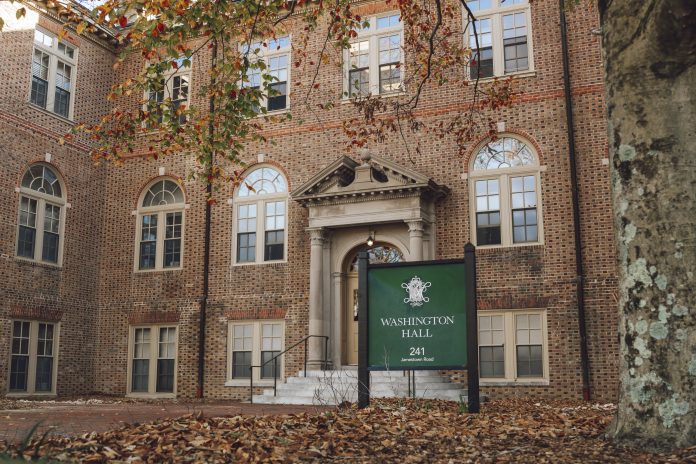
Wednesday, April 22, human rights activist and author Alicia Partnoy delivered a lecture in Washington Hall commemorating the 50th anniversary of the 1976 coup in Argentina. The lecture was sponsored by the Global Research Institute, the Reves Center for International Studies and the Hispanic studies department at the College of William and Mary.
Partnoy worked as an associate professor of modern languages and literatures in Spanish at Loyola Marymount University in California, where she currently holds emeritus status. Partnoy was a university student and young mother in Bahía Blanca, Argentina in 1976 when a military coup overthrew President Isabel Perón, suspending the constitution and closing congress.
Visiting assistant professor of Hispanic studies Matias Oviedo delivered opening remarks. He described how the military junta changed Argentine society.
“Hundreds of books were blacklisted and millions were burned, sometimes in large public spectacles,” Oviedo said.
Oviedo also noted how some activists became the targets of political violence.
“They would become known as the ‘disappeared,’ taken to illegal and secret detention centers where they would be tortured, and most would be murdered and their bodies thrown into the ocean or buried in mass graves,” he said.
Partnoy was a survivor of these political purges.
“I was very, very lucky. My daughter was with me. She was a year-and-a-half when I was arrested,” she said. “I was very lucky that I got her back.”
Partnoy spent time incarcerated at The Little School, a concentration camp where she was blindfolded, starved and beaten.
Oviedo explained how efforts by the United States helped in Partnoy’s eventual release.
“With support from President Carter, the Inter-American Commission on Human Rights of the Organization of American States conducted a visit to Argentina in 1979,” Oviedo said. “National and international pressure forced the release of a number of political detainees by the junta, and Dr. Partnoy was among them.”
After her release, Partnoy moved to the United States and raised awareness about the disappearances caused by the junta.
“[Partnoy] published ‘The Little School: Tales of Disappearance and Survival [in Argentina],’” Oviedo said. “It brought worldwide attention to this human rights violation and has been used as evidence against perpetrators.”
During the lecture, she recognized students involved in Argentine archival declassification. Some students in the audience were congratulated for their work on the project.
“Thank you. It’s work for justice, for truth, for memory,” she said.
Much of the talk focused on the importance of creating records as a form of justice.
“I tell people today, if you are a victim of a kidnapping by ICE [U.S. Immigration and Customs Enforcement], if you survive, document what you see,” Partnoy said. “And you guys are doing it on Instagram, on Facebook.”
Partnoy read excerpts from books, poems and other accounts of the experiences of military regime survivors.
“March 30, 5 p.m., they call together, their screams muffled. They go, as always, these mothers,” she read in one account. “Three thousand they take. Six mothers they arrest, held at gunpoint. People screamed.”
The junta made sure to erase records and locations associated with the crimes, Partnoy said. Thousands of records relating to political prisoners were purposefully destroyed in attempts to cover up the regime’s crimes against humanity. Many victims have yet to be found.
“During the time of President [Jorge Rafael] Videla in Argentina, they demolished the place where I was kept,” Partnoy said.
Still, progress is being made to memorialize the experiences of survivors.
“Now [The Little School] is marked as a place of memory. There is a memorial for the mothers who gave birth there, right there at the school,” Partnoy said.
Partnoy’s friends, who were also imprisoned, have not been forgotten, either.
“This is in the town where my friends were born, Graciella and Sulma,” Partnoy said. “In these small towns, they created satellite universities. This one, in general, has only two classrooms, one with the name of Graciella and one with the name of Sulma.”
Partnoy finished the lecture by speaking about her daughter.
“I could see my daughter. I could see her through a glass and speak to her through a microphone. I couldn’t touch her for this time,” she said. “On the plane, she kept asking me, ‘Are you sure you know how to take care of me?’”
Partnoy reconnected with her daughter, and the two recently wrote a book together outlining their experiences.
Ted Van de Verg ’27 was in attendance and spent a semester studying abroad in La Plata, Argentina. He noted the influence that recording memory can have.
“The biggest takeaway is that a lot of the recollections, memoirs and books that these survivors write have a lasting impact,” he said. “The works that people leave behind, whether it’s art or literature, whatever it is, does have a lasting impact on memory.”
