

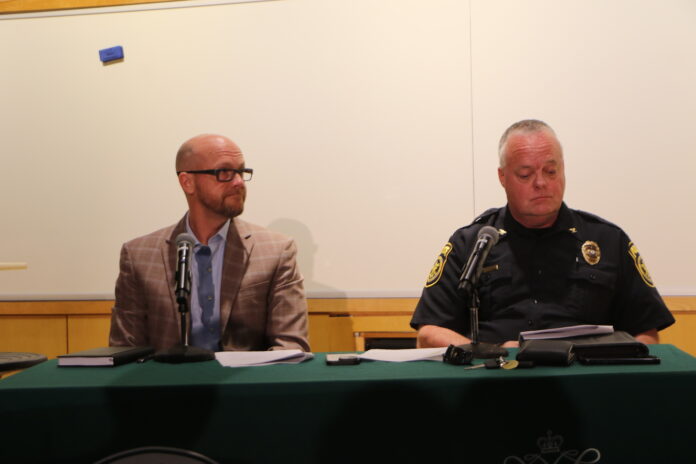
Wednesday, April 29, the College of William and Mary’s Student Assembly held a public moderated conversation with Associate Vice President of Public Safety Cliff Everton ’96 and Chief of the William and Mary Police Department Don Butler. The discussion centered on the implementation of new public safety initiatives and technologies around campus, including artificial intelligence-powered surveillance systems Flock and ZeroEyes.
SA Vice President Sophie Kennedy ’27 and Sen. Neha Baskar ’29 moderated the conversation. Questions were submitted through a public online form which Kennedy and Baskar cited, and the audience could not address Everton or Butler directly.
A full video of the discussion has been uploaded on the SA YouTube channel.
Everton began by discussing the College’s partnership with ZeroEyes, which he said the College views as a proactive public safety tool.
He added that, so far, the software has only detected non-lethal objects that may appear as firearms, such as water guns or Nerf blasters.
When asked about instances in which ZeroEyes falsely detected firearms and triggered school lockdowns, Everton declined to describe specific WMPD procedure on dealing with possible false positives but said that the College has policies in preventing a similar incident from occurring on campus.
“I feel like we have a lot of fail-safes,” he said.
Everton explained that he views ZeroEyes as a technology that could help improve police response times on campus.
“The faster you can get our police officers and our law enforcement responding to an incident, the quicker it’s going to end,” he said.
Butler then pivoted to Flock surveillance, which both WMPD and the Williamsburg Police Department use.
“We have 10 Flock cameras that are designed essentially to be at every major entrance and exit to the campus,” he said.
Butler added that College police have solved two major crimes using Flock technology.
In one instance, Butler said police caught a former campus worker who attempted to break into a new campus building and drive away.
“We were able to identify the vehicle based on [the individual] passing by a Flock camera,” he said. “[The individual] was arrested and charged with multiple crimes.”
Butler described another instance in which police found an individual who was allegedly masturbating in front of students in a parked car on Ukrop Way before attempting to drive away.
“[That individual] was a predator on our campus that was apprehended because of the effectiveness of Flock technology,” Butler said.
Flock gives law enforcement agencies the option to provide collected data to other departments, either by selecting specific agencies or by sharing with a statewide network. Butler said that campus police used to be members of the statewide sharing network with Flock, allowing over 110 different law enforcement departments and agencies across Virginia to access their Flock data. WMPD now only shares its Flock information with 16 other police departments across Virginia, per its recently-launched Flock transparency portal.
“We have professional and personal relationships with these agencies, knowing that they are following the law if they’re accessing our data,” he said.
Butler acknowledged that some police departments in Virginia may be misusing Flock technology.
“There’s bad apples,” he said. “[Flock is] not going to catch everything.”
Baskar asked Butler the extent to which the College could trust Flock as a company more broadly. She brought up an example where Flock CEO Garrett Langley labeled anti-Flock activists as domestic terrorists.
Butler said that Langley’s recent statements do not change how WMPD views the company’s technology.
“If you’re to surmise that he’s a jerk for behaving like that, the jerk has an effective public safety product,” he said.
Kennedy mentioned concerns that United States Immigration and Customs Enforcement would have access to campus Flock data. Butler said that WMPD would not share any data with ICE unless required by a court order.
“I’m not doing something illegal or unethical, particularly if it puts our students in jeopardy,” he said.
Kennedy then asked Everton about a viral online video by cybersecurity YouTuber Benn Jordan that showed him hacking a Flock camera in under 30 seconds and accessing live video feeds.
Everton said that campus police consulted the College’s cybersecurity department before contracting with Flock.
“When security breaches happen, the tech people are quick to jump on them and fix them,” he said.
Butler said that the College has no plans to roll back its use of any of these public safety technologies.
“If we get rid of Flock and ZeroEyes today, William and Mary is less safe,” he said. “I can’t do that.”
Butler said that he does not believe concerns regarding Flock or ZeroEyes necessarily fall into the realm of privacy.
“If there are true privacy concerns, that’s different,” he said.
Everton acknowledged that there may be disagreements among the student body related to the continued use of this technology. He said the Division of Public Safety hopes to continue engaging with community members.
“Even if we don’t all agree on everything, I think we all know we’re part of the William and Mary family,” he said. “We’re all in this together.”
After the event, Maria Enriquez ’27 said that she finds the College’s use of Flock and ZeroEyes technologies upsetting.
“I don’t really like the message [using Flock and ZeroEyes] sends in terms of normalizing surveillance, especially in the age of the current [Trump] administration using and abusing government powers and law enforcement powers against citizens,” she said.
Enriquez emphasized other concerns with the technology.
“I didn’t consent to having my data and location being used to help some company profit, especially when that company has dubious ethics, if not downright heinous ethics and leadership,” she said.
Student Body President Nico Giro-Martin ’27 explained that he did not immediately release College President Katherine Rowe’s response to the Flock and ZeroEyes referendums because he wanted to put it in his weekly Thursday newsletter, as well as to account for delays in uploading the statement to the website.
“I wanted to make sure that everything was publicly available before announcing it to the student body,” he said. “So I made a decision that I’d just wait until [Thursday] morning to release it.”
Giro-Martin said he was not happy that the Division of Public Safety did not allow audience members to comment directly during the event.
“We weren’t exactly happy with the choice without student public comment, but we understand the needs and the interests of the [Division] of Public Safety,” he said. “With the form we released, I think Neha and Sophie did really great work fielding those questions and formulating ones that encompass general student interest.”
