

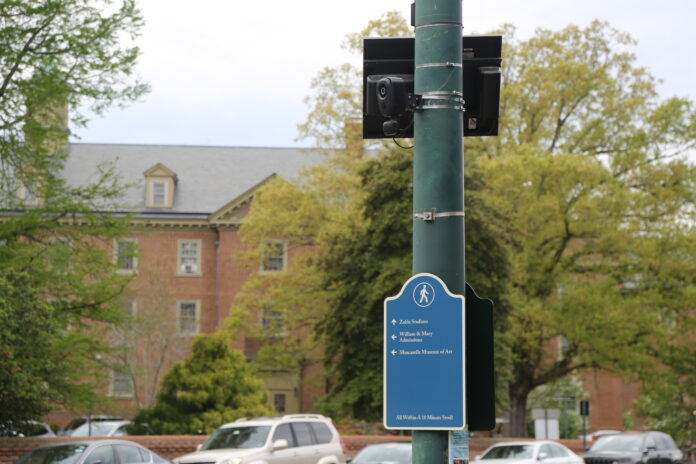
Friday, April 10, The Flat Hat interviewed Williamsburg Police Department Chief Sean Dunn regarding the City of Williamsburg’s usage of FlockOS Safety technology. Dunn addressed student concerns regarding data privacy and security.
Flock is an artificial intelligence-powered automatic license plate reader camera system that has been implemented across the City and the College of William and Mary. Thursday, March 26, students voted overwhelmingly to ask the College to cancel its Flock contract. Thursday, April 9, students attended a Williamsburg City Council meeting to voice concerns about the technology.
Dunn began by explaining how the Williamsburg Police Department first utilized Flock Safety technology through a trial period in 2021.
“I had a representative from the Flock company reach out to me and ask me if we would be interested in piloting their program,” he said. “Frankly, I explained that we were a very safe city, and I wasn’t sure how beneficial Flock would be for our community, but that I’d be happy to try it out on this no-cost trial.”
Dunn said the Flock trial quickly yielded positive results for local law enforcement.
“They put it at a number of locations, and probably within two or three weeks, we had so many successful contacts as a result of the license plate reader tool that I felt like, ‘Wow, this is something that would make our community much safer,’” he said. “That started our goal of expanding this program.”
Dunn cited two particular examples of Williamsburg law enforcement using Flock data to resolve investigations. One case resulted in the apprehension of a man, Richard Lee Gibson, who attempted to assault a student at the College. After his arrest, Gibson was found to also be the culprit of a separate assault dating back to 1987. In another case, Flock data helped locate a missing senior citizen who suffered from dementia.
“The ability of this [Flock] to make our community safer — those are the reasons that I’m supportive of license plate reader technology,” he said. “I know that there’s a downside, and I know that there’s some risk, but I think that the value to the community, in my opinion, certainly outweighs that risk.”
When Flock and other automatic license plate reader systems were first developed, the police department was aware of privacy concerns, Dunn said.
“There is the constant conversation around [Flock] and the privacy considerations that are associated with this tool and the importance of law enforcement appropriately using this tool — not just most of the time or some of the time, but all of the time, without exception,” he said. “We would never want to do anything where we have a misuse because our community would certainly feel betrayed by that, and that’s the last thing we want to do.”
Dunn said that the City’s Flock systems only operate in public spaces and do not document private data.
“We could grab a lawn chair and sit at any point in the city and collect tags all day long,” he said. “It is data that’s publicly available on public right of ways, without any search warrant or any legal reasoning or anything else.”
Dunn said that Flock data is far less personal than many other forms of technology.
“If you are concerned about the privacy of a license plate reader capturing your vehicle at a particular point in time, you probably don’t have a cell phone,” he said. “I don’t think that [Flock] being on public roadways compares to the ‘Big Brother’ that most people carry in their pockets with their cell phones.”
Many anti-Flock advocates argue that the technology violates Fourth Amendment privacy rights guaranteed by the U.S. Constitution. Some have even challenged the technology in federal court on those grounds. Dunn refuted claims that Flock systems are unconstitutional under this standard.
“There’s nothing in the Fourth Amendment that says, ‘The right of the people to be secure in public places,’” he said. “It’s about being secure in your houses, papers and effects against unreasonable searches and seizures. [Flock operates] only on public roadways and vehicular traffic, and it’s not continuous monitoring.”
Legal scholars and courts have debated the extent to which modern surveillance technologies implicate Fourth Amendment protections. These concerns were also raised by students and residents during the city council meeting and in the referendum referenced above.
There also exists a high concentration of Flock cameras in the City. Per capita, the City has nearly triple the number of Flock cameras compared to Norfolk, Va., and over five times the regional average. The rate of cameras per mile of road or square mile of area is also above average.
An analysis by Matthew Esposito ’26 found that the majority of the City’s residents will cross the path of a Flock camera while traveling to essential locations such as grocery stores, schools or hospitals.
Dunn said that the City’s higher concentration of Flock cameras mostly relates to the City’s layout.
“Unlike a lot of communities, we’re not just a square, a rectangle, or a circle — we’re a very oddly-shaped road,” he said. “It’s just a matter of the way our roads are. I think that’s largely based on the shape of our city and our desire to be able to monitor.”
Dunn noted that tourism in the City creates additional security challenges that Flock could help address with what he considers a relatively small infringement on privacy.
“As a tourist community and a historic community, we do have some vulnerabilities that some communities may not have, and we potentially could be a target for different types of activity that would certainly be unwanted,” he said. “I think that the minimal privacy invasion whilst on public roadways is justified by the safeguards that we are able to work towards.”
Dunn explained how the City has tried to be open about its use of Flock technology.
“We have not been secretive about it,” he said. “We want folks to know that we have this technology here, and if you come here to commit crime, we’re going to use that technology to attempt to hold you accountable for whatever crime you’ve committed.”
Dunn explained the statewide Flock data-sharing system in which the Williamsburg Police Department participates. The statewide sharing system allows Virginia police departments to participate in a “hotlist” system, which allows police to mark certain vehicles and notifies them when these cars drive by a Flock camera.
“If we take a police report, let’s just say for a missing person, that police report ultimately goes to the Virginia State Police and what’s called the Virginia Criminal Information Network,” he said. “That then becomes what I call a ‘hotlist.’”
Virginia law prohibits sharing automatic license plate reader data with out-of-state law enforcement agencies for most purposes unrelated to the implementation of state law and restricts data storage to 21 days.
A report by the Virginia State Crime Commission found that 13% of Virginia law enforcement agencies allowed out-of-state or federal law enforcement continuous access to their Flock data. It also found that 21% of state law enforcement regularly stored data for longer than 21 days.
Dunn said that he trusts Flock’s ability to prevent agencies from breaking the law, intentionally or unintentionally.
“I actually had the opportunity to meet with Flock’s leadership, and I shared with them some of the questions that I was receiving and some of the conversation that was occurring in the community,” he said. “The response that I was given from Flock was that, in the states where they have their systems in place, they pay very close attention to the legislation, and they ensure compliance on their systems.”
Dunn also refuted concerns that Flock data may be vulnerable to security breaches, including hacks. He said all systems containing private data are held to high standards of security.
“In my conversation with Flock leadership, they insist that their cloud server has not been hacked, and I have to believe that,” he said. “We’re audited by the state police to ensure that what we’re doing is compliant. Because of that, I have comfort in Flock and their database.”
Cities across the country, including Staunton, Va. and Charlottesville, Va., have canceled their contracts with Flock. Dunn said these cancellations do not cause him concern and that he believes the current criticism Flock is garnering will push the company to increase its security.
“If [Flock] had a breach, or if they had some kind of major catastrophe, they would lose a lot of customers,” he said. “They’ve got to get it right every time. That’s the sort of thing that gives me comfort, and I think it’s the sort of thing that should give our community comfort.”
Dunn cited an example where he found that Flock automatically deleted data after 21 days had passed.
“We had a situation where, at 28 days and about three or four hours, we realized that we might have a case that could be assisted through the use of Flock,” he said. “We didn’t have any reason to suspect that that would be the case until that moment. So we went to the system, not sure if there would be the information that we were looking for there or not, and we literally found that the information was purged.”
In response to reporting on instances where law enforcement misused Flock data for undocumented or private reasons, Dunn insisted that the system’s safeguards and record-keeping would allow any abuse of access to be uncovered.
“For an officer to query the database, [they] would have to type in a reason, and it would have to be for law enforcement purposes, conducting an investigation,” he said. “[They] would have to type in a case number, a report number. When we do our monthly audits, if something seems at all out of place, we have this officer who we know used his credentials to run this particular search, and it does make a great audit trail for us. The system is set up to discourage the types of things that people are concerned about, the inappropriate usage of this database.”
Dunn said that any officers who abuse Flock data would be fired and prosecuted.
“In Virginia, that is just how seriously our legislators are taking this matter,” Dunn said. “It isn’t one of those things where an officer could just playfully do some inappropriate searches; they know that their job and their freedom is at jeopardy if they misuse this tool.”
Dunn said that the Williamsburg Police Department does not collaborate with U.S. Immigration and Customs Enforcement and that it has no plans to do so in the future.
“That would not be appropriate for our community, even if we were allowed to,” he said. “Right now, we would be prohibited, even if we chose to. I don’t see that ever changing.”
Dunn said that despite ICE reportedly widely using Virginia Flock data for its past enforcement operations and recorded instances where ICE has accessed Flock data without the permission of local police, he believes Virginia law will prevent further violations.
“Virginia implemented some pretty major changes, and I think it went a long way towards preventing this sort of thing,” he said. “We’ve absolutely got to have the best systems in place that we can so that we are doing our very best to discourage the misuse.”
Some privacy advocates have expressed concern that the Trump administration could obtain Flock data in violation of state law. For instance, the state of Illinois found that Flock shared data with U.S. Customs and Border Protection despite prohibitions in its state law. Dunn said he does not believe such a situation could occur in the City.
“It’s a tool for local law enforcement, and it’s an effective tool. I don’t think there’s any place for it with immigration,” Dunn said. “I really don’t see that changing, and I can’t imagine there would be a scenario where federal authorities would misuse that data.”
Dunn said that, if immigration enforcement officials were to request access to the City’s Flock data, he would deny the request and report it.
“Our response [to a request from ICE] would be, ‘Absolutely not,’” he said. “That’s an inappropriate request. We are prohibited by law from doing that.”
Dunn said that he would consider expanding the City’s Flock usage if any risks arose that he thought the software could help dissuade.
“We have no plans to expand at this point,” he said. “However, I always say [it] with the caveat: Should there be a specific issue or need — and it’s easy with us being a tourist community — if we had some specific or even non-specific credible information about some threat here, and if I felt like a Flock camera might help us to prevent that threat, I would certainly entertain the possibility of expanding our Flock program. But absent some specific situation, I have no plans to expand our program.”
Dunn said he appreciates the conversations he has with students who express concern with Flock and that he hopes to remain open to their input.
“There were a number of individuals that spoke at City Council that I’ve personally met with to discuss Flock and license plate reader technology in general,” he said. “I try to be very open and very transparent. I think that as we have the conversation, as we talk through the technology and the legislation, it helps members of our community have some comfort in how it’s being utilized here in the City of Williamsburg.”
Dunn said the Williamsburg Police Department does not have any plans to decrease its Flock usage.
“What some members of our community want is for us to discontinue our use of license plate reader technology, and I don’t think that’s right for our community,” he said. “It makes us safer to have this technology. As long as we’re an ethical department using it in the right manner and we’ve got the safeguards in place, it remains an appropriate tool for us.”
CORRECTION (4/15): The print edition of the paper incorrectly titled Williamsburg Police Chief Sean Dunn as William and Mary Police Chief.
CORRECTION (4/20): Article was updated by Mona Garimella, the Editor-in-Chief, to clarify legal debates surrounding the Fourth Amendment.
