
William and Mary football (0-1, 0-0 CAA) posted efficient performances on both sides of the ball during its Saturday, Aug. 30, season opener against Furman (1-0, 0-0 Southern), outpacing its opponents 352 to 237 in total yards and holding the Paladins to a measly 3.94 yards per play. However, the Tribe fell by a final score of 23-21 after committing a series of disastrous errors that swung the game in Furman’s direction. For the first time since 2021, the Green and Gold sports a record below .500.
The red-hot Greenville, S.C., sun forced droves of fans into the shady recesses of Paladin Stadium, but William and Mary began the afternoon ice-cold. After the Tribe received the opening kickoff at its 25-yard line, graduate student running back Rashad Raymond ripped off an 11-yard rush to earn a new set of downs. Junior quarterback Tyler Hughes, making his debut as William and Mary’s full-time starter, connected with junior receiver Carson Jenkins on a screen before lofting a ball up the left sideline. Intended for junior tight end Sean McElwain, Hughes’ telegraphed pass was effortlessly intercepted by Furman graduate student safety Taylen Blaylock, who rumbled into the end zone and gave the hosts an early 7-0 lead.
“Hat goes off to Furman,” William and Mary head coach Mike London said postgame. “They did a good job capitalizing on the miscues that we had. It doesn’t help that the first possession that you have the ball, we throw an interception for a touchdown for them. That was unfortunate.”
William and Mary’s next two drives ended in three-and-outs, and it seemed as though the Paladins might build on their early advantage. However, the Tribe defense held steady, forcing a three-and-out of its own. Furman finally mounted an attack during its final possession of the opening quarter, using a series of short passes to move the chains for the first time, but sophomore defensive lineman Ty Gordon crushed Furman sophomore quarterback Trey Hedden on third-and-long. Facing a fourth-and-21 after recovering the fumble forced by the hit, the hosts booted a punt that William and Mary pressured. The wobbly kick gave the visitors the ball at their own 48-yard line.
It was then that the Green and Gold made the next of its game-altering mistakes. Known for being a threat with both his arm and his legs, the multifaceted Hughes led William and Mary deep into opposing territory, accumulating 22 rushing yards in four plays and firing a 19-yard strike to sophomore receiver Garrett Robertson. Although the Tribe’s drive stalled at the Furman four-yard line, graduate student kicker Keegan Shackford was presented with a chip-shot field goal, which would have given the Green and Gold its first points of the afternoon. However, a low snap spoiled the ensuing attempt, forcing senior holder Andrew Piercy to heave up a pass that had no chance of finding the end zone. Later in the half, William and Mary committed another special teams blunder, this time in the form of a 28-yard field goal that went awry off the foot of Shackford.
“Statistically, the passing game, the running game, total yards, explosive plays, we were out in front,” London said. “But the bottom line, what matters, is the end, what’s up on the scoreboard. You throw an interception for a touchdown, and then we had a miscue twice down in the red zone, a poor snap that could have led to three points. And then later in an end of half situation, we miss a field goal. So we lose 23-21, you have an opportunity to make a kick or so, then maybe we’re talking a little different. But hat goes off to them. They executed what they were supposed to do and they won the game.”
Despite its consequential errors, London was encouraged by William and Mary’s offensive performance, particularly that of Hughes. Although without context, the young signal-caller’s passing statline — one interception, one touchdown and 19 completions on 31 attempts for 210 yards — doesn’t scream excellence, London saw Hughes steadily improve after his initial misfire as the longtime backup adapted to game action.
“What’s interesting about a quarterback, even though he went through training camp and all those things, is when you get out there and you’re playing a team with no coaches, you’re out there by yourself,” London said. “You have to make the decisions. This is his first opportunity to do that, and I thought the first series wasn’t indicative of the type of player that he’s shown himself to be and what he’s capable of being.”
According to London, Hughes’ future improvement will be catalyzed by both internal and external factors. He needs to develop his pocket presence, a task that will become significantly easier if his teammates execute their roles with increased attention to detail.
“I think that [Hughes] did a great job in settling down and in moving forward and making those throws,” London said. “He had a long 37-yard run and a couple other opportunities, and I think when you look at us, the details of doing things — cut your split down so you can make a block on the safety to allow a running back to go free — all those things like that, not as much schematically but just technique-wise, we got to hone in on that for him. He’s got to trust what he sees out there and make those throws.”
Two relative newcomers to the program led the Tribe receiving room — graduate student Deven Thompson, who racked up 63 receiving yards, and senior Isaiah Lemmond, who accumulated 45 receiving yards. The former transferred from Division II Edward Waters over the offseason, while the latter transferred from the Virginia Military Institute in 2024 and saw limited action last season. London said the unit must become more detail-oriented in the future.
“There are a lot of [new] guys in the receiver room, and it’s a good thing,” London said. “It’s also a growth thing. When you have an opportunity to see yourself play and execute, and if you [create angles] just by a few couple steps inside, the way you come off the ball, all those things like that are highly critical to a successful play. And we got to do a better job of executing those things.”
Hughes was perhaps more impactful on the ground than through the air: the quarterback finished the afternoon as William and Mary’s leading rusher, racking up 75 yards and one touchdown on 12 carries. His 37-yard run came early in the second quarter during the drive following the Tribe’s botched snap. With the Tribe trailing 7-0 and in desperate need of a spark, Hughes turned in his best sequence of the game. First, he rolled out of the pocket and fired a 15-yard pass to Lemmond; next, he navigated a horde of Paladin rushers to connect with graduate student running back Tariq Sims; finally, he took a quarterback draw up the middle, speeding past defenders and scurrying to the Furman six-yard line. This time, William and Mary was not denied in the red zone, as Raymond powered it in from three yards out to tie the game at seven with 10:18 remaining in the second quarter.
Furman responded with a quick touchdown after sophomore wide receiver Devin Hester Jr. secured the Paladins prime field position with a 75-yard kick return, and William and Mary’s promising subsequent drive stalled after Hughes was sacked in Furman territory. The hosts rumbled their way to the Tribe’s 18-yard line in the waning moments of the first half, but as it had in the first quarter, the Tribe defense burst into the backfield and ripped the ball away from Hedden; this time, the Green and Gold recovered it. Redshirt freshman defensive end Justin Krueger slammed into Hedden’s blind side, graduate student linebacker Luke Banbury jumped on the ensuing fumble and, following Shackford’s missed field goal, the Tribe entered the locker room down only 14-7.
London had few negative things to say about William and Mary’s defense, which held Furman, a traditionally strong rushing offense, to 58 yards on the ground and a miserable explosive play rate of 2%. The Paladins’ only offensive touchdown of the game came after Hester’s kick return allowed them to begin their drive at the Tribe’s 21-yard line. London particularly praised the performances of sophomore linebacker Harrison Johnson and graduate student linebacker Luke Banbury, a pair that recorded a combined 27 tackles on the day. Although London said he wished Banbury had stayed on his feet and returned Hedden’s fumble for a touchdown, he lauded the Cornell transfer’s leadership abilities and embrace of William and Mary’s culture.
“I think that Luke just fit in with the culture here,” London said. “He just fit in with the players — very smart, intelligent player, very physical. He had the chance to work with the inside ‘backers, [sophomore] Harrison [Johnson], all those guys, and just kind of fit. Those two guys playing well is critical for our success. I think the guys up front, [senior lineman] Davin Dzidzienyo, and Ty Gordon and [redshirt freshman lineman] Brady Echols, those guys like that, they also provide an opportunity to be stout in the run game.”
The third quarter was William and Mary’s best and, according to London, Hughes’ most impressive. The Tribe mounted two scoring drives of 64 yards or more: the first was powered by a 46-yard completion from Hughes to Thompson and ended in a Hughes quarterback keeper that tied the game at 14, while the second was powered by 29 rushing yards from Sims and ended in a touchdown pass from Hughes to McElwain that gave the Green and Gold a 21-14 advantage. On the day, Sims, Hughes and Raymond combined for 168 of the Tribe’s 182 rushing yards, spearheading a potent ground game that ripped off an average of 5.87 yards per attempt. The unit was the most productive of any on the field; however, London believes they can be even better if they clean up footwork and alignment mistakes.
“You go back and you look at the film, and you see so many plays of that one step, that alignment, those things like that, that one-to-two read or whatever it might be,” London said. “So this week is about us correcting those things that were on the field that could lead to positive plays that turned out to be plays that were negated.”
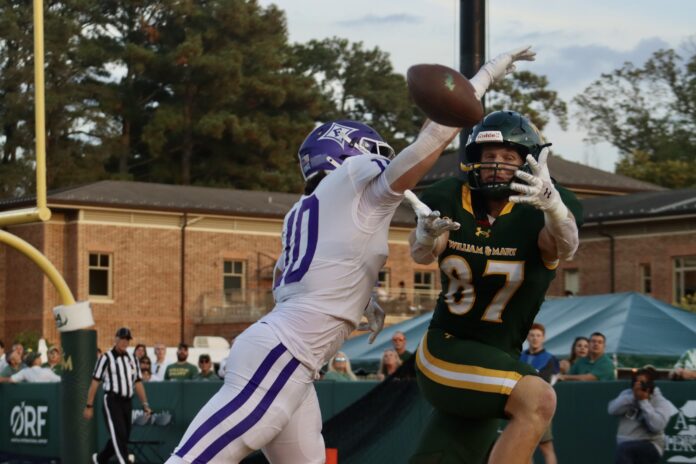
Following a Furman field goal, the Tribe entered the fourth quarter clinging to a 21-17 lead, but further unforced errors ultimately doomed William and Mary. The Tribe defense posted one of its weaker stretches, giving up two Paladin field goals that catapulted the hosts back in front, and the Green and Gold’s comeback chances slowly evaporated as it accumulated 35 penalty yards over ten minutes. William and Mary was unable to get into field goal range, as holding calls on consecutive drives twice forced the Tribe to punt in its own territory. Trailing 23-21 with 2:43 left on the clock, the visitors mounted a final scoring effort, creating a third-and-one at their own 34-yard line after Hughes found Thompson on the right sideline. However, Blaylock, who dramatically opened the game, closed it in the same manner. On the ensuing play, he burst into the backfield, swamping Raymond for a loss of four yards; on fourth-and-five, he swatted away Hughes’ pass to Lemmond, allowing Furman to run out the clock on its victory.
Despite the loss, London said he’s “very highly positive” about the state of his team and expects the Tribe to learn from its mistakes against Furman. The Green and Gold must improve quickly: William and Mary opens the CAA slate Saturday, Sept. 6, at home against Maine (0-1, 0-0 Coastal), a team London describes as “big,” “highly skilled” and “athletic.”