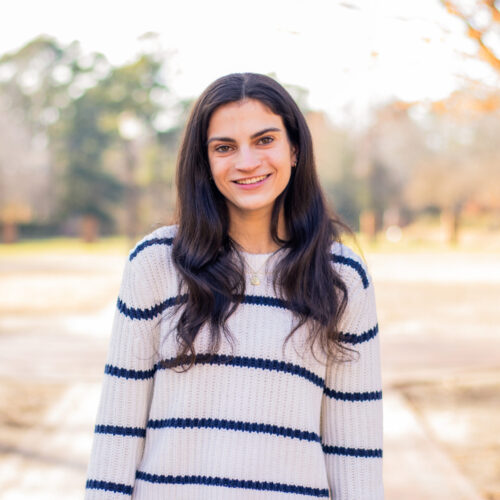

Emily McLaughlin ’28 didn’t expect to come across Global Medical Brigades upon her arrival at the College of William and Mary in fall 2024. Instead, a search on TribeLink for student organizations with a medical focus led her to the group.
GMB is an international nonprofit focused on improving access to healthcare in underserved communities. Through partnerships with university chapters, the organization provides students with opportunities to shadow doctors and assist clinics in Honduras, Panama, Guatemala, Ghana, Belize and Greece.
McLaughlin — a pre-dental chemistry major and Hispanic studies minor who now serves as the College’s GMB chapter president — said she decided to join the organization to improve her Spanish-speaking skills.
“A really big disparity in the healthcare field right now in the United States is this language barrier, this language gap in medicine,” she said. “I wanted to gain a cultural understanding while also getting involved in things that weren’t just in the classroom, that you couldn’t just write on a resume.”
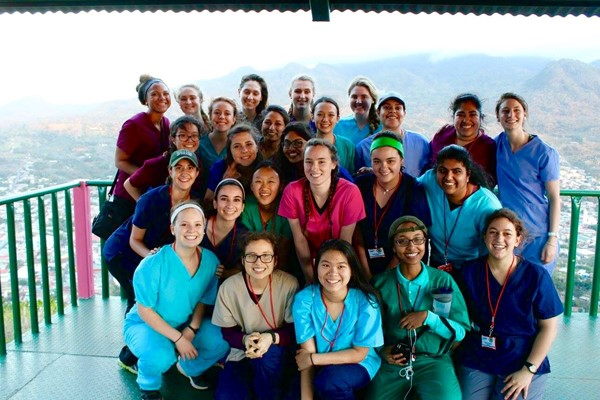
The College’s chapter traveled to rural communities in Honduras in 2025 and Panama in 2026 over spring break. Members will return to Panama in 2027.
McLaughlin said the chapter’s executive board decides the country they will visit based on safety and affordability, while GMB selects the specific community they will serve. The leadership team initially settled on Belize but decided to return to Panama this spring due to high airfare costs.
Both McLaughlin and Amber Tompkins ’27, the chapter’s vice president, acknowledged a growth in club membership over the past two years. McLaughlin attributed this to the recruitment and social chairs.
“We’ve really tried to make GMB something people feel like they’re part of all year, rather than just a group that comes together for one week to go on a brigade,” Tompkins said. “When people see how close everyone gets and how much our members love their experiences, they want to get involved.”
To accommodate this growth, McLaughlin and Tompkins worked to raise the attendance cap for the spring 2027 trip from 40 to 70. Fifty members have already confirmed they can attend the Panama brigade.
“We can have anyone join, as long as they see themselves fit to do it,” McLaughlin said. “It’s not easy volunteer work.”
McLaughlin and Tompkins both identified overcoming the language barrier as a major challenge on brigade. While GMB-assigned translators accompany chapters on trips, student volunteers still often communicate directly with local residents and doctors. To help bridge this gap, the College’s chapter has two Spanish chairs that lead language lessons during weekly meetings and attend the brigades.
“Sometimes in the heat of the moment, you want somebody that’s able to understand even just a few words,” Andres Merizalde ’28 said, one of the chapter’s Spanish chairs. “You don’t necessarily need fluency when you’re on the trip, but we provide a helping hand for people to feel more comfortable communicating with patients and understanding medical terminology.”
Despite the language barrier, McLaughlin said patients and doctors are understanding with student volunteers.
“Everyone that I’ve met from all the different communities we’ve been able to do this outreach with has been so kind,” she said.
While on brigade, student volunteers stay in complexes provided by GMB. On clinic days, they typically travel to local schools to set up equipment and help manage patient rotations. Volunteers also escort patients to local doctors in the clinics, answer preliminary questions and keep children entertained.
McLaughlin said one of her core memories from the spring 2026 Panama trip was comforting a nine-year-old girl with dental fusion, a condition in which two separate tooth buds join together during growth to form a single, irregular tooth. The girl attended the school where the volunteers worked, which was closed for two days to accommodate the clinic.
“She was very nervous going into it and obviously in a lot of pain,” McLaughlin said.
To comfort the girl, McLaughlin said some of the volunteers made balloon animals with medical gloves typically used during procedures.
“Even though they didn’t speak Spanish, they were just playing back and forth, making her feel comfortable as she was waiting for the dentist to come over,” McLaughlin added. “That little act of kindness stood out to me so much, just remembering that we work as a team and that everything we do really does make an impact.”
Merizalde, who also attended the spring 2026 Panama brigade, said the chapter surveyed local residents about health outcomes. On days off, student volunteers participated in cultural immersion activities and explored the town, located in central Panama.
Funding for trips comes from both chapter fundraising and out-of-pocket costs. McLaughlin said trips typically cost each student volunteer $2,000 to $3,000 maximum. This includes airfare, transportation to and from the airport, food, lodging and necessary supplies to run the clinic.
McLaughlin acknowledged the financial burden but said she thinks the experience is worth the cost.
“It is such a privilege to be able to go on these trips and learn what you did and take it back with you,” she said.
Tompkins said students who are unable to attend the trip can still contribute by fundraising and donating supplies. Student volunteers bring glasses, toothbrushes, toothpaste, floss, shampoo, conditioner and other hygiene products in checked luggage to distribute to patients. They can also contact local businesses near the Williamsburg area for donations.
McLaughlin said her work with GMB will prepare her well for her future career in dentistry.
“Coming back to campus, these experiences really remind you why you’re doing what you’re doing when you’re taking these abstract organic chemistry, general chemistry, biology classes,” she said. “It’s just something tangible, and I know I want to do what I can with the resources I have.”