

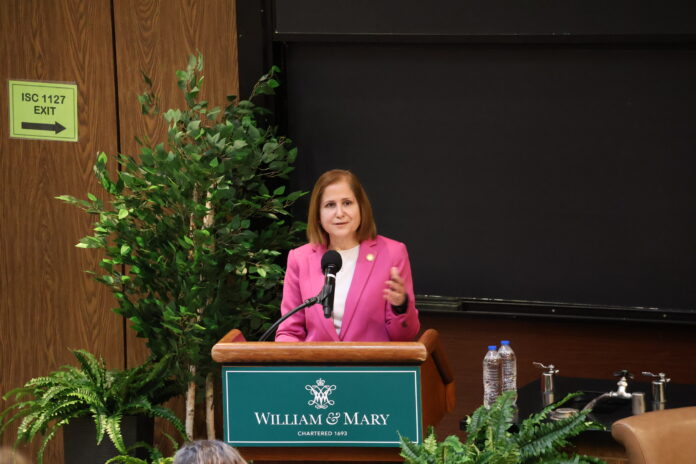
Wednesday, March 15, Lt. Gov. Ghazala Hashmi delivered the inaugural lecture in her new college lecture series, “Literature & Government,” hosted in the Integrated Science Center. The lecture series is part of a broader, statewide initiative to engage college campuses within the Commonwealth.
College of William and Mary President Katherine Rowe opened the event with an introductory speech commemorating the significance of the talk in light of the United States’ 250th anniversary.
“These centennials call us into our foundational role as a university in establishing U.S. democracy, the roles of universities in establishing U.S. democracy and to our responsibilities today,” Rowe said.
In the inaugural talk of the lecture series at the College, “What Air is to Fire: Factions and Our Contemporary Politics,” Hashmi examined the Federalist papers, specifically the argument against factions and how they can be applied to contemporary governments.
The Lieutenant Governor opened by explaining the objectives of her new series.
“This series examines how American writers have defined and challenged and interrogated systems of governance and institutional power and how political authority in turn influences literature’s place of purpose and voice,” she said.
Hashmi shifted focus to the issue of partisanship, highlighting James Madison’s statement in Federalist No. 10: “Liberty is to faction is what air is to fire.”
“The answer is not to remove liberty that allows the factions to develop,” she said. “For Madison, the proper response to factions is to control their dangerous effects.”
Hashmi emphasized the acute historical political polarization between the Federalists and Anti-Federalists as the context for Madison’s words.
“On the streets of Albany, New York, over the Constitution, these two groups met with swords and bayonets, clubs and stones,” Hashmi said.
Hashmi examined Virginia’s governmental structure in light of Madison’s idea of government as a tool to control the effect of factions. She questioned what Madison would say in the face of local and national contemporary technological and governmental issues.
“I think he would say that the republic is working, but it’s under strain,” Hashmi said.
Hashmi emphasized elected leadership’s role in creating political polarization, according to Madison.
“He would likely ask us to question whether today’s elected leaders are acting as thoughtful representatives or as agents of factional pressures,” she said.
Within the current climate of political polarization, Hashmi highlighted Madison’s words about the need for compromise.
“He reminds us that compromises are a representation of a functioning governing structure and not signs of weakness or inadequacy,” she said.
Hashmi concluded with one final question.
“Has the American Constitution succeeded in limiting and dividing power?” she asked the audience.
Following the Lieutenant Governor’s lecture, government professor Christine Nemacheck offered a short address and opened the floor to questions for Hashmi.
Regarding the Federalist and Anti-Federalist debates, Nemacheck noted many parallels between historical and contemporary politics.
“We’re having the same debates that the founders were having about sort of just exactly how much power an executive should have,” Nemacheck said.
Hashmi emphasized the tour as a means for constructive political thought.
“It’s so important that we have the space to think about the texts that really have shaped our American democracy, our American culture,” she said. “It’s literary writing that gives dimension to a lot of the issues that we’re talking about.”
The Lieutenant Governor also expressed her enthusiasm about engaging with students through the series.
“It’s an amazing chance for me to listen and hear the experiences and the concerns that our students have,” Hashmi said.
Amelia Johnson MPP ’27 voiced her appreciation for Hashmi’s willingness to connect with younger generations.
“It’s definitely a good shift that politicians are engaging with students and also that students are in turn going to events and finding ways to get involved,” Johnson said.
