

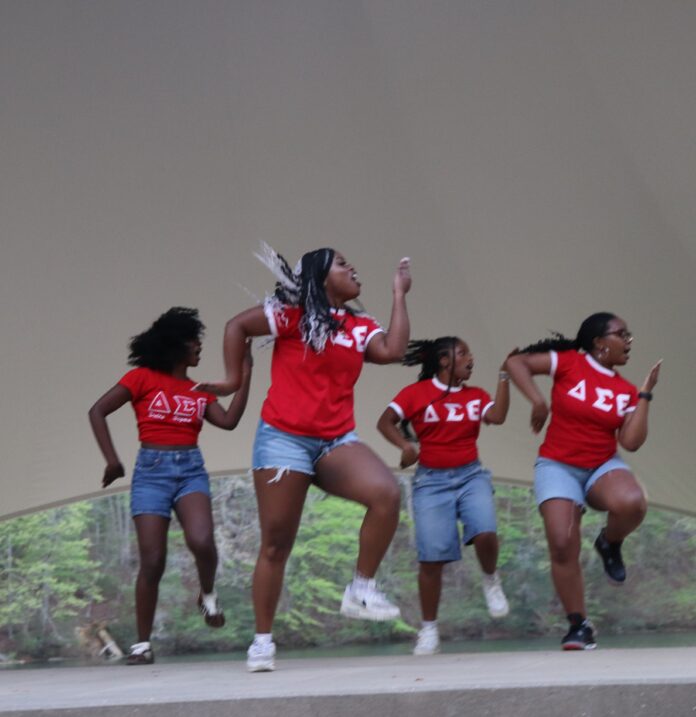
Sunday, April 12, historically Black sorority and fraternity members joined together onstage at Martha Wren Briggs Amphitheatre at Lake Matoaka, stomping, stepping and singing. NPHC Yard Show is an annual step show run by historically Black fraternities and sororities since 2018. It celebrates their history on the College of William and Mary’s campus. NPHC pushes for greater representation of the Black community on the College’s predominantly white campus.
NPHC vice president Nya Tefferi ’27 introduced the show with brief remarks on the performance’s significance and background on historically Black fraternity and sorority life at the College.
The program’s performances were rooted in history, as sororities and fraternities highlighted their place within the College’s campus past and within the Black community through stepping, strolling and chant.
Beginning the program, fraternity Alpha Phi Alpha performed as a trio, slipping and sliding to the beat. The performance ended with the trio coming together in a row. Yet, for all the smoothness of their moves, the quiet solemnity of their voices created a pause in the crowd as they shouted out their founding year.
Next, sorority Alpha Kappa Alpha performed with sharp movements and black shirts that caught the crowd’s attention. As they stepped, they shouted out their founding date, along with phrases like, “Oh so pretty!” The sisters leaned into the song’s light comedic background to contrast the serious significance of their role as the first Black sorority in the nation.
The fraternity Kappa Alpha Psi, outfitted in full suits, performed with five performers, stomping and strolling. They finished in a classic jazzy line, holding canes with their hands on each others’ backs.
In between these performances, Tefferi and her co-host appeared in their respective organizational attire, representing NPHC leadership.
The intermission wasn’t a break in the celebration, but a proliferation as over thirty audience members joined the performers on the floor of Matoaka Amphitheater.
For the grand finale, the Mu Upsilon chapter of the Delta Sigma Theta Sorority, Inc. performed their song, “All of My Love” in a sweet soprano, while performing a perfectly synchronized step. It was a sea of red outfits as the sisters supported one another in a line.
The event organizers, Tefferi and NPHC community outreach Jazmine Klinedinst ’28, emphasized the importance of the show in representing the college’s Black community.
“This is how we spread awareness that we’re loud, we’re doing amazing things,” Klinedinst said.
Klinedinst highlighted the commitment, preparation and dedication that go into the show.
“They make it look so easy, but it’s probably around hours each night, for months beforehand,” Klinedinst said.
Delta Sigma Theta Sorority, Inc. president Kennedy Byrd ’26 emphasized the history of historically Black fraternity and sorority organizations on campus. As a member of the first historically Black sorority on the College’s campus, chartered in 1976, and a legacy Delta, Byrd recognizes the significance of the NPHC show.
“Just being able to represent, being on a majority white campus and being able to show what culture means to us and being able to kind of showcase what we’re about, that means everything to us,” Byrd said.
Tefferi stressed that NPHC’s performances aren’t just about representation, but also commemoration of the Black community on campus.
“This show is meant to support our work, including the Garden Project. The Garden Project is a push for memorialization for historically black sororities and fraternities on William and Mary’s campus,” Tefferi said.
NPHC’s Garden Project campaign would provide formal statues to recognize each historically Black fraternity and sorority’s place in the history and social life of the College.
“There’s the regular sorority and fraternity court, but there’s no commemoration of historically Black sororities and fraternities on campus,” Tefferi said.
CORRECTION (04/15/26): This article has been updated by the Standards and Practices Editor to reflect accurate terminology regarding NPHC performances. References to “dance” and “line dance” have been corrected to “stepping” and “strolling.” Additional corrections clarify Delta Sigma Theta Sorority, Inc.’s chartering of the Mu Upsilon chapter at William & Mary (1976). The title of the song performed in the finale has also been corrected, and descriptions of performers’ attire and roles have been updated for accuracy. Also, the title of the article has been updated.
