

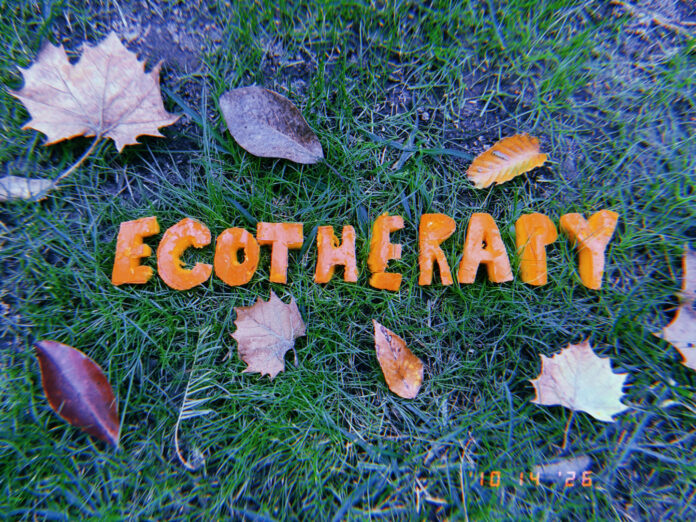
During Homecoming weekend, alumni and current students wandered up to a table covered in leaves and were invited to add one to a growing nature mandala. Many did, and many stayed to chat. Ecotherapy Club member Alexander Betts ’27 enjoyed watching the unforced simplicity of these acts.
“Ecotherapy is not trying hard to be something it’s not,” he said.
The club works as a space to get people outside, off their phones and paying attention to the environment around them.
The club grew out of an academic course. Founder and co-president Erin Shannon ’27, an environmental science major, took an ecotherapy capstone class last fall. Having taken science and lab-heavy courses for her degree, this capstone offered something new. She got to see the wellness side of her studies.
The class, however, only has space for a few students.
“I wanted to start the club to bring ecotherapy practices to more students who couldn’t get into the class,” she said.
Shannon worked diligently on launching the club, even while studying abroad.
“I was dead set on getting it up and running for my senior year,” she said.
Shannon was surprised by the club’s turnout. Many of the students who attend the club’s nature walks are freshmen who have never heard of the ecotherapy course. Shannon says this indicates the necessity of groups like this on campus.
“I think it kind of shows that students want that,” Shannon said.
Ecotherapy Club meetings tend to center around a nature walk or a hands-on activity. Member Madeline Gieser ’30 described taking time to slow down and notice her surroundings at meetings.
“Sometimes we will take a moment of silence to take it all in, and then afterwards we’ll talk about it,” she said.
On other days, the group might enjoy making eco-art. The Crim Dell Meadow functions as the club’s typical meeting place, but longer walks follow the Matoaka Trail.
Shannon created a mix of easier sessions, like visits with therapy dogs, with more advanced ones. Her favorite is forest bathing, otherwise known as shinrin-yoku.
“It’s a Japanese term, and it means basically bathing in the forest using your five senses,” she said. “It’s a very good mindfulness practice, and I think it’s such a great way to take a break and really step into your own world away from everything.”
Before a practice begins, she explains the science behind it so members can observe the effects. Afterward, they check in on how they feel.
The results touch every member differently. Shannon pointed to a concept she took from her class: attention restoration.
“Your brain uses this thing called soft fascination because it’s just so in awe of nature,” she said.
She explained that this phenomenon gives the brain a rest from constant demands, something that students are severely lacking.
“Especially at William and Mary, we’re very go, go, go,” she said. “I find breaks in the form of scrolling on my phone rather than actually giving my brain a break.”
Instead of these habits, she suggested that modes of unplugging as simple as looking at nature on the walk to class can have significant impacts.
Unplugging is part of the appeal of Ecotherapy Club for its members.
“We tend to put our phones away whenever we’re on a walk, and it’s always great to take a technology break and just connect in person,” Gieser said.
Betts seconded this philosophy.
“In a digital age where we’re all looking at our phones 24/7, it’s nice to unplug and have a third space where you can be with people that are friendly while also observing nature and appreciating it,” he said.
Members described the effects they feel from ecotherapy plainly.
“Afterward, I feel more relaxed and almost like my focus has reset for the day,” Gieser said.
Betts has built skills he’s learned from the club’s activities into his own personal routines.
“When I’m overwhelmed by my work, I will take the time to go on a 15-minute walk,” he said. “I will take the time to go outside and ground myself, and that is not something I used to do.”
Gieser said the club has also encouraged her to see the bigger picture while on campus.
“Ecotherapy has taught me that the world is much bigger than one specific class or one specific assignment,” she said.
Betts noted his perspective shifting as well, sharing that he never used spots like the benches around the Sunken Garden until this year.
“People just walk past them every day, but they’re beautiful, and they’re there for you,” he said.
New to the campus as a freshman, Gieser said the club’s walks have also introduced her to unseen places.
The club has also served as a social outlet for its members. Betts joined the club as a senior and confirmed that it has far surpassed his expectations. He described the club as a welcoming space to appreciate nature and spend time with friends.
Shannon acknowledged that the club’s activities can look or feel silly. Despite this, she encourages members to get over the initial feeling of self-consciousness to feel the full effects of their meetings and rebuild the relationship with nature she thinks many people lack.
There are no particular qualifications for the club, and members do not even need to be outdoorsy people. Betts called himself a gamer who also loves to hike, and Gieser shared that she is not typically the nature-loving type.
“As long as you can be observant of the world around you, can look inwards and don’t mind getting a little dirty, then I’d say you can have a positive experience in the club,” Gieser said.
The club has no membership dues and no required attendance. Gieser noted that the drop-in basis of the club really allows it to work into students’ schedules.
“It’s just about enjoying nature in a way that works for you,” she said.
Shannon will graduate in the spring, and she hopes the club continues to function as a welcoming space to unplug and de-stress. Rain or shine, she noted the importance of spending time in nature and its tangible impacts on both mental health and general well-being.
“Do the uncomfortable thing and just get outside at least once a day. It sounds so simple and very cliche, but it’s so true that it helps,” she said.
