

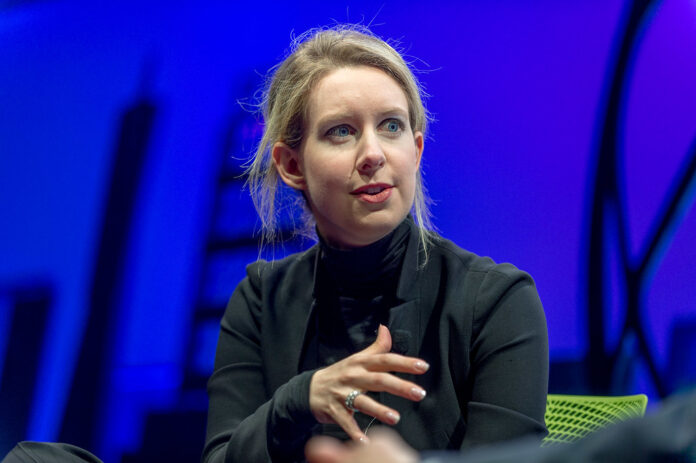
“You Can See Everything” is a three-hour, genre-bending documentary directed by Nathan Fielder and Lance Oppenheim. It follows Theranos founder Elizabeth Holmes and her partner, Billy Evans, starting 34 days before Holmes begins an 11-year federal prison sentence.
Holmes founded Theranos, a health technology company, in 2003 as a 19-year-old Stanford dropout. Holmes, along with her 38-year-old business partner and boyfriend Sunny Balwani, built the company around a medical device that claimed to be able to run over 1,000 tests on just a few drops of blood.
In reality, the machine ran only 12 tests, and the results were riddled with errors. Investors and venture capitalists, unaware that the company was a scam, poured over $700 million into Theranos. At its peak, the company was valued at $9 billion. Holmes became the youngest female self-made billionaire in history.
In 2015, it all came crashing down. Whistleblowers raised concerns about the company’s technology, leading to Theranos’ collapse and federal fraud convictions for Holmes and Balwani. Holmes completely stopped speaking to the media in 2016 — until now.
Nathan Fielder is an unlikely candidate to document the life of Elizabeth Holmes. Why would one of the most elusive entrepreneurs of all time pick a man known for creating poop-flavored frozen yogurt to tell her story? But it is exactly this absurdity that makes him perfect for the job.
Just as Fielder maintains a deadpan facade in his docu-comedy shows “Nathan for You” and “The Rehearsal,” Holmes, too, never breaks character, maintaining that she is completely innocent throughout the film. At one point, she claims that she has never told a lie in her life, leaving Fielder incredulous. They make an odd pair: two people playing characters in a piece that presents itself as honest, vulnerable nonfiction.
From the film’s opening moments, cinematographer David Bolen creates an uncomfortable intimacy between the audience and the film’s subjects. Claustrophobic tightness frames nearly every scene. Far too close-up angles show every pore and crease; to maintain this proximity, the camera moves frantically, rarely allowing a moment of ease as it obsessively tracks its subject. Even in wider compositions, the shots are always crowded by walls and objects, trapping the viewer and forcing their attention inwards.
Bolen’s cinematography suggests familiarity between the viewer and Holmes. Why would she deceive us — or, as she says, how could she deceive us when we’re watching her from inches away? But the closeness doesn’t convince us that she’s being honest; even as we see tears welling up in her eyes, something feels inauthentic. Gradually, we no longer feel like guests invited into Holmes’ life. Instead, we feel stuck, and the walls around everything we can see begin to draw our attention to everything we cannot see.
The film’s score, composed by Ari Balouzian, is just as anxiety-inducing. The piano pounds rhythmically, and chords build on themselves in a never-ending staircase. The energy climbs but does not peak, rarely providing a moment of satisfaction where the viewer can revel in what they have seen. Even when a scene seems to climax, the score pushes forward, implying that there is something yet to be revealed (even if we never find out what that thing is). Balouzian’s compositions feel more well-suited to horror, and they can make a simple shot of Holmes’ family on the beach feel just as disturbing as anything from “The Exorcist.”
The film will make you question what you think you know about Holmes. Is she a delusional visionary who genuinely believes in Theranos? Or is she a pathological liar and manipulator obsessed with power and influence?
You also begin to doubt Fielder’s reliability as a narrator. You wonder whether he is being truthful or bending the narrative to protect Holmes — someone he clearly comes to care about. Fielder changes impressions and interpretations retroactively, spiraling internally, seemingly Stockholm-syndromed by his subject. Fielder’s self-doubt in his narration creates unease within the viewer: If he doesn’t believe himself, how can we believe anything?
Fielder approaches conversations with Holmes and Evans in an awkwardly disarming way, weaponizing something he has mastered in his other works: silence. The documentary comprises scenes of Fielder and Holmes staring into each others’ eyes, waiting for one of the two to speak, to admit, to probe or to elaborate. Holmes’ fierce, doe-eyed, unblinking, blue gaze creates an indecipherable front.
This impenetrability extends to Holmes’ relationship with her partner, Evans, who opens the film. The couple met in 2017 after Theranos was exposed as a fraud; Evans claims that he fell in love at first sight despite knowing about Holmes’ professional history.
The two trust each other to the point that it is unclear whether one party is manipulating the other. Was Evans duped by Holmes’ charade of innocence, or is Evans taking advantage of Holmes’ notoriety to further his own agenda? We found this to be one of the most compelling components of the documentary. While Evans described his relationship with Holmes, the three of us were literally at the edge of our seats, leaning forward, mouths agape.
For a three-hour-long documentary, “You Can See Everything” doesn’t resolve much. We were left with more questions than answers, not knowing what to believe or who to trust.
In an initial interview, Fielder himself tells Holmes that the evidence points overwhelmingly towards her guilt. In spite of this, we found ourselves wanting to believe her. After days of thinking and talking about this movie, we still disagree about her character. One has to wonder what Holmes’ intentions were in pursuing this documentary. Is she reclaiming a narrative? Proving her innocence? Is she just narcissistic?
We can’t say. We didn’t see everything.
