

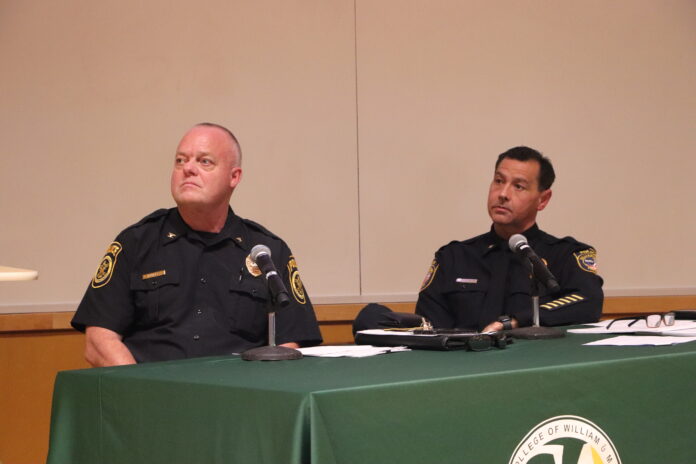
Thursday, Nov. 12, the College of William and Mary’s Student Assembly hosted a forum in the Integrated Science Center on Flock automatic license plate readers. The event featured Williamsburg Police Chief Sean Dunn and William and Mary Police Department Chief Don Butler in conversation with community advocates and residents.
The event began with Sen. Danny Otten ’23 Ph.D. ’27 and Sen. Neha Baskar ’29 presenting results from a recent Student Assembly survey. The poll asked Williamsburg residents about their opinions on Flock cameras.
The survey garnered over 1,000 responses and found overwhelming opposition to Flock from student and nonstudent residents of the City of Williamsburg.
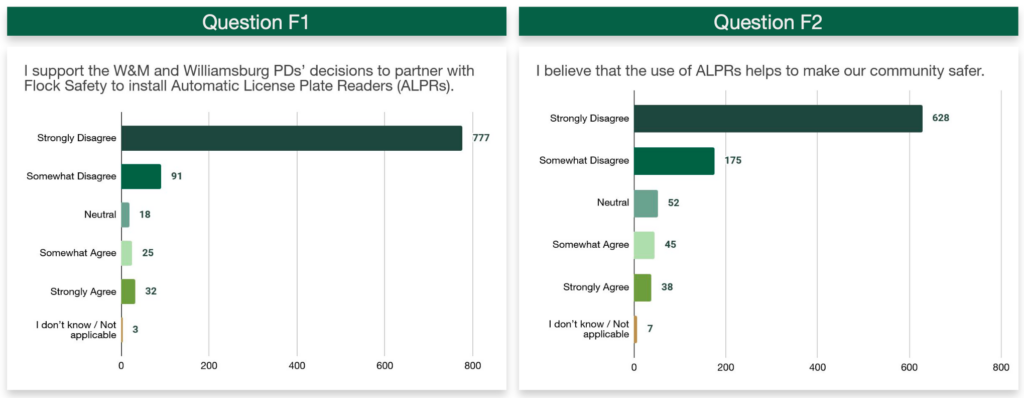
“The results are kind of lopsided here,” Otten said. “Most people, over 700, strongly disagreed with the decision [to install Flock ALPRs].”
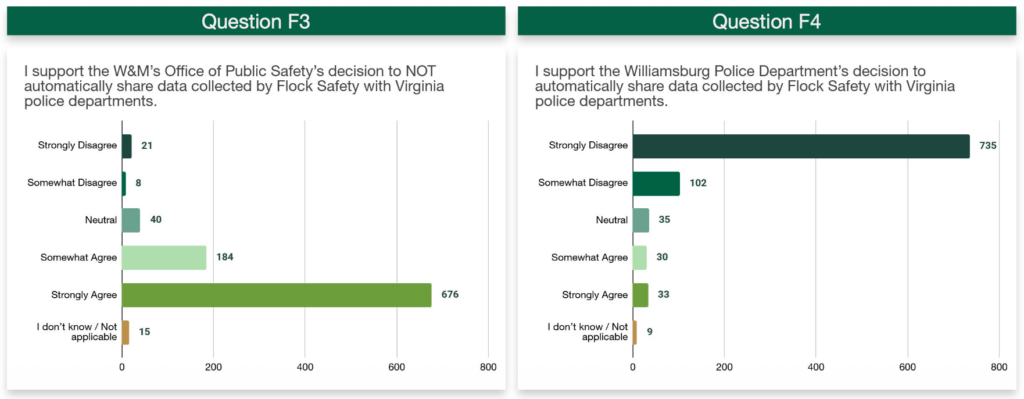
The survey also asked about Flock data-sharing. WMPD does not automatically share data from its Flock cameras with other agencies, a policy that respondents overwhelmingly supported. By contrast, the Williamsburg Police Department automatically shares data with other Virginia law enforcement agencies, a practice respondents widely opposed.
Most respondents also favored greater transparency about police use of Flock and indicated support for law enforcement to publish all cases in which Flock data are used. Additionally, the survey displayed low levels of concern about crime in the City.
“I think that’s an excellent sign, and that means our public safety officers are doing a wonderful job,” Otten said.
Following the introduction, Dunn gave an overview of WPD’s implementation of Flock technology. He said he valued the event because it allowed him to engage directly with students.
“One of the things as we prepared for this conversation tonight that was deeply important to me [was that] even though we might have different views, maybe we find some common ground at least on some of the issues,” he said. “I don’t have too many opportunities to work with you guys and to connect with you a little bit.”
Dunn said WPD initially implemented Flock cameras through a pilot program offered by the company ahead of a conference of Virginia police chiefs in Williamsburg.
“Within a matter of days, and certainly within a couple of weeks, we thought, ‘Holy smokes, these are effective tools,’” he said.
Dunn noted that Williamsburg is relatively low-crime and low-population. However, he said there still exist high levels of vehicular traffic through the City, which averages 6 million to 8 million visitors per year.
“Williamsburg is the transportation hub,” he said. “For a population of 16,000, we are not quite staffed where I’d like to be — you can imagine what that population really is.”
Dunn also outlined restrictions on Flock camera usage, including 21-day data storage limits, monthly audits and requirements that searches be tied to specific case numbers. He said many of these limits are built into Flock’s system, which helps prevent violations.
Dunn believes data-sharing in Virginia is a valuable tool for law enforcement agencies across the state.
“If there were a murder suspect in, say, Winchester, Virginia and they happen to see that murder suspect’s vehicle in Williamsburg, I think we all would like to know that,” he said.
Any WPD officer who misuses Flock data would be terminated, decertified and prosecuted, per Dunn.
“People sometimes make mistakes,” he added. “When you make that mistake, there are very, very, very serious consequences.”
Dunn said Flock technology is “colorblind” and would not be used for any immigration- or reproductive-related law enforcement.
Community advocate Charlie Goodman ’27 and Student Assembly Undersecretary for University Policy and Student Rights Hannah Sawyer ’27 then asked Dunn and Butler questions.
Goodman described the results of a March student referendum, in which 89% of students indicated support for canceling WMPD’s contract with Flock.
Butler said he and Associate Vice President for Public Safety Cliff Everton ’96 implemented changes after the referendum, including ending automatic sharing of Flock data with statewide agencies. They felt preventing other agencies from accessing WMPD data would not significantly hinder law enforcement.
“We pledged to consistently monitor the usage of Flock cameras,” Butler said.
Dunn said WPD remained in the statewide network because he feels Williamsburg Flock data is valuable to other police departments.
Sawyer asked Dunn and Butler to respond to community concerns that collecting and storing license plate data with AI-powered technology is an invasion of privacy.
Dunn said he did not believe Flock should be considered “AI cameras.”
“It is a common misconception that these are AI cameras,” he said. “What we have is a system that’s taking a picture of a vehicle, capturing both the exterior as well as the license plate and then basically putting that in a database for us.”
Goodman pushed back, noting that Flock cameras integrate AI technology for their search features.
“That [AI integration] power gives police the ability to search for specific license plates or vehicle characteristics, damage to the car, etc.,” Goodman said.
Goodman also mentioned how, even if Williamsburg community members trust the police to use data responsibly, many are hesitant about entrusting public safety work to a private corporation.
Butler and Dunn said Flock data is public. This limits their concerns about the collection and dispersion of information.
“The fact is that it’s public data,” Butler said. “I don’t know that there’s any company, per se, a large company you can trust in this country. So it’s a risk analysis. I see the safety benefit outweighing the risk.”
Sawyer asked whether the chiefs were concerned that over 42 other Virginia law enforcement agencies canceled or reevaluated their Flock contracts.
“It might be 43 because we’ve reevaluated constantly and we have made changes,” Butler said. “42, first of all, is a small number of Virginia agencies. I don’t think it’s fair to say all 42 have done so because of privacy issues. It could be cost; it could be any number of things.”
Dunn reasserted that WPD and WMPD are always reassessing their ALPR usage.
“We are constantly evaluating what we’re doing and why we’re doing it,” he said. “Trust me, if there’s a better option, then at some point, we’re going to explore it. If there’s a better way to deploy it, we’re going to do that.”
Goodman mentioned a Virginia Center for Investigative Journalism report which found that officers in the Norfolk Police Department frequently cited unclear reasons for accessing Flock data. For example, the term “123” was used over 1,200 times between July and October 2025.
Dunn and Butler questioned the report’s validity.
“Well, let me respond first off by saying I don’t know that any of that you just said is accurate,” Dunn said. “I just don’t have the information. But I can tell you that’s not the way, and there is legislation in place that causes that to be very hard to believe that in November 2026, that’s what happened.”
Butler echoed a similar sentiment.
“That is a people problem,” Butler said. “If they did that, it was a criminal act, and they are criminals. The system didn’t do that — Flock didn’t do that.”
The forum was then opened to public comment.
Ella Forlin ’27 noted that Virginia legislation does not entirely prevent abuse of Flock, as evidenced by the recent Virginia Crime Commission Report. This found that over 20 departments reported illegal use of Flock.
“The Virginia ALPR law might be stringent, but this law isn’t enforceable,” she said. “You keep saying that this technology is airtight and changing to be consistent with state law. If this is true, people shouldn’t be able to misuse this technology.”
Austin Wright MPP ’27 said Dunn and Butler had violated their responsibility to serve the public will by continuing to operate Flock cameras.
“On the whole, we trust you to make good decisions, but there are limits to our discretion and limits on the power to choose which we bestow,” he said. “If you are servants of the people, duty and honor permit a single course of action. Renounce Flock and all ALPRs before us here and now.”
One attendee criticized Dunn’s claim that Flock is colorblind, saying that police should instead trust their officers to be colorblind. Another attendee supported Flock use, noting that ALPRs are not new and saying they can serve a legitimate public safety goal.
Butler acknowledged the community disagreements.
“I know it’s a topic there’s not a lot of agreement on,” he said. “But I do hope that we were able to share some points, and you certainly have shared some perspectives with us. This is democracy in action.”
He said everything he does as an officer stems from care for the community.
“None of you can possibly imagine what it’s like to be a police chief responsible for the care and safety of the community and have something bad happen,” he said. “We care very much about you, about the community that we serve and about the jobs that we do every single day.”
After the event, Butler said he appreciated the opportunity to speak directly with students.
“The reason we agreed to do it, at least from my perspective, is we were asked to do it,” he said. “The student body is who we’re here for, and I thought it was important … I like the idea that if there’s some disagreement, we have dialogue about it.”
Goodman told The Flat Hat he felt inspired by the community’s willingness to attend the event.
“I think the thing that stood out to me tonight was that a lot of people are upset because they don’t feel listened to,” he said. “It’s not just that the technology is here. The technology is here even after we ask for it not to be.”
