

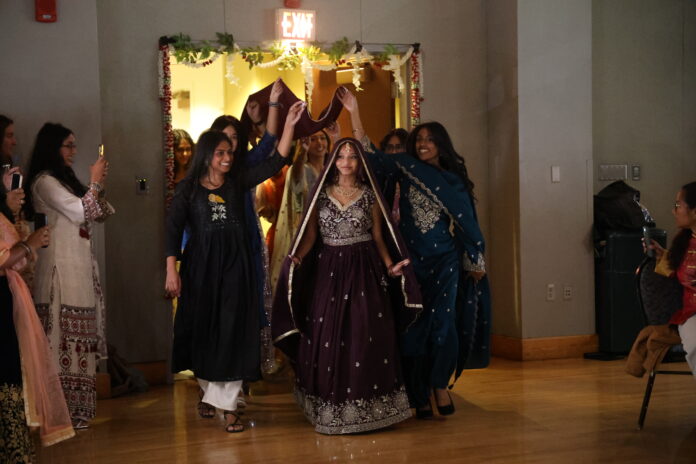
Saturday, Nov. 14, the South Asian Student Association hosted Mock Mehndi, an event recreating South Asian pre-wedding rituals.
Mock Mehndi became popular post-COVID, when students at Stanford University and Harvard University, as well as the College of William and Mary, began hosting the event. Mock Mehndi has since been a burgeoning trend within the South Asian community on college campuses.
What is a Mock Mehndi like, you might ask?
Saris shimmered, kurtas slid and formal wear abounded as people milled about the room.
Spice Palace Indian Restaurant catered food for the event, which was held in the Chesapeake Room of the Sadler Center.
The event began with an introduction of SASA’s presidents, Kamna Kalkunte ’28 and Arman Bajwa ’28. SASA culture chair Kevin Jacob ’29 highlighted the cultural basis of the event.
“Mock Mehndi is a pre-wedding ceremony, heavily inspired by Pakistani culture and traditions. Historically, mehndi was an at-home ceremony that only involved the women of the wedding party, but it has evolved into a larger-scale gathering,” Jacob said.
The event also celebrated SASA’s extensive fundraising campaign, raising over $1,500 dollars for Ama Foundation’s efforts to help children afflicted by the 2026 flooding in Nepal.
After this introduction, a set of performances began.
The new South Asian choral group on campus, Taal Tribe, debuted at the event, singing to the song “Friend Like Me” from the Disney movie “Aladdin” and “Zoobi Doobi” from the Bollywood classic “Three Idiots.”
Then, the College’s Bollywood fusion dance group, Afsana, danced to an upbeat mashup of music.
If it were possible, the College’s Bhangra dance group increased the momentum even more. Griffin Bhangra performed with perfect precision.
Then, for a brief moment, the room became quiet, the lights dimmed and the flashlights from attendees’ phones shone under the cover of darkness, as the groom, Sam Snoddy ’27, and his groomsmen entered, carrying Snoddy above their heads from the hallways of Sadler.
Then the bride, Shama Hasan ’27, entered adorned in a dark purple sari as her bridesmaids circled her in bejeweled outfits, dancing in a myriad of colors.
The bride and the groom sat upon a sofa adorned with purple roses.
The wedding party continued the night with a traditional wedding game. The bride’s party stole the shoes off the groom, and he playfully ran after them while they teased him all the way.
Soon after, the bride and the groom’s parties took center stage for a wedding game of musical mehndi, a game of musical chairs themed around who could grab a guest in specific attire. The light-hearted game taught quick identification of traditional South Asian wedding attire for outsiders. Everything from kurtis to watches was called out as those from the audience made a mad dash to find people wearing the specified attire and bring them back to a seat.
After this, each side of the wedding party had their own dance performance. The bride’s side danced to the song “Baby Doll” by Kanika Kapoor and Meet Bros Anjjan, while the groom’s party danced with swagger to Diljit Dosanjh’s “GOAT.”
Both sides came together for one final dance, and the crowd then joined the dance floor in celebration.
Kalkunte emphasized that the College’s Mock Mehndi is all about celebrating unity within diversity.
“There is so much togetherness of cultures within the South Asian culture that happens at these events. It’s a chance to celebrate how all of these different cultures within South Asia come together, educate the student body a bit on South Asian culture,” Kalkunte said.
Hasan emphasized that the event is part of a greater trend of fake weddings in recent years.
“People don’t really want to get married these days. We just want to do the fake ones,” Hasan said.
Event director Anjali Krishnan ’27 emphasized the distinct place of Mock Mehndi as an expression of South Asian culture, especially in light of the broader fake wedding tradition in Fraternity and Sorority Life in recent years.
“The Mock Mehndi definitely holds a distinct place within South Asian culture generally. It’s a really unique way for all these cultures that are very different within South Asian culture to come together,” Krishnan said.
Afsana dancer and co-founder of Taal Tribe, Himani Ravva ’28, emphasized that although the celebration may be fake, there’s nothing farcical about the culture it represents.
“This is a fake wedding, but at the same time, this is the way that we represent our culture, because it’s such a big thing in South Asia,” Ravva said.
