

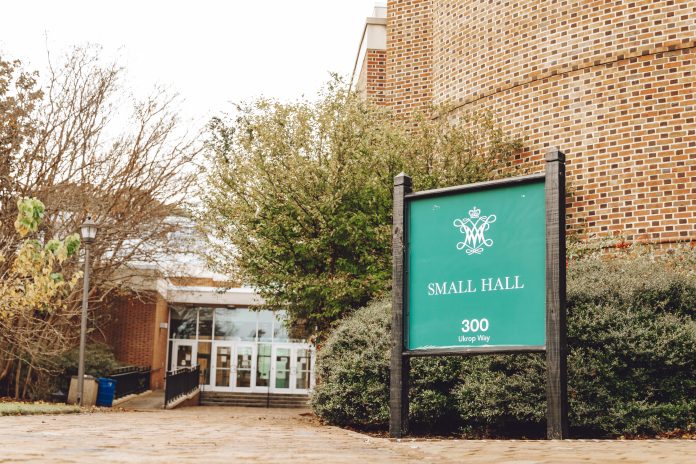
Friday, Nov. 13, former director of Lawrence Livermore National Laboratory George Miller ’67, M.S. ’69, Ph.D. ’72 spoke at a colloquium sponsored by the School of Computing, Data Sciences and Physics in the College of William and Mary’s Small Hall.
Miller described the purpose of the talk.
“There are a set of what I call ‘existential challenges’ facing the country and the world and most of its institutions that need to be paid attention to,” he said. “It’s not only the technological change but the rate of change and the fact that it affects not only technology but society in general.”
Miller described potential changes to society due to artificial intelligence and other technologies as beyond anything human societies have seen in the past.
He said these changes pose challenges for institutions in their efforts to react and manage risks.
Miller compared these challenges to the Stockpile Stewardship Program, a U.S. Department of Energy initiative to maintain and test the country’s nuclear weapons stockpile without underground explosive testing.
First, he described how it took time to phase out nuclear tests. Proposals to ban nuclear testing emerged alongside the atomic bomb, and international treaties limiting the testing of these weapons took effect in the late 1950s.
He noted, however, that the Comprehensive Test Ban Treaty was not signed until 1995. This was because of fears that the Soviet Union would not obey the limits and concerns that the limits could hinder the United States’ confidence.
“This idea of highly optimized and ‘how do you have confidence’ is no more complicated than an engineering safety factor,” Miller said. “You know things work here, you know they fail there, and as long as you stay away from the failure point, you’re okay.”
Issues with the program included the need for new technologies and facilities to study the weapon’s longevity and the detector’s success. According to Miller, this proves that the United States can clear major hurdles if the will exists across government, private and academic institutions. He questioned whether the same grit can be mobilized to solve issues emerging from AI.
Graduate student Zoe Fong ’25 M.S. ’28 said she enjoyed the talk.
“I was pretty engaged,” she said. “As a physics student, we have these colloquiums every week, and this one was very different in terms of the style and the topic.”
Kate Krogen M.S. ’31 echoed the sentiment.
“I thought it was very interesting to hear the perspective of somebody in a national lab who’s working on that and how you would advise the government on these things,” Krogen said. “I think it’s so important to work together, scientists and the government.”
Chair of the physics department and professor Joshua Erlich said he found the talk interesting.
“Our colloquia in physics are often very technical about aspects of physics, so it was quite refreshing to hear a more historical perspective about a topic that’s important today, as it was years ago from somebody who was in the center of it all,” he said.
