

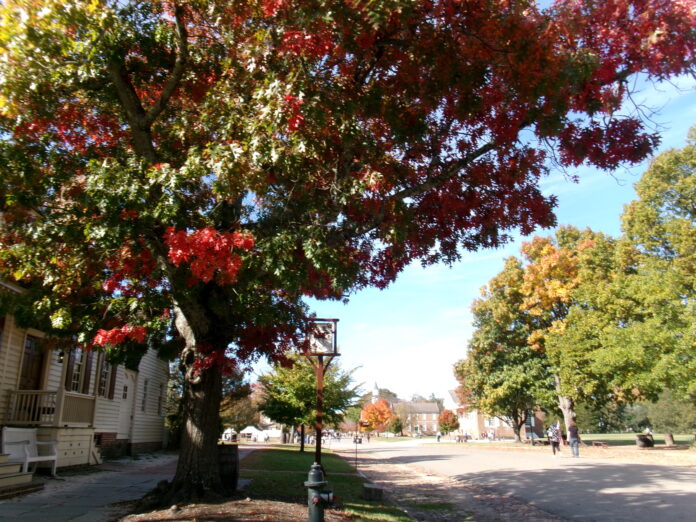
The Flat Hat analyzed data from 2016-26 and compared fall weather in Williamsburg with Washington, Philadelphia, New York, Chicago, Denver and San Francisco. Data came from the European Centre for Medium-Range Weather Forecasts, the Climate Data Store and Open-Meteo.
The primary data point for measuring weather volatility is day-to-day temperature shifts, or the variation in yesterday’s high temperature from today’s. Across the United States, autumn brings cold fronts that can drop high temperatures by 20 to 30 degrees Fahrenheit in 24 hours.
In contrast, the Atlantic Ocean and Chesapeake Bay help moderate the City’s temperatures, insulating it from sudden shifts in air masses. While Denver experiences daily temperature swings of 7.37 F and Chicago averages 5.55 F in the fall, Williamsburg’s shifts remain below 5 F, the second lowest of all cities measured.
While Philadelphia and Washington both posted around 50 autumn days below freezing over the past decade, Williamsburg recorded just 16.
Elizabeth Lawless ’27 said the first below-freezing day each academic year often comes as a surprise.
“There’s a time it’ll just be really sudden drops in temperature,” she said. “I remember wearing my puffer jacket and being freezing and regretting that I didn’t bring any of my winter clothes from home.”
Williamsburg also tops the list among measured cities in terms of consecutive days between rain events. During autumn months, Williamsburg averages 3.1 consecutive dry days between rainstorms, outperforming both New York and Philadelphia.
Williamsburg also outpaces almost every city in sustained rainless weather. Over the last decade, Williamsburg recorded a maximum of 32 consecutive fall days without precipitation.
Beyond day-to-day shifts and dry stretches, another key indicator of weather stability is diurnal spread, or the temperature gap between the daytime high and the nighttime low within the same 24-hour period.
In high-altitude regions like Denver, fall intra-day swings average a 28.25 F difference between peak afternoon highs and midnight lows. In contrast, Williamsburg maintained an average daily temperature range of 15.81 F during the fall, less than cities like Washington, New York and Philadelphia.
“[It’s] definitely completely inconsistent,” American studies professor Jay Jolles said. “If you’re mad about the weather in the morning, don’t worry; by the afternoon, it’ll be different.”
