

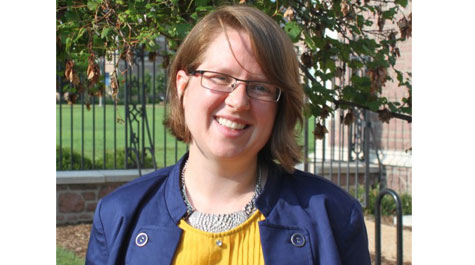
Associate professor of government and gender, sexuality and women’s studies Claire McKinney’s office has become the physical manifestation of a decade of rigorous academic life: binders and papers stacked high, an accumulation of research and shelves crowded with books.
This fall, McKinney celebrates her 10th year at the College of William and Mary. While a decade on campus has brought plenty of institutional shifts, she noted that one element has remained consistent: the students.
“William and Mary students still remain incredibly driven, incredibly curious and really game to explore things that a professor puts in front of them,” McKinney said.
McKinney said her last 10 years of teaching have not been completely smooth sailing. She pointed to disruption from the COVID-19 pandemic and the rise of large language models, alongside broader cultural shifts in education.
Rather than blaming technology or pandemic learning gaps, McKinney said she sees her role as meeting students where they are, helping them cultivate their own independent voices.
Her work has long centered on power dynamics, which she applied to political theory, identity and the body. McKinney said that while her research focus has not changed over the years, her approach has.
“The question of power has always been central to how I approach topics of politics, political theory, thinking about identity and the body,” she said. “That has remained the same, but thinking about the ways that power creates its own contradictions and has its own unforeseen consequences when you’re able to wield power in particular ways really comes to the fore as I’ve theorized.”
She encouraged bringing this analysis of power to conversations about reproductive justice, noting instances where physicians who may still be anti-abortion are experiencing legal constraints.
“There’s this irony in the use of power,” she said. “Dwelling with that kind of complexity really reveals that our institutions are, in some sense, malleable, that malleability requires really insight into thinking about their operation.”
The nuance did not come naturally to McKinney.
“I remember my advisor telling me repeatedly that I saw the world way too ‘black and white,’” she said. “It was a real challenge to me because I wanted to make these really strong, normative judgments and conclusions.”
As she’s grown as a researcher, professor and advisor, McKinney said she feels this mindset has softened.
“The sort of research that I’ve come to do is one where that ‘black and white’ has really faded in favor of dwelling in the kind of ‘gray zones,’” she said.
Her appreciation for individualistic thought is central to her scholarship. Her studies’ themes converge in her latest book, “A Womb of One’s Own: Abortion, Citizenship, and the Politics of Reproduction,” which was released in October.
McKinney said she hopes readers, especially students, take away three things. The first is that abortion politics are not a periphery concern.
“We should stop thinking about abortion politics as something that’s only on the periphery of politics, that [it] only matters for the real zealots on either side of the political spectrum,” she said.
Access to abortion, she argued, is central to “gendered belonging” in America.
She also hopes readers note the medical field’s politicization.
“We need to rethink the institutions that are ‘political,’” McKinney said.
She said that medical textbooks, websites and the way that medicine is taught all shape politics and should be treated as such.
Third, she urged attention to the present.
“We really should pay attention to this moment where abortion has become a new political problem,” she said.
Since the Supreme Court’s decision in Dobbs v. Jackson Women’s Health Organization, which overturned Roe v. Wade, McKinney said she sees institutional and structural instability, but also possible new paths for the country.
“Hopefully, the book helps us think about what was happening in the past that we either do or do not want to revisit, and that opens up opportunities for us to innovate for new futures,” she said.
Before entering academia, McKinney spent years coaching high school debate across diverse socioeconomic landscapes. She said that background deeply informs her current classroom philosophy.
“How do I foster an environment that allows everybody to achieve the degree and type of learning that they desire?” she said. “It’s about actively fostering capacity both through very high, rigorous standards that I think everybody can meet.”
Returning to campus after a year of research leave, McKinney is eager to reconnect with the student body.
“I get a lot of joy seeing people being able to explore and to discover new capacities and new things that they had not encountered before,” she said. “I’m really happy to get to be here with students and celebrate my book.”
