

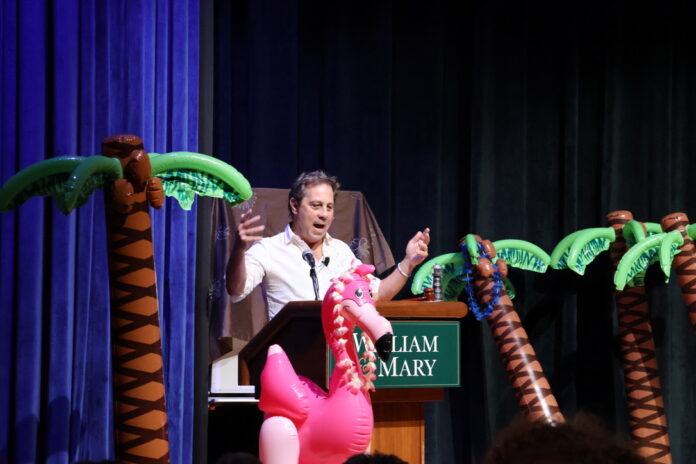
Tuesday, Oct. 27, the College of William and Mary held its annual raft debate in the Sadler Commonwealth Auditorium.
Four professors, each representing a separate academic discipline, simulated being stranded on a deserted island for the event. Each debated who deserved to receive the one life raft that would help them escape the island and survive.
Participants included associate professor of psychological sciences Peter Vishton, who represented the social sciences; Bickers Professor of Middle Eastern Studies and professor of music and ethnomusicology Anne Rasmussen, who spoke on behalf of the humanities; and geology professor Chuck Bailey, who represented the natural sciences.
Associate history professor and Director of Graduate Studies in History Andrew Fisher served as the Devil’s Advocate, arguing that none of the disciplines deserved to survive. This year’s event, dubbed the “All-Stars Debate,” featured past victors returning to compete. Bailey emerged as the winner.
Trey Mayo, assistant dean for graduate studies in the School of Computing, Data Sciences and Physics, opened the event with brief remarks. Mayo explained that this year’s event commemorated the 50th anniversary of the third 1976 presidential debate between former Presidents Gerald Ford and Jimmy Carter, which occurred in the College’s Phi Beta Kappa Memorial Hall.
“Tonight, as America celebrates its 250th anniversary and William and Mary celebrates its Year of Civic Leadership, that tradition of spirited debate continues at the Alma Mater of the Nation,” he added.
Mayo said the Raft Debate dates back to the 1960s and has challenged generations of faculty to defend the value of their discipline.
“Tonight, in that enduring William and Mary spirit of inquiry, argument and perhaps a little absurdity, we gather once again to debate without reserve,” he said.
Participants were then each allotted seven minutes to deliver their opening statements.
Rasmussen, the 2002 debate victor, began her argument with a song.
“The pure and social sciences, I’ll bring them to their knees,” she sang. “We are all former victors of this famous raft debate. With poetry and literature, filmography, language, religion, film and dance: I am an ethnomusicologist and the others have no chance.”
She centered her argument around the oud, a short-necked traditional Arabic instrument often called the grandfather of the modern guitar.
“Music is a window to culture, society and the individual, and to the materiality of the natural world,” she said. “We can build concentric circles of inquiry and knowledge around this instrument.”
These connections across cultures, she said, are what make the humanities vital.
“That’s what humanists do,” she said. “We write, we paint, sing, dance, and we share and archive our work for new generations of learners and creators.”
She ended her initial remarks by quoting a colleague’s advice about the arts.
“The sciences are nice, but they can’t help us understand how human beings maintain hope, where new visions for the future come from or why we need stories, songs and music to keep moving forward,” she said. “You need the humanities for that.”
Bailey, the 2003 debate winner, spoke next. He joked that the faculty’s cruise crash that landed them on the deserted island was caused by someone “vibe coding” the ship’s GPS, where software developers build applications by prompting artificial intelligence models.
“When someone tinkers around with something they don’t understand, bad things happen,” he said. “This is why we need information in real time, and correct information at that.”
Bailey argued that humanity would have no path to slowing a rapidly changing climate without geology and the natural sciences.
“If we want to regulate our climate, perhaps we need to learn how to make these rocks more efficiently in the future,” he said. “That is why science is the way forward, friends.”
Vishton, victor of the 2015 debate, argued that scientific and artistic progress mean little without an understanding of human behavior.
Vishton opened by sarcastically criticizing the natural sciences.
“Thanks to natural sciences, we extract and burn billions of tons of fossil oil,” he said. “This is changing the climate to make it much warmer and cozier.”
Vishton’s central point was that humanity’s biggest problems are not technical.
“We already know about climate change. We don’t know how to make people care about climate change enough to change their behavior,” he said. “We know how to make safe and effective vaccines. We just don’t know how to convince people to use them.”
Vishton also warned that artificial intelligence could eliminate students’ future careers.
“Who wants a career for the last 10 years you’re here on the planet?” he said.
Vishton also attacked the arts, holding up two similar paintings, one a museum masterpiece and one made by a six-year-old. He argued that beauty is plentiful and requires no mastery for its importance.
Vishton noted that the College’s Muscarelle Museum of Art, like most museums, keeps the majority of its collection in storage.
“How do we protect our democracy, address income inequality, navigate AI without being enslaved by it?” he said. “These are social science questions.”
Vishton concluded with a parody of Harry Styles’ “Watermelon Sugar,” repeatedly asserting that social sciences are superior.
Fisher, the 2011 victor for the social sciences, concluded the opening remarks. As the Devil’s Advocate, he opened by joking about his own situation.
“I was promised that I could live the rest of my career in peace and obscurity, better known as being an associate professor,” he said.
Fisher began with the natural sciences, arguing that scientists pursue what is possible without asking whether it is wise.
“Scientists are always doing things because they can before considering whether they should, he said.”
Fisher also took a jab at the AI boom.
“Human intelligence goes down the drain faster than a data center can drain an aquifer,” he added.
Fisher said the social sciences have grown “insecure” around the hard sciences, attacking their methods and their funding.
Fisher saved his last barbs for the humanities, mocking academic jargon in paper titles and philosophy students who lecture about how “dumb” other disciplines are. He closed by borrowing from Shakespeare, acknowledging the irony of using a literary reference to criticize the humanities.
“Full of sound and fury and jargon and MLA citations, signifying nothing,” Fisher said.
After the arguments, each debater fielded one audience question before a lightning round began.
When asked about climate change, Rasmussen said the humanities offer a different kind of contribution.
“We don’t spend a lot of time drying our clothes in the dryer,” she said. “We are creating. We’re communicating, we’re learning, we’re reading. The humanities will feed your soul without killing the whole.”
Bailey argued that the sciences extend to the arts and other fields, then asked whether those fields reach back.
“It’s the scientists who have reached across to take on the challenges that we need,” he said.
Bailey also revealed that he prepared for the shipwreck by bringing a life vest.
“I am hoping that I can end up on that raft,” he said. “If I don’t, I’ve got a way out. If I do end up on this raft, I will save them all.”
Vishton was asked if he believed his song could save humanity from climate change.
“Singing is a way of communicating,” he said. “Using music to communicate with people is the sort of thing you see in the social sciences. We make use of all of the tools at our disposal to solve real-world problems.”
Vishton was also asked how social scientists will strive to keep corrupt leaders out of office.
“By educating people about the value of social science, by encouraging people to vote, we continue our march towards improving all these huge challenges we have,” he said.
To conclude the debate, Mayo used a decibel meter to measure audience support for each participant. The debater who generated the most noise would be crowned the victor.
Mayo gave his thanks to those involved, including student leaders.
Bailey was then declared the winner, and the natural sciences took home the first annual raft debate trophy.
