
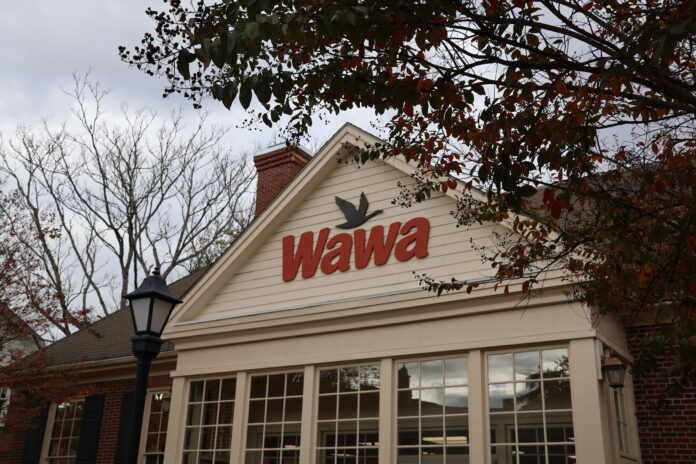
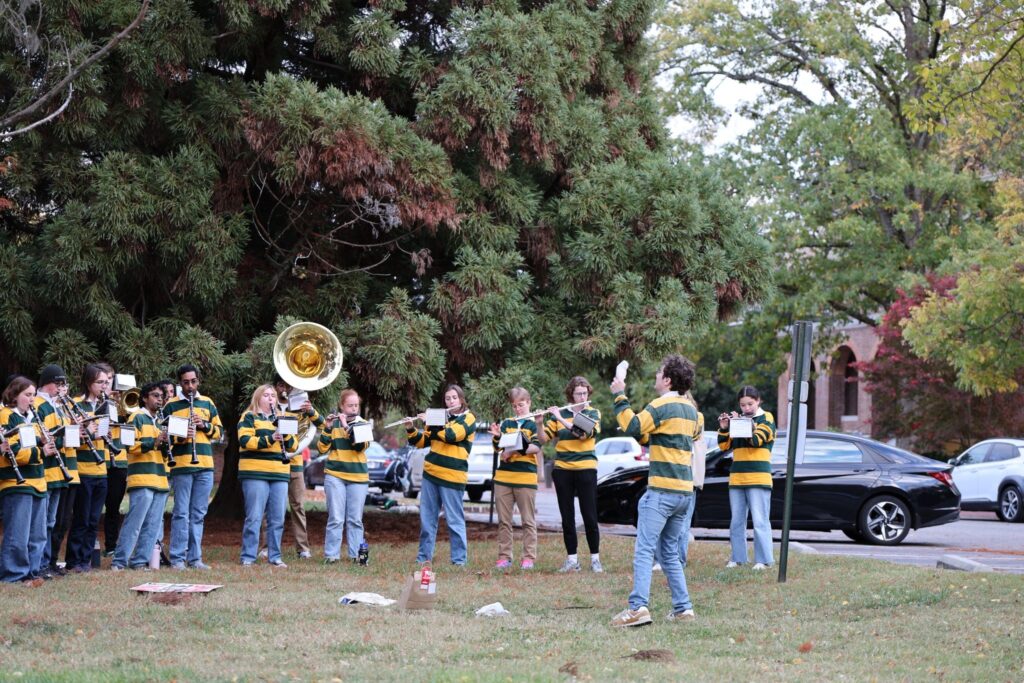
Friday, Nov. 13, the College of William and Mary’s Pep Band hosted a “Save the Wawa” performance on the Dawson Circle Lawn, uniting to demonstrate support for the Wawa on 315 Richmond Road amid its impending closure Wednesday, Dec. 16.
Joey Calisti ’27, director of the Pep Band, said the idea for the performance originated with his father after the two discussed the location’s closure. Calisti said the band began planning the event approximately a week in advance, officially announcing it Wednesday, Nov. 11. Within days, the event attracted widespread attention on social media.
“I think a lot of the activity on Yik Yak and Instagram was the most attention the Pep Band has ever gotten from the student body,” Calisti said. “I’m hoping that with this turnout, maybe they’ll reverse the decision. I mean, I know it’s all corporate stuff, but I’m hopeful, and I just think it was a nice way for the community to come together.”
The Pep Band performed Wawa-themed renditions of popular songs, including “Wawa Fight Song,” “Hey Wawa (Hey Baby!)” and “Take Me Home, Richmond Road.” The band also adapted the College’s Alma Mater, replacing the lyrics “Hark upon the gale” with “Wa Wa Wa.”
Calisti said the performance reflected the importance of Wawa to students beyond its sentimental value. He emphasized the location’s role in providing accessible food and coffee during late-night hours and inclement weather.
“I know I’ve seen some people dismissing it as not a real issue, but when it comes to food on campus and food availability, I think that’s actually a bigger issue than people realize surrounding this Wawa,” Calisti said.
Calisti said he initially hoped to hold the performance on Wawa’s property and contacted the location’s management to seek permission. After being referred to the company’s public relations department, Calisti said he exchanged voicemails with a representative but was unable to finalize arrangements. The band ultimately decided to hold the performance on College property instead.
“We just reviewed some of the rules about stuff on campus to make sure that we weren’t breaking any rules,” Calisti said. “But other than that, we planned this ourselves.”
Calisti added that the Wawa closure could create a gap in late-night dining options. He suggested that the College should consider extending the operating hours of campus convenience stores and dining facilities, including the Marketplace at the Campus Center.
Tuesday, Nov. 10, College President Katherine Rowe addressed the impending Williamsburg Wawa closure during a Student Assembly Senate meeting. She expressed disappointment over the decision and outlined potential steps the College could take to address the loss of a nearby, late-night food option.
Rowe said neither the College nor the City of Williamsburg had received advanced notice of the closure from Wawa corporate. She added that the College and the City planned to jointly contact the company to voice their concerns and explore whether the decision could be reconsidered.
“Neither us nor the City had any communication from corporate,” Rowe said. “We will be acting together to see what might happen. When corporate entities make decisions, they are often not undoable.”
While acknowledging the College’s limited influence over Wawa’s corporate decisions, Rowe emphasized her commitment to addressing the needs the convenience store currently fulfills for students.
“I do have control about the needs, those are important needs to meet,” Rowe said. “I try to think about what’s in the scope of action of William and Mary and what’s aligned with our mission.”
Rowe added that she had already discussed the potential gap in food accessibility with Student Assembly President Nico Giro-Martin ’27 and planned to continue those conversations with City officials. She did not announce any specific plans to replace the services currently provided by Wawa.
Wednesday, Nov. 11, Senior Associate Director of University News Erin Jay and City of Williamsburg Communications Director Nicole Trifone provided The Flat Hat with a joint statement regarding the impending closure of the Richmond Road Wawa.
“Neither William & Mary nor the City of Williamsburg were consulted in this decision nor notified of it,” Jay wrote in an email to The Flat Hat. “We understand why the campus and local community are disappointed and concerned. We are both ready to engage with the property owner to identify the best options for that space moving forward.”
Deanna Sabec, media relations lead for Wawa corporate, also provided a statement to The Flat Hat acknowledging community disappointment over the closure and explaining the company’s process for evaluating store locations.
“We understand the disappointment surrounding the decision to close the store on December 16, and this was not a decision we made lightly,” Sabec wrote in an email.
Sabec explained that Wawa regularly evaluates its stores based on several factors.
“We review a number of factors, including store performance and the ability to expand or to make improvements necessary to the physical space to maintain or meet Wawa’s current operating and brand standards,” Sabec wrote.
Sabec confirmed that all Wawa associates at 315 Richmond Road were offered continued employment at another local Wawa store location.
The Flat Hat independently confirmed with an employee that store associates would be offered employment at another nearby location. Associates at the Wawa declined to provide further comment, referring The Flat Hat to corporate.
Sabec also said the store will offer free coffee Tuesday, Dec. 15, the last day before the store closes, as a token of appreciation to its customers.
Students and Class of 2029 Student Assembly leaders Daria Lesmerises ’29, Nate Acklie ’29 and Neha Baskar ’29 created an Instagram account to gather community support for keeping the Richmond Road Wawa open. The account has attracted widespread attention from students, alumni and Williamsburg residents, with its first post garnering approximately 120,000 views as of Wednesday, Nov. 11.
Acklie, Baskar and Lesmerises clarified that these efforts were separate from their roles in SA. Baskar said the group deliberately chose to organize independently.
“We wanted to keep it a separate initiative from Student Assembly because we thought it would mean more coming from the general population, like an anonymous account more or less, rather than people who are in student government,” Baskar said.
Acklie described the location’s significance to generations of students and Williamsburg residents. He said the campaign offered an opportunity to demonstrate the community’s appreciation for the business and its employees, regardless of whether the closure proceeds.
“If you told me two years ago that I would be spending a month of my time fighting for a gas station to stay open, I don’t know what I would have told you,” Acklie said. “But I think what’s been revealed over time is that this is something that really unites generations of William and Mary students. It unites people within this community.”
The students also plan to hold a rally near the Wawa Thursday, Nov. 19 at 5:15 p.m., coinciding with the College’s Board of Visitors meeting. Baskar said the timing was intentional, with organizers hoping to attract Board members’ attention and encourage them to support efforts to preserve the location.
“We’re hoping that as they’re [Board of Visitors members] ending their day, they will see the love that the community has for this Wawa and they would hopefully be able to help us if they have any connections in the industry,” Baskar said.
The demonstration will be across the street from the Wawa, on College property. The team met with Simón Franco, associate director of Student Unions and Engagement, to discuss permits. The organizers ask attendees to stay at least 25 feet away from a College building and refrain from blocking parking lots, sidewalks and public roads.
Lesmerises said even if the campaign fails to prevent the closure, it could encourage the College and local businesses to consider alternatives that would meet similar student needs.
“Even from this, if Wawa does close, we’ve at least communicated our needs to maybe local businesses that could fill the spot or just businesses in general,” she said.
The three Student Assembly leaders clarified that they do not anticipate using their roles in Student Assembly to fill the void created by the Wawa closure.
“It’s not anything beyond reposting it on our Instagram, I think just because we’re nearing the end of the semester anyways, and I feel like our initiative is as successful, if not more successful, as an independent initiative than it would be in Student Assembly,” Baskar said.
Rather than writing a bill through SA, Lesmerises said she could use connections through her role as class of 2029 president to fill Wawa’s gap.
The organizers said they intend to continue advocating for the location to stay open through its scheduled closure date. Wednesday, Nov. 11, Acklie, Baskar and Lesmerises also spoke to WAVY TV-10 about their efforts and planned demonstration.
“I don’t think we’re gonna give up on this,” Lesmerises said. “I don’t think we’re gonna have the rally and be like, ‘Well, that’s it.’ I think we’re gonna keep going until December 15th.”
Acklie acknowledged that the ultimate decision rests with Wawa corporate leadership but maintained that the campaign would remain meaningful.
“I think we have a higher chance by doing something and saying something than not by doing anything at all,” Acklie said.
Ryan Dikon ’30, who has Type 1 diabetes, said the Wawa on 315 Richmond Road is among the few nearby establishments that he can rely on for quick access to food and accurate nutritional information.
“I actually have this mapped out that if I am to have a diabetic emergency and I need rapid access to food, my best bet is going to be going to Wawa, going to Chick-fil-A or going to [the Food Hall at] Sadler,” Dikon said.
Dikon said he has encountered inaccuracies in nutritional information provided by College dining facilities, recounting an incident in which he administered too much insulin after relying on an incorrect carbohydrate count for a muffin served at Commons Dining Hall. He said the discrepancy resulted in a severe episode of low blood sugar that took approximately an hour to treat.
“At the moment, the two places that I can 100% count on for accurate nutrition information if I need food are Chick-fil-A and Wawa, the two chains nearby,” Dikon said. “And with Wawa closing down, the only place nearby that I can really depend on 100% of the time is Chick-fil-A, and that is very concerning.”
Dikon said the Wawa closure highlights broader concerns about food accessibility for students with medical conditions and dietary restrictions. He called for greater administrative oversight of nutritional information across campus dining facilities, particularly as the College prepares to open the West Woods Dining Hall.
Beyond nutritional transparency, Dikon emphasized Wawa’s proximity to student housing and its ability to provide food quickly, particularly for students living in the Jamestown Triangle residential area.
Dikon added that long wait times at the Food Hall at Sadler during peak dining hours can make it difficult to obtain food quickly. He also noted that students without dietary restrictions have expressed concerns about losing one of the few nearby establishments offering food around the clock.
“I know many people are very, very concerned with where they’re going to go in especially late-night circumstances with Wawa closing down because not everything is open 24/7,” Dikon said. “That was a really big benefit of Wawa.”
Giro-Martin praised the Pep Band’s performance as an opportunity for students to demonstrate their support for the Richmond Road Wawa.
“I thought the Pep Band rally was a fantastic opportunity for our students to show Wawa Corporate how much we care about this store,” Giro-Martin wrote in a message. “I was very glad to see a good crowd of people, and if the worst still happens, I’m happy that this can be a unifying moment for this community.”
Beyond the loss of an affordable, late-night food option, Giro-Martin spoke to concerns about the potential implications of Wawa’s closure for student safety. He stated that without a nearby, walkable convenience store, students seeking food late at night may turn to establishments farther from campus, potentially increasing the risk of impaired driving.
“I am of the same mind around late-night safety and have shared these concerns with the President’s Office,” Giro-Martin said. “If students lose this convenient and accessible store, they will seek out further-away options that require a car.”
Giro-Martin emphasized that even a single instance of impaired driving could endanger students and other members of the Williamsburg community.
“All it takes is one person to think they are fine to drive when they are most definitely not and risk the safety of everyone in that car, in the cars around them and the pedestrians that seek to move safely,” Giro-Martin said.