

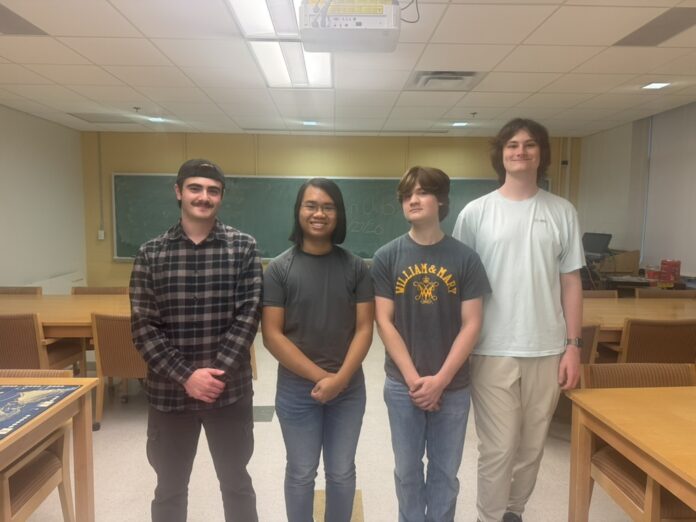
Nearly a century after Amelia Earhart became an honorary member of the College of William and Mary’s Aviation Club, the organization continues to bring aviation enthusiasts together. The club delves into several different areas of aviation, including military, commercial and civil sectors.
The club has gone through many variations, tracing its roots back to the 1930s. In fact, the College was the first university in the United States to incorporate a flight school into its academic program.
“We actually had our own airport and three planes,” club president Gabriel Cross ’29 said. “If you go to Special Collections in Swem, they’ll actually talk about it. Last year, we actually had an exhibit put out.”
Aviation Club is home to members with a variety of majors, ranging from accounting to international relations.
“I am studying to be an actuary,” Cross said. “I would like to do aviation as a recreational thing, which is why I’m working towards my private pilot’s license. So, I see the club as a great way to actually work towards it.”
On the other hand, club member Bryan Nguyen ’29 is considering a potential career as a pilot.
“I kind of set myself up on the path to more or less immigration law, but flying really excites me,” Nguyen said. “I wanted to try and get my private pilot license, see if it’s something I really wanted to dedicate my life to before spending a couple of years of my life becoming a commercial pilot, for instance.”
Meanwhile, member Cameron Sherr ’28 is not as interested in flying, and is instead pursuing a museum career.
“My interest in aviation is more about historical stuff: World War II aviation, Cold War aviation, military, that kind of side,” Sherr said.
Though the club’s passion for aviation is palpable, numerous challenges exist as a result of its presence in a liberal arts college.
“A lot of people who come to a liberal arts school aren’t exactly looking to be professional aviators because there are schools or colleges for that. So, we’re more of an enthusiast or fan club for now,” Cross said.
Nonetheless, the future of the Aviation Club seems promising. Recently, the club has received funding from a donor, which could give them the opportunity to travel to the local airport and get in the air. Additionally, the club now meets in Small Hall, home to the physics department.
“In the past, we were located in Washington [Hall] and didn’t have a very large connection to the physics hall, but this year I really worked on broadening a connection between physics,” Cross said. “I feel like this hall is more representative of what aviation actually is than just Washington, because here a lot of professors are actually interested in what we’re doing, and I find that the professors often inspire students to do it, as well.”
Cross elaborated on the connection between aviation and physics, noting that an interest in aviation displays concepts from physics classes in a hands-on context.
The club debuted one of their ongoing projects — a flight simulator — at PhysicsFest, an open house during homecoming weekend. Cross explained what the simulator will offer the club.
“The really cool thing about this is that it’s FAA-approved, and what that means is that without actually going onto the airfield and flying planes, which is usually expensive, we can still log hours towards our flight license. It’ll be done in early November,” Cross said.
Once the flight simulator, which is currently run on a computer, is completed, the club intends to turn it into a VR experience.
Members say they have gained a wider breadth of knowledge from Aviation Club by visiting local museums, participating in movie nights and assimilating with like-minded individuals who share their passion. Nguyen added that learning more about aviation helped him open his mind to the field’s interdisciplinary nature.
“Academia is so well-regarded because it’s just a useful skill to have to think in different ways about a particular subject, and this could really help me develop that skill,” he said.
Cross notes how the club helped him expand his aviation knowledge as well as his friendships on campus.
“I definitely wasn’t as knowledgeable as some of the members here, and I found that I definitely improved on what I know,” Cross said. “Although I’m not an expert by any means, the club means a lot more to me than just planes and stuff. It’s a place where I go to make friends.”
