

Michael Gabriel ’28 is a history major. Besides writing and editing opinion pieces, he contributes an issue of his Willy and Mary comic almost every edition. He is a big baseball fan, likes the outdoors and is always happy to talk to anyone about anything. Contact him at mdgabriel@wm.edu.
The views expressed in this article are the author’s own.
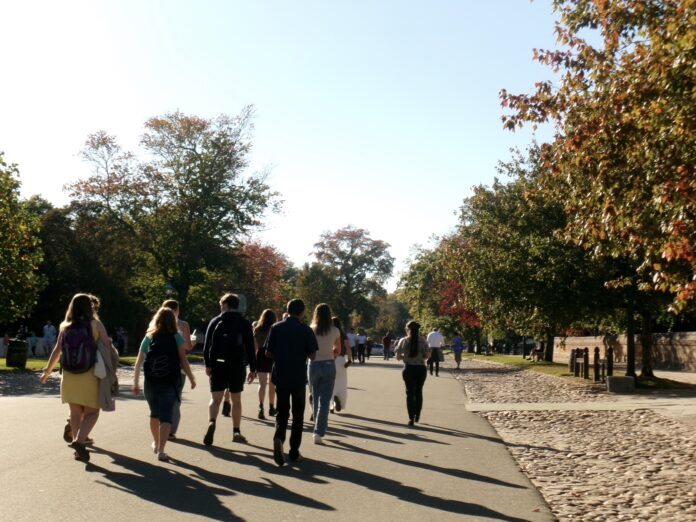
When I got to campus as a freshman, walking came naturally. I grew up in Brooklyn, New York, so I could walk to the park, the grocery store, my friends’ places, church, etc. Walking to and from the dining hall and classes felt about the same. College campuses really are great in terms of their walkability, but outside of them and some of the nation’s larger cities, the walkable city or town is somewhat nonexistent. Even in really urban places like Brooklyn, cars still tend to dominate.
Now for what it’s worth, Williamsburg is pretty walkable, especially when you realize that most of the city is made up of our campus and Colonial Williamsburg, but I can’t help but imagine what it could look like if we put a greater emphasis on walkability. Williamsburg is also home to so many local businesses (especially if you’re into pancake houses), which is great, but you really do need a car if you want to explore them all.
Merchants Square at the start of Duke of Gloucester Street, while tourist-centered in nature, speaks to the benefits of walkable areas. There is a mix of storefronts, restaurants and community spaces all within close proximity to one another. Yeah, you may not be looking to buy a Christmas ornament in April or a Scottish kilt for your student org’s formal, but it’s possible (there really are some random stores there). Now, imagine if some of those more high-end and niche businesses were replaced or supplemented by ones catered towards students and members of the greater Williamsburg community, rather than tourists? Imagine too that that sort of urban planning scheme extended down Richmond Road and Jamestown Road and up the random side streets.
The farmers market and Second Sunday both set up shop in those side streets of Williamsburg, drawing huge crowds of tourists, students and locals alike. Yes, part of the reason they’re so well attended is the novelty of outdoor street fairs. People choose to take time out of their weekends to make the trip to Williamsburg just for that reason. If we were to have more year-round businesses in this area, we’d need more foot traffic to support them, and in order to have more foot traffic, we would need more people to live here.
The Midtown apartment complex in particular does a good job incorporating apartment housing with businesses, allowing its residents, largely students, to be able to just walk downstairs and pick up some food or take a quick walk over to the adjacent shopping centers. The issue is that it is a little bit of a trek from campus, so many students still rely on their cars to get to class in a timely manner. It is also just more convenient to drive.
I believe that the perfect combination would be to have more storefronts right off campus with apartment housing above and behind. Of course, it should be tasteful, fitting in with the architecture of the surrounding areas. There are already examples of this here in Williamsburg. Following Prince George Street from Armstead Avenue to North Henry Street, you’ll see multiple restaurants and stores with apartments above. The Aromas café and Oishii sushi restaurant, both located on this stretch, are popular establishments among students and locals alike. They are also extremely accessible to the College of William and Mary’s underclassmen who don’t have cars to drive to the places off campus. They are also more than convenient for the people who live upstairs.
The College itself has also made an attempt at replicating this format with Tribe Square, which opened in 2011 with space for four restaurants and housing for 56 students. Today there is just the Chick-fil-A and the William and Mary Entrepreneurship Hub, but the bones are there.
Now, I’m not saying we should start building modern high-rises and turn Williamsburg into a metropolitan city. That would mess up the whole character of the city and would probably send a colonial reenactor into shock. However, I do think there’s something to the tree-lined main streets, packed with bustling storefronts and people living their lives. This whole line of thinking has just been a thought experiment. We are really fortunate to go to school in such a unique environment that encourages us all to walk and explore. At the end of the day, I guess any place is walkable. It just depends on how far you’re willing to walk.
