

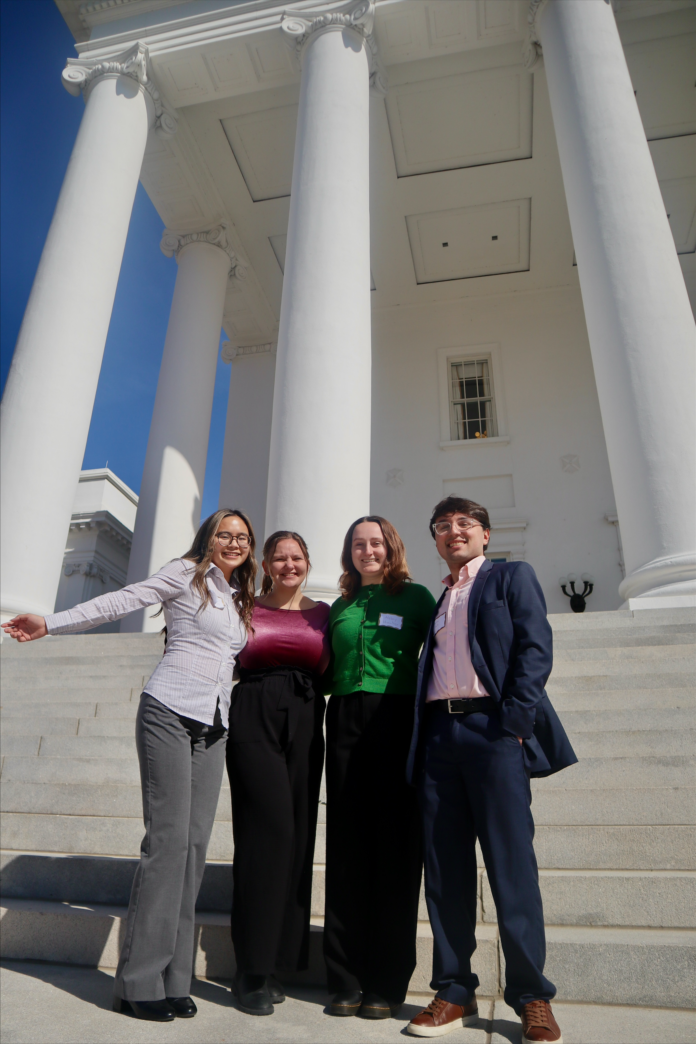
Citizens’ Climate Lobby is an international grassroots organization that uses collective action to promote and support environmental policy, with a focus on bipartisan regulations. With chapters across the United States containing volunteers of all ages and experience levels, the organization stresses that anyone can participate in advocating for policies that lower the country’s carbon footprint and advance clean energy.
The College of William and Mary’s chapter of CCL advocates for action to mitigate climate change on both the national and local scale. The club welcomes students of all backgrounds and levels of interest, focusing on creating an environment of respect with the central idea of building on their shared values to enact climate-conservational change.
Nationwide, the organization’s efforts include optimizing the permit process for clean energy projects.
“Something like 90% of energy and infrastructure projects waiting in the permitting queue are clean energy,” co-president Noa Rudisch ’27 said. “So one of our goals is to make that process more streamlined in order for us to build up our clean energy and transmission capacity.”
The organization is also working to promote the Carbon Fee and Dividend, a market-based policy that would lower the country’s reliance on carbon-based energy.
To accomplish these goals, the College’s CCL chapter communicates with Virginia representatives and partners with local organizations, including the Chesapeake Climate Action Network. This organization unites states in the Chesapeake region in a movement toward climate sustainability while taking advantage of their proximity to Washington, D.C. to inspire action nationwide.
“Right now we’re looking at the climate impact of data centers and looking at how we can create environmental policy that is thinking about moratoriums on data centers and policies that curb the environmental impact of all the data centers that are being implemented in Virginia,” Rudisch said.
They are also working to pass the Make Polluters Pay Act in Virginia, which aims to hold big corporations accountable for the climate damage caused through their carbon emissions.
The CCL offers a range of ways to get involved in advocacy and lobbying while fostering a welcoming atmosphere for its members. Meetings take place every Wednesday from 6:30-7:30 p.m. in Tucker 123, and usually consist of discussions about current policies that the club is working to promote. Members also take time to learn from one another by sharing their personal experiences relating to the climate crisis.
“People really get to share their own perspectives of where they live, because a lot of people at William and Mary, they’re from around the states and some are experiencing droughts, wildfires, polluted rivers,” co-president Olivia Parker ’27 said.
CCL’s treasurer, Matthew Peralta ’27, said that through the club, he was able to gain more awareness of the environmental issues in Florida, his home state.
“Florida has dealt with a number of climate impacts, rising sea levels, degradation of the local beaches,” he said. “That’s made me more conscious of my home environment as well.”
Outside of discussions, the club takes actions to promote real change. Vice president and outreach chair Gavin Hoyt ’28 transferred to the College in part because of a lack of environmentally-focused clubs at his previous school. CCL immediately stood out to him as a place to channel his commitment to the environment into something productive.
Parker explained that a crucial part of CCL is their work to maintain connections with Virginia state legislators.
“On the local side, we have connected with Jessica Anderson, and we were just figuring out her perspective on the data centers and the conversations that happen within the General Assembly,” she said. “It’s creating connections with our local delegates that’s been really nice, to be able to introduce the Williamsburg side and understand Hampton Roads and rising sea levels.”
The club also writes gratitude cards to legislators and has collaborated with the Environmental Voter Project to send letters to magazines. These letters were ultimately published in outlets from the Virginia Dispatch to the Washington Post.
“The idea is we’re just really trying to spread awareness of our policies and also connect with our local legislators here in Williamsburg, because what’s really interesting is that they’re very receptive to hearing our goals and our worries,” Parker said.
CCL at the College also provides the opportunity for members to lobby at the nation’s capitol. Every summer, the club participates in a two-day conference to lobby on Capitol Hill for two distinct policies. The cost of this event is covered for organization members. Parker noted that members can see their efforts with CCL generate tangible results for environmental legislation.
“What’s really inspiring is that one of the acts that I did my freshman year has now passed. It’s called the Prove It Act, and it’s now written into law,” she said.
The College’s CCL chapter communicates with other campuses’ chapters, including Bowdoin College and the University of Michigan, and also with other community chapters containing volunteers of all ages and backgrounds.
Rudisch stressed the value she has found in connecting with members of CCL who have more life experience.
“A lot of our volunteer base is retired, and so it’s really cool to make these connections and learn from people of all ages about why they’re passionate about climate and connect on that,” she said.
Rudisch, Parker and Hoyt each found Chris Weigard, CCL’s Virginia coordinator, to be of particular influence. Rudisch noted that she gained lobbying knowledge and media literacy skills from Weigard’s expertise.
Members can get much more out of the learning opportunities and connections offered by CCL than they might have first expected. Peralta first joined the organization with an interest in lobbying politicians and did not previously have much interest in environmental issues. However, he said that he gained a newfound understanding of the impacts of climate change through CCL and that it drove him to further explore environmental policy through his classes.
Following the midterm elections, there will soon be more representatives both in Virginia and nationwide looking to pass clean energy bills. Peralta emphasized the club’s hope that permanent reform efforts in the Bipartisan American Affordability and Jobs Act, which includes measures on clean energy, will soon pass.
“It’s going to take more work and more compromises between the two houses, of course,” he said. “But in general, there’s a lot more friendly faces for climate in the House and in the Senate now, and we are excited to lobby our new representatives.”
Matthew Peralta ’27 was formerly on The Flat Hat staff but is no longer involved.
