
Thursday, Nov. 5, the College of William and Mary’s government department hosted a panel discussion on the Democratic Party’s historic defeat of Republicans in the 2026 midterm elections.
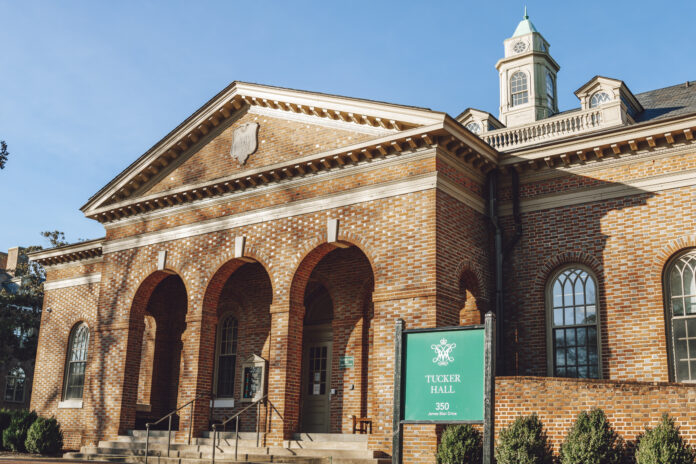
Held in the Tucker Theater, the event featured Newton Family Professor of Government C. Lawrence Evans, Harriman Professor of Government and Public Policy Chris Howard, Associate Professor Mackenzie Israel-Trummel, Chair of the Government Department Jaime Settle and George and Mary Hylton Professor of International Relations and Director of the Global Research Institute Mike Tierney ’87.
Class of 1935 Professor of Government John McGlennon helped moderate.
Evans emphasized the importance of Democrats flipping Senate seats in traditionally red states.
Evans said the way Senate elections are staggered could mean Democrats maintain control of the chamber through 2028 and 2030.
“We may be looking at a six-year stretch with Senate Democratic control,” Evans said. “It’s not a lock, but it’s not unlikely now. The ramifications of that are massive.”
Howard noted the restrictions placed on Supplemental Nutrition Assistance Program benefits, Medicaid and Affordable Care Act subsidies.
“One fairly safe prediction is that Democrats and Congress will try to reverse, postpone and delay all of those cuts to the Affordable Care Act and to Medicaid,” he said.
Howard added that Republicans likely will not work with Democrats to reverse these cuts.
“A lot of the more moderate, less conservative Republicans just got kicked out of office,” he said. “So the folks who were going to be around in January to band together for overriding vetoes probably aren’t going to be in much of a mood for overriding vetoes.”
Israel-Trummel argued that polls did not overestimate Democratic support, despite some questioning before the elections.
“Errors can, and still do, swing both ways,” Israel-Trummel said. “Last year, polling in Virginia underestimated Democratic support in the gubernatorial election and in the state house election. The election this week showed the same.”
McGlennon highlighted the South’s record voter turnout.
He categorized the “blue wave” change into three groups: African Americans frustrated by the Supreme Court’s hollowing of the Voting Rights Act, Hispanic voters concerned about the economy and extreme deportations and a region-wide surge in young voters.
“In terms of the Electoral College, [the Republicans’] great advantage has been a unified South,” McGlennon said. “If they can’t depend on Texas, Georgia, North Carolina and other Southern states, then their road to the White House becomes much harder.”
Settle said concerns about an increasingly partisan election administration and the validity of methods and results were not significant issues. This was largely due to Democrats’ early and clear lead, she said.
Tierney said he does not expect significant changes to U.S. foreign policy following Democrats’ victories.
Tierney connected the midterm elections to the rejection of far-right leaders worldwide, such as in Hungary, Serbia, Israel and Brazil.
Tierney said he believes the United States’ global standing likely will not change.
“European leaders and Canadian leaders decided more than a year ago that the United States could not be trusted,” Tierney added. “This doesn’t mean they can’t trust [President] Donald Trump, or Trump’s administration. They can’t trust the United States.”
Tierney also predicted renewed strikes on Iran before the new congressional term begins.
The discussion then shifted to audience questions. Madeleine Fuller ’30 asked Israel-Trummel about the possibility of reforming polling practices.
Israel-Trummel highlighted the importance of sound public opinion research while criticizing polling firms’ tendency to engage in horse-race coverage. She said many of the United States’ polling issues stem from problems with money in politics.
“I think part of the struggle here is that [the issues with polling] isn’t an individual person-led phenomenon,” Israel-Trummel said. “The sad answer I have for you is I don’t actually think there’s a lot that you can do.”
Settle echoed a similar sentiment.
“You cannot separate this from the changes in our campaign finance system and the amount of money in politics,” she said.