

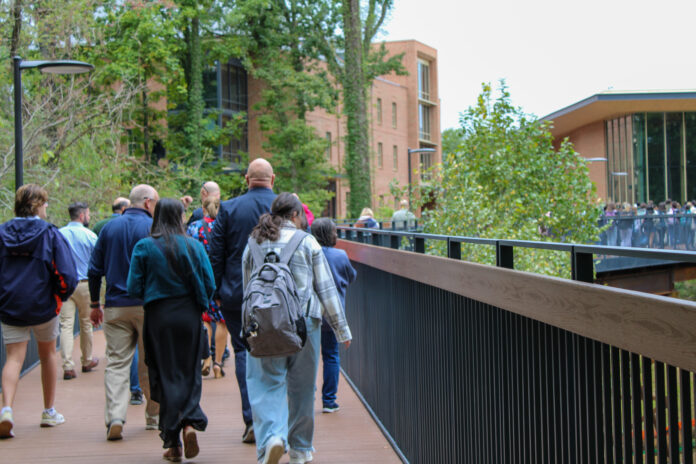
Tuesday, Oct. 14, students and community members from the College of William and Mary gathered for a ribbon-cutting ceremony hosted by Student Affairs to commemorate the opening of a new pedestrian bridge connecting the Student Life Neighborhood to the new West Woods housing complex.
The event began with brief remarks from the Senior Vice President for Student Affairs and Public Safety Ginger Ambler ’88, Ph.D. ’06.
Ambler explained how this pedestrian bridge came from the university’s comprehensive facilities plan for housing and dining.
The comprehensive plan, unveiled in 2022, is a long-term proposal for modernizing and revitalizing campus residential and dining facilities.
“That [plan] envisioned moving students to both sides of campus through this beautiful walkway, envisioned as the Student Life Walk,” she said. “And so, today, we are celebrating the completion of the Student Life Walk.”
Ambler was appreciative of everyone who contributed to the project.
“I’m just so grateful to everyone over these last 10 years that has dreamed, visioned and, especially in the most recent months, labored hard to bring this to place,” she said.
Ambler specifically thanked Kelly Crace, former associate vice president for Health and Wellness; Maggie Evans, associate vice president for Campus Living; Ambler Hall, project manager; Dan Pisaniello, university architect; Tim Dean, director of Design and Construction; Ron Russell, construction manger; Sean Hughes, chief business officer and Marra Austin, deputy chief business officer, for helping bring the pedestrian bridge together.
After Ambler’s remarks, Student Body President Zoe Wang ’25 MPP ’26, class of 2027 Sen. Mayer Tawfik ’27, Stamps and 1693 Scholar Cedrick Dimaranan ’27 and Thomas Riley ’27, representing the Residence Hall Association, had the honor of cutting the ribbon.
Once they cut the ribbon, everyone at the ceremony participated in the first official walk over the bridge to the West Woods complex.
After the event, Dimaranan explained how his environmental proposal helped with the construction of the bridge.
He recalled a conversation he had with professor Randolph Chambers, who teaches biology at the College and serves as the director of the Keck Environmental Field Lab, where Chambers asked Dimaranan if he had any ideas for a sustainable policy proposal that could be funded by the College’s Green Fee Fund.
Dimaranran initially proposed paving over unfinished walkways around campus with permeable pavement, which would improve sustainability by reducing water runoff and erosion in these areas.
He took this idea to Tony Orband, associate director of Grounds and Gardens.
“I presented this idea to Tony Orband, and what he told me was that because these [unfinished pathways] are part of active construction zones, it probably wouldn’t be the best idea to do something permanent like that because of the fact that they’re going to get paved over,” Dimaranran said.
Obrand instead suggested to Dimaranran about incorporating his permeable pavement idea into the pedestrian bridge project and have it be funded by the Green Fee Fund. Dimaranran went with the idea.
“Essentially, what transpired afterwards was me typing up the [new] Green Free proposal and collaborating with Amber Hall, who was the project manager, and then also Dan Pisinello, the university architect,” Dimaranran said.
Dimaranan’s new proposal called for placing permeable pavement on the pathway, near the McLeod Tyler Wellness Center and Sadler Center, that led toward the bridge.
His proposal won a $60,000 grant, paid by the Green Fee Fund, which covered the cost of upgrading the impermeable asphalt that was originally going to be on that pathway to permeable pavement.
Dimaranran was optimistic about the bridge, specifically as it relates to improving accessibility on campus.
“This bridge allows us to help with the accessibility of people who may not be able to make it down the winding asphalt trails through the woods that have different gradients and different slopes that make it difficult to traverse,” he said.
Wang also shared how she thought the new pedestrian bridge would improve the students’ lives.
“Well, I think it’ll get students who are living in West Woods to class faster,” she said.
Wang thought the bridge could do a good job in connecting West Woods complex to the rest of the campus.
“I hope it serves as a connection point for students who are living in West Woods to the old campus and to the rest of the university,” she said.
Hughes came to watch the ribbon-cutting. He explained how his role as the Chief Business Officer to the College helped with the project.
“Part of what the Chief Business Officer oversees is facilities and construction, so we built it and [are] happy to support Ginger in opening it,” he said.
Hughes went on to explain how he envisioned the bridge contributing to the community at the College.
“One, I think it’s a really picturesque spot on campus,” he said.
Hughes talked about the functionality of the bridge in improving transportation around campus.
“It cuts down the transit time for these 939 beds back to Sadler,” he said. “And I think it’s a prototype of sorts for how we might move people around campus elsewhere as well.”
Hughes mentioned how the university would try to create more of these bridges in other places where they might be needed.
“If you look in the comprehensive plan, we have another bridge shown that drops next to the library as well,” he said. “We’ll be doing more of these where it makes sense.”
Hughes finished his thoughts by expressing gratitude for students being patient as these projects continue to develop around the College.
“We’re really excited to open the remainder of the project, and we appreciate the student body’s patience as we get there,” he said.
Correction (10/27/2025): Article was updated by the Standards & Practices Editor to correct the spelling of Ginger Ambler’s name.