

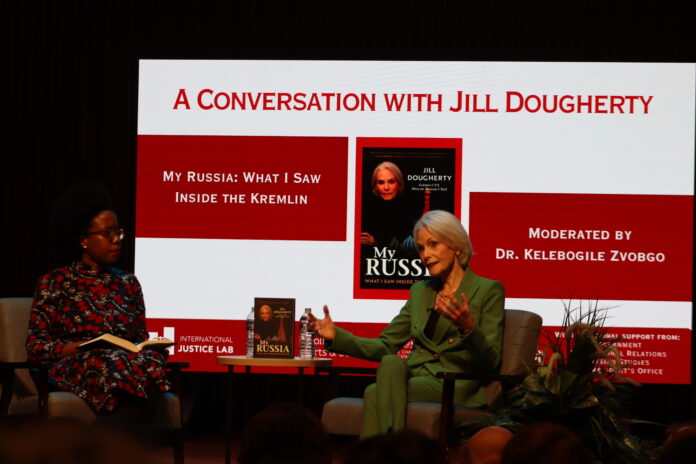
Thursday Nov. 13, the College of William and Mary’s International Justice Lab hosted a moderated conversation with former Moscow Bureau Chief for CNN Jill Dougherty. This discussion centered around her career and new book, “My Russia: What I Saw Inside the Kremlin.” The International Justice Lab is a collaborative effort between students and faculty to research human rights, international law, social justice and more. The project leader, Mansfield Associate Professor of Government Kelebogile Zvobgo, was the moderator of Thursday’s discussion.
The event began with a brief retelling of the events of Dougherty’s book, as well as her background and relationship with Russia.
Zvobgo spoke on how Dougherty’s background gives her a strong understanding of Russia and how its historical memory is pervading current politics. Dougherty herself represents the furthering of discussions surrounding changing world affairs and their impacts. From Russia’s ongoing invasion of Ukraine to the transfer of power to Putin, there have been many significant changes and developments with far-reaching consequences.
Dougherty learned this history through living in St. Petersburg as an exchange student at Leningrad State University, then through journalistic pursuits such as Voice of America and CNN. She reported on the presidencies of Gorbachev, Yeltsin and Putin, allowing her to watch Russia’s evolution over the years.
Dougherty came to love Russia. While explaining her time in Russia as a twenty-something American exchange student Dougherty stated that, despite its obvious shortcomings, she found it to be beautiful. She remarked that there was no shortage of art, opera, ballet or concerts to engage with. Yet, at the same time, her college dorm was bugged. She and her roommate were followed around, listened to, and socially segregated for their American identities.
At the time, the Soviet Union heavily restricted its youth. Travel, literature, newspapers and the internet were all banned. Because of the jammed information pipeline, Dougherty explained that Russians were often kept in the dark.
“They didn’t know things about their own culture,” Dougherty said.
Despite this, Dougherty became a Russian language broadcaster and writer for Voice of America radio. During the discussion, she spoke on how this radio program was always jammed to stop the sound from reaching people, another example of how much of a closed society the Soviet Union was.
Eventually, Dougherty found her way to CNN, where she worked for 30 years. She held the roles of Moscow bureau chief, White House correspondent, U.S. affairs editor, and more. While working in Russia, Dougherty watched the Soviet Union die, as Boris Yeltsin came into power, and as Putin morphed into the leader he is today.
“Vladimir Putin, there was a lot of optimism and his ability to be a reformer in that context.” moderator Zvobgo said.
Dougherty agrees. When Putin campaigned, he was viewed as someone who said the right things and looked good doing it. Dougherty said that many assumed, because of his family’s tragic experiences with the Nazi blockade in World War II, that he would be a strong protector of Russia and its people. Despite this, we can see that Putin’s Russia is one characterized by war, discrimination, restricted press and human rights violations.
Once in power, Putin began to express his resentment towards the West. He felt that the West tricked Russia into making itself a “second-class country,” according to Dougherty.
Dougherty says that the issues we can see with Russia today, where the government is overly controlling and hungry for war, reflect the mentality of its people. Dougherty explained that, since there was a large failure to integrate Russia into the West, Putin felt he had a chip on his shoulder, resulting in a stark divide between these two parts of the world.
All of this information provides important context for the Russia we see today. These kinds of events are good for bringing light to these issues while also spurring political action and education among students.
“It’s really about, you know, training up students to understand their role in this world, the agency that they have, and their ability to participate in political life, whether domestically, states, locally even,” Zvobgo said.
The far-reaching nature of these topics furthers integration among departments on campus. While this event was primarily sponsored by the government department at the College, it also garnered support from a wide range of hosts, such as Russian, East European and Eurasian Studies, international relations, the Charles Center, the Global Research Institute, Arts and Sciences, and the President’s Office.
“It fosters connections. We can certainly meet people who can discover something you may not have known that you like,” attendant Thelma Kestner ’29 said.
There are other benefits besides meeting new people, such as learning novel ideas and engaging in conversation that enriches the mind.
“Even if it’s just like making it a point to go to one event a month that is just totally outside of your wheelhouse, to just learn something new,” Tiffany Clark, fiscal coordinator for the government department, said.
One of Dougherty’s principal points emphasized how Russia has declined in the past half-century because the Russian youth has historically been stripped of the freedom to dissent in their speech and beliefs, which Clark explained is a great privilege to have in America.
“Having this academic freedom to be able to say, ‘hey, this is a very unpopular opinion, but it is a legitimate one,’ has helped foster this kind of environment that is open to maybe unusual or unconventional ideas, but also allows us to generate discussion, discourse and help us progress,” Clark said.
