

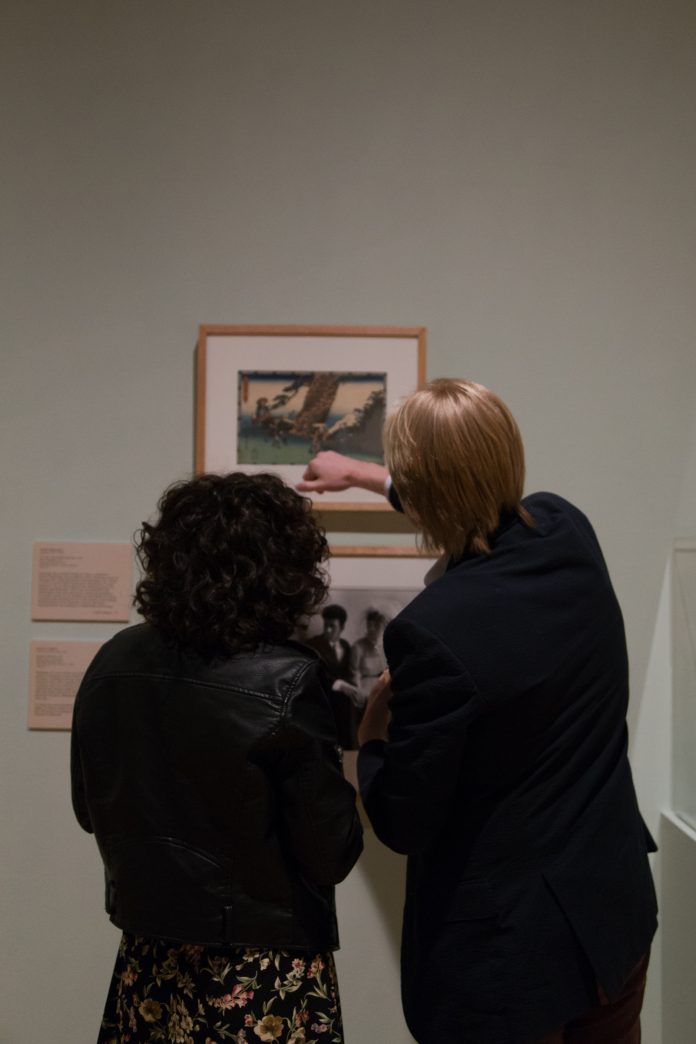
Thursday, Nov. 6, the Muscarelle Museum of Art held a book talk for Alan C. Braddock, chair of the department of art and art history and Ralph H. Wark Professor of Art History, Environmental Humanities and American Studies at the College of William and Mary. Braddock gave a presentation on “Nature’s Nation,” a book published in 2018, which he produced alongside Karl Kusserow, currently the John Wilmerding Senior Curator of American Art at the Princeton University Art Museum. After his presentation, he conversed with and answered questions from Muscarelle Museum’s Director David Brashear.
Brashear began the book talk by first highlighting other events the museum would be holding, such as the Liquid Commonwealth exhibition.
“I’m really thrilled to be able to announce the opening next Friday of our show ‘Liquid Commonwealth’ that we’ve done in conjunction with the department of art and art history, and the art history component’s curatorial class for this fall. It is a juried exhibition, inviting artists to come and present works for consideration into the exhibition,” Brashear said.
Brashear explained that Braddock’s class reviewed hundreds of project submissions, selecting 50 for exhibition at the Muscarelle Museum.
“The class, led by Professor Alan Braddock, worked through 777 submissions from artists across the commonwealth, and the result is about 50 works being displayed in galleries 1, 2 and 3 that take a look at the importance of water in the daily life of Virginians,” Brashear said. “And that members’ opening will be next Friday, and then we’ll be opening the exhibition beyond that starting on Saturday.”
After these highlights, Brashear introduced Braddock and his book.
“So it [“Nature’s Nation”] was published in 2018, and ‘Nature’s Nation’ accompanied a traveling exhibition, co-curated by Professor Braddock and Professor Kusserow, winning three major awards by the way,” Brashear said.
Braddock soon took to a podium at the front of the room; his opening remarks included a description of “Nature’s Nation.”
“It’s kind of an academic book, but its ambition is to kind of rewrite American art history from the perspective of ecology and environmental history,” Braddock said. “And so, I fit into this series that the Muscarelle has been doing with some very interesting speakers.”
Braddock appeared to be referencing other environmentally focused events that are part of Muscarelle Explorations, which Brashear also discussed earlier.
Braddock went on to discuss the formation of “Nature’s Nation,” both the book and the exhibit. He included information about his other scholarship on the intersection of art with the environment, such as his book “Thomas Eakins and the Cultures of Modernity.”
“For years, for about a quarter of a century now, I’ve been doing art history, teaching and writing and researching in art history, focusing on relationships between works of art and the environment that began with the book on Thomas Eakins, the great realist painter from Philadelphia, known for his pictures of the people of Philadelphia, as well as the outdoor spaces, the environments of the Philadelphia region,” Braddock said. “And I pointed out in that book that despite his vaunted realism, he was very careful to avoid some of the uglier truths about Philadelphia, its industrial history, pollution and whatnot. And so that book provided a different perspective on that artist and the meaning of realism.”
Another one of his earlier works, “A Keener Perception,” led to Kusserow contacting Braddock and, eventually, to “Nature’s Nation.”
Both Braddock’s research and the courses he has taught reflect an interdisciplinary outlook on teaching and studying art.
“More recently, I developed a course called ‘The Environmental Humanities: An Introduction,’ which is really reaching across disciplinary boundaries, and it’s meant to start a conversation with students in literature, in the arts and sciences and social sciences, about ‘How could we think creatively about environmental issues?’” Braddock said.
On “Nature’s Nation,” Braddock noted the project’s large scope, including the various authors and perspectives that contributed to it. He emphasized this here and throughout the event, the role of Indigenous people in environmental art history.
“And as we had more and more conversations with our curatorial colleagues at other institutions, we realized how necessary this was, especially bringing in Indigenous people’s voices in a book about American art and environmental history,” Braddock said. “That was necessary because the environment is an essential component of the cosmology and spirituality of Indigenous people across the continent.”
The book’s purpose focused on re-examining and revising American art history.
“This book is in some ways a more ambitious effort to retell the whole history of American art, going back hundreds of years, and broadening the scope to show how artists have not only depicted the environment at different points in time, but how they have imagined better futures and more sustainable visions for the future,” Braddock said.
He transitioned into an analysis of these themes with “The Grand Canyon of the Yellowstone,” painted by Thomas Moran in 1872. Braddock discussed how landscape painting impacted America’s conservation movement.
“And the landscape genre, the artistic vocabulary of landscape painting, the astonishing explosion of colors and majestic vista that you see in this and other works like it in the 19th century, make it clear that landscape painting was central to the evolution of an environmental consciousness — a modern environmental consciousness,” Braddock said.
Braddock shifted towards another factor in the American conservation movement and its art: Indigenous marginalization. He noted the contrast in the depictions of a Native American man and a white man in Moran’s work. While the white man faces the canyon, Braddock explains that, in Moran’s eyes, the Native American man was unable to appreciate the canyon’s beauty, so he faces away from it in the painting.
“But Moran viewed the Native American man as unable to appreciate that [Yellowstone], and therefore turning his back to him,” Braddock said.
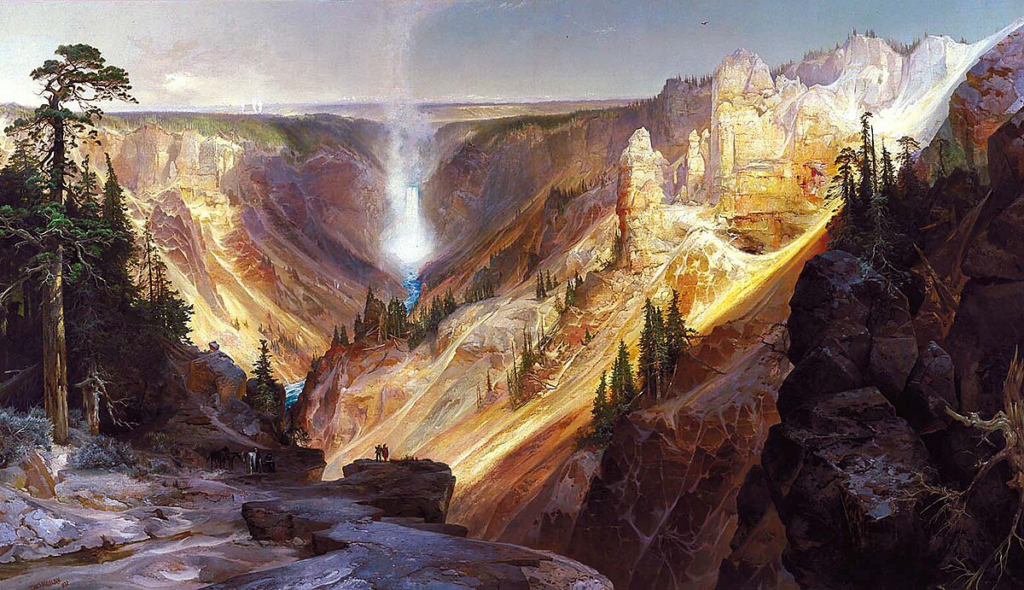
The image above, “The Grand Canyon of the Yellowstone” by Thomas Moran, is from Wikipedia.
Braddock detailed other depictions of Indigenous peoples, including newspaper reports and Indigenous art such as Jaune Quick-to-See Smith’s “Browning of America.”
“She wrote for the catalogue and wrote for the book [“Nature’s Nation”], and lent works to the exhibition, including this one that shows the United States as a kind of map, with starkly drawn boundaries,” Braddock said. “But the entire map is overridden with indigenous symbols as a way of showing the historic and ongoing presence of indigenous people, crossing the borders, crossing the boundaries, being part of the environment, the American environment.”
Braddock then dug into the main themes of “Nature’s Nation” and explained why they were chosen.
“The exhibition was organized in three sections: colonization and empire, industrialization and conservation, and ecology and environmentalism,” Braddock said. “And as those section titles suggest, the exhibition project was meant to tell a story of the emergence of what we now think of as modern ecological consciousness, which is not the same as the environmental perspective of people in the past, and yet we saw glimmers and inklings of that modern consciousness in historical works of art.”
On colonization and empire, Braddock discussed various philosophical and ethnic perspectives on the environment.
“Many of these early, colonial works of art tried to present nature as a kind of orderly place that could be organized and understood through science and religion,” Braddock said.
He used as an example a piece by Spanish-Indigenous artist and missionary Diego de Valadés.
“And learning about Catholicism in Mexican, in Spanish schools, this artist, Diego de Valades, presented in this print at left, a vision of the Great Chain of Being, a kind of European, Christian view of nature as a hierarchical, organized system, with God and the angels at the top, with echelons of beings below — humans, animals, stones, and then Hell at the bottom —- a very kind of stark, rigid, systematic way of understanding nature,” Braddock said.
Braddock then explained a transition in thinking in the 19th century, seen in works by John James Audubon.
“And in Audubon’s work, you see this new, kind of more romantic, vision of nature as a dynamic place of violence and change, not order,” Braddock said. “You see close-up views of birds in midair, in flight or at right, the Carolina parakeet, a species now extinct, whose extinction Audubon even foreshadowed with some of his comments about how farmers were shooting them too often and too much. And his work even makes these so-called animals quite alive and dynamic, almost like people with their visceral power and visual energy. One of them even looks out at us as we look at the work of art.”
Braddock also mentioned Maher Curatorial Fellow of American Art at Harvard Art Museums Laura Turner Igoe, who contributed to “Nature’s Nation” by examining the impact of furniture production on Jamaica’s environment, and more generally, the origins of the media artists utilized.
Braddock moved on to industrialization and conservation, a theme that emphasized how industry changed the environment and human lives. He began with a piece from David Gilmour Blythe on the oil industry.
“So he shows us this kind of drifter figure, who’s probably a self-portrait of the artist, holding a jug of liquor and all the possessions that he has over his shoulder, and a bag of worthless greenbacks, because the inflation that is being caused by the new industry is altering the economic landscape as well as the environmental landscape,” Braddock said. “And he stares at signs advertising new opportunities for petroleum extraction. Meanwhile, the landscape in the background shows oil derricks, and smoke, and environmental devastation.”
Braddock emphasized the rarity of such a depiction as opposed to a more positive one. Braddock also discussed portrayals of cotton farming.
“Winslow Homer’s ‘The Cotton Pickers’ of 1876 shows two Black American women working in this endless field of cotton; gorgeously painted picture that evokes impressionism, French impressionism at the time, but recasts it in the American context to tell us not just the story of nature’s beauty, but of the environmental and social realities of modern agriculture, and of the people who were typically laboring under those conditions,” Braddock said.
Braddock ended this section by discussing public parks, in particular Central Park, both in terms of their intentions — such as pluralism and urban nature — with the changes required to build the park.
“And this, too, tells us something about the complexity [of] art and environment, because it’s a very artistic creation, this nature in the city, and it’s an indication of how we need to look at that word ‘nature’ carefully, and understand how sometimes the things that we regard as a pristine nature are actually a constructed nature,” Braddock said.
Braddock then shifted to the last section, ecology and environmentalism. He opened with a discussion of the etymology of “ecology,” then explained how the topic was approached in the exhibition.
“And here, my co-curator [Kusserow] and I wanted to be careful not to just turn art into a kind of political statement, even though there’s plenty of art that’s that way,” Braddock said. “We wanted to maintain attention, or keep our eyes, on the form of art itself, and the way in which artists creatively used beauty and form to make their statements. And so, we’re very interested in works that used traditional media, like painting, but did so in new ways to draw attention to new issues and new concerns.”
His examples included the paintings “Dust Bowl” and “Crucified Land” by Alexandre Hogue, both of which centered on the Dust Bowl.
“My mother, who grew up in Iowa, remembered during the 1940s, the late ’30s and ’40s, dust gathering on the windowsill of her small home in northwest Iowa, as an indication of just how pervasive this issue was,” Braddock said. “And Alexandre Hogue was one of a number of artists who used his medium of art — in this case, painting — to grapple with the magnitude of that disaster, and to, in a way, scare us into recognizing that something needed to be done.”
On “Crucified Land,” Braddock emphasized the addition of religion to the devastation depicted in Hogue’s painting.
“He merges that vision with a kind of Christian sense of moral outrage by showing a scarecrow in the shape of a crucifix, and the idea being that the land itself has been crucified by unwise agriculture, by this disaster,” Braddock said.
Braddock also analyzed pieces from Dorothea Lange.
“And here, in this, I think, amazing photograph, Lange reduces the meaning of the Dust Bowl and its effects on the land and the people to the most simple forms you can imagine,” Braddock said. “The furrows of a dead field, reduced to dust, and the empty house, vacated by a farmer who could no longer afford to pay his mortgage, because of these conditions. And here you see, I think, how both of these artists — Hogue and Lange — bring an artist’s eye to kind of reduce a condition — environmental and economic condition — to its essentials.”
Braddock also included Lange’s “Migrant Mother” as an alternate perspective. “If this is what happens to the land at the right, at left is what happens to the people,” Braddock said.
Braddock closed off this section with a piece by Georgia O’Keeffe made in honor of D.H. Lawrence.
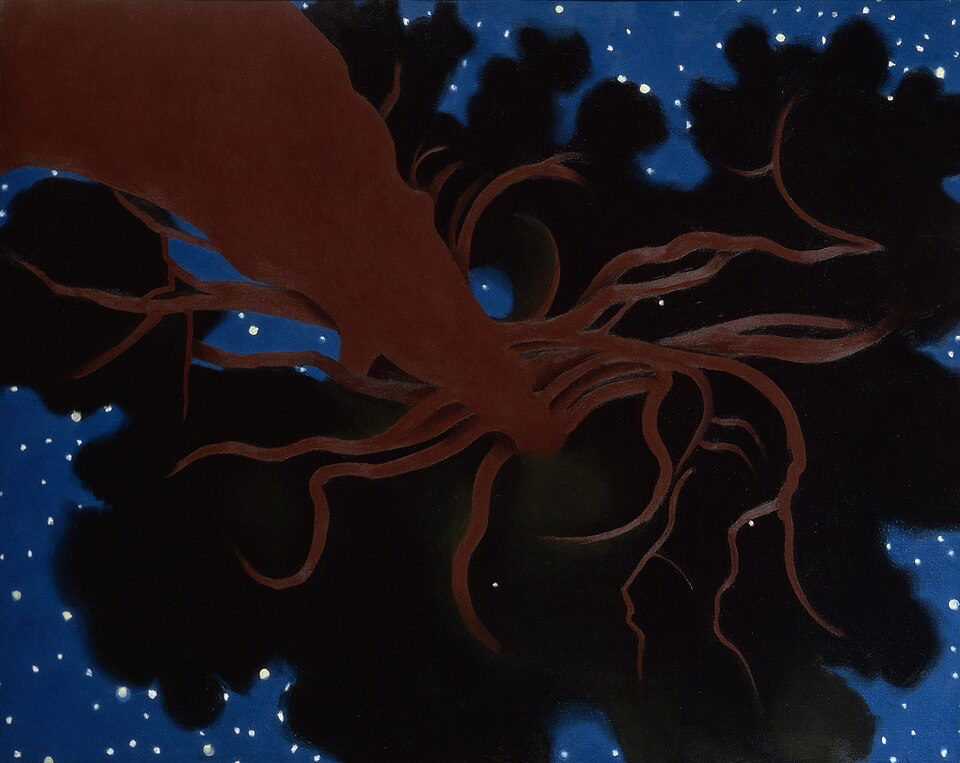
The image above is from Wikipedia.
“And while this isn’t a work that screams ecological consciousness, we wanted to include this kind of work because it, in its very disorientation of our perceptions, forces us to see nature in a new way, and to recognize how, in this case, how a tree is maybe close to us, something even connected to us,” Braddock said. “Note how she represents the branches, almost like arteries reaching out from our own body into the sky. O’Keeffe was a master of connecting us to nature, and that, too, I think is an environmental story worth telling.”
To finish his presentation, Braddock focused on several pieces of art that communicate themes of or connect to environmental activism.
“I’ll finish with this work, bringing the story full circle back to Indigenous culture, by pointing out very a recent, contemporary work by one of the most prominent, contemporary Indigenous artists today, Cannupa Hanska Luger, who was very involved with the Standing Rock Water Protectors’ demonstrations in the Dakotas several years ago, when he and his community were concerned about the implications of oil drilling in their vicinity,” Braddock said. “And so they created these so-called ‘mirror shields’ to reflect the images of the police and military who were trying to contain them, as a way of connecting them to his community, and making them reflexively see themselves in the very environment that they were policing.”
After Braddock concluded his presentation, Brashear moved to the front of the room to engage in a conversation with Braddock on several topics.
One of those topics was the Anthropocene. Braddock noted the ongoing disagreement between geologists, but also what the term means to him in terms of art.
“Anthropocene’s meant to refer to a new kind of geological epoch in which human beings are the cause of change. And the reason it has come about — and geologists are still debating its legitimacy, actually — but it’s gained currency beyond the world of geology in the world of culture today,” Braddock said.
He gave examples of human impacts on the planet and explained the relevance of these impacts in an artistic context.
“And that’s why in the book [“Nature’s Nation”], early in the introduction, I suggest that we can use that term to think of planet Earth as a work of art, for human beings are creating or recreating,” Braddock said. “And, while that’s a scary prospect in many ways, it also tells us that we’re the ones who can fix the problem. And the artists who are pictured throughout this exhibition and book are giving us cues on how to do that.”
Braddock and Brashear also discussed national parks and conservation, Black and Indigenous people, bison, and the New Deal through the lens of art and the environment.
“The artists were part of this — they weren’t necessarily part of the Civilian Conservation Corps, but they were part of this nation-wide, New Deal effort to document the truth of what was happening,” Braddock said. “And they did so with an artist’s eye, but not to kind of distort or lie, but to rather, I would say, condense the truth into the most meaningful nuggets of visual information you could imagine.”
Brashear ended with thanks to Braddock.
“So Alan [Braddock], I want to thank you for being here tonight to discuss your amazing book and reflect upon your amazing exhibition, and also to thank you for being at that space, that intersecting point where environmentalism and art and conservation and concern about ecology all are coming together, and for your own role in creating this realm of, what I think you’re terming ‘ecocriticism,’” Brashear said.
He then spoke to the audience.
“And so I invite you all to digest the book, to investigate the book, to learn more about what professor Braddock has talked about tonight, and we hope to see you at some of the upcoming features we have in the continuing saga that we’re telling this fall about that intersection of environmentalism and art.”
George Clark ’28 was one of the attendees at the event, and noted he chose to attend because he took a class with Braddock and enjoyed the work he did.
“I came to the book talk tonight because professor Braddock was my teacher last fall. I really enjoyed the work that he did, and I wanted to get a better idea of what he was doing outside of class,” Clark said.
Clark described what he learned from the book talk.
“I think one of my main takeaways is that approaching art, and the world, from a perspective that acknowledges our effect on the environment is a really good path forward to recognizing the things that we can change in our actions and beliefs to better fit our reality,” he said.
Clark also discussed subjects that the talk challenged him or surprised him on, like Western culture’s deep connection to consumption.
“I think it is challenging to recognize how much of Western culture is built around the consumption of everything,” Clark said. “And so, that extends to the times when we are consuming the idea of nature or the environment. And a lot of times, that consumption is enabled by a lot of human industry, and less so a pure view of nature, like we like to think it is.”
In addition, Clark elaborated on his experiences with activism and environmental art.
“I think that my experience with activism is largely political activism. I attend marches and rallies when I feel that they have an actionable component behind them,” he said. “I canvass for the progressive candidates in my districts, and I think that those who believe that the environment needs saving should be putting in work to save the environment.”.
Clark’s art is in the medium of poetry, where he, too, attempts to interpret human interactions with the natural world.
“I don’t have anything on hand, but I have been inspired to make poetry about the bits of nature that I’ve found, and the ways that it interacts with, kind of, the human environment,” Clark said. “I don’t have any of it on hand, but it does typically cover nature’s scenes and the ways that they’re disturbed by thoughtless human intervention.”
As Brashear noted at the beginning of the talk, the Muscarelle will continue running environment-related events, of which Braddock’s presentation and conversation were one.

.jpg)
