

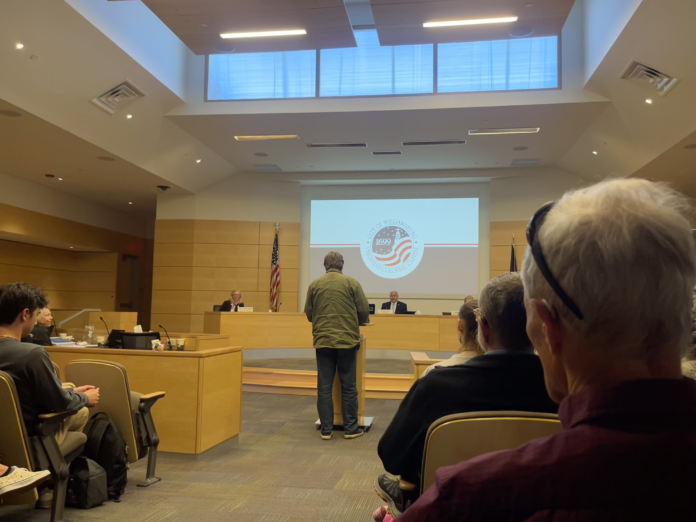
Thursday, April 9, students from the College of William and Mary attended the Williamsburg City Council meeting to raise concerns regarding Flock Safety. Flock is an automatic license plate reader system powered by artificial intelligence that has been implemented across the City of Williamsburg and at the College.
Anti-Flock advocates raised concerns about privacy and the use of some Flock data by federal immigration enforcement as key risks of the technology.
In addition to license plates, Flock cameras use artificial intelligence to record other vehicle characteristics, such as type, color, unique alterations and whether a car frequently passes by any of its cameras. This information is stored on the FlockOS system, allowing local law enforcement to search for vehicle details.
The Williamsburg Police Department began its Flock implementation with a trial program in 2021. The City’s Flock program has now expanded and includes over 30 cameras. Virginia state law places restrictions on the storage and sharing of data collected by Flock and similar technologies. These restrictions include requiring all data to be deleted after 21 days and prohibiting police departments from sharing data with out-of-state partners. This law also requires that data only be shared pursuant to specific requests relating to law enforcement actions.
A report by the Virginia State Crime Commission found that 13% of surveyed state law enforcement agencies that contracted with Flock allowed out-of-state or federal law enforcement continuous access to their data. The survey also found that 21% of state law enforcement agencies regularly retained their Flock data for over 21 days. Both of these actions are explicitly prohibited by Virginia law.
Reporting by The Richmond Times-Dispatch found that federal immigration enforcement accessed Flock data in Richmond, Va., without the permission of local police.
Thursday, March 26, students at the College overwhelmingly voted to pass a referendum calling on the William and Mary Police Department to cancel its Flock contract, which is separate from the City’s contract.
Ella Forlin ’27 spoke during the public comment portion of the meeting. She shared her opposition to Flock, expressing concern about U.S. Immigration and Customs Enforcement’s ability to access local Flock data without the direct permission of the City’s police.
Forlin noted that the City’s Flock cameras are also connected across a statewide network. She said that even if Williamsburg police are diligent in their data protection, local data could remain vulnerable to other Virginia police departments that may not safeguard it.
“When our data is shared as widely as it is, there are always ways for nefarious actors and people who are not intended to have this information to get it,” she said.
Charlie Goodman ’27 said that he views Flock surveillance cameras as privacy violations.
“These cameras are on 24/7, recording every license plate that passes them,” he said. “They are not for traffic enforcement. They are for tracking people. Police officers can access this license plate data without a warrant.”
Goodman noted that cities such as Denver, Colo., and Staunton, Va., as well as the state of Illinois, have terminated their Flock contracts.
“You can look to Illinois, where Flock allowed data to be illegally shared for up to a year with agencies external to the state,” he said. “Williamsburg should stand alongside Staunton and other cities against a company that has built a system prone to abuse and believes they should be immune from public criticism.”
Matthew Esposito ’26 noted the high density of Flock cameras in Williamsburg. Esposito conducted an analysis and found that over 60% of Williamsburg homes cross the paths of Flock cameras while en route to essential utilities, such as schools, hospitals or supermarkets.
“We have an extremely high concentration of these cameras within Williamsburg,” he said. “It’s actually one of the highest in the country — it’s somewhere in the top 10 or 15.”
James Holden J.D. ’27 said he does not believe that Virginia law is sufficient in preventing abuse by federal law enforcement.
“We have unfortunately witnessed, over the past year or so, a federal government which has promised to respect the sovereignty of state and local governments, instead violating that sovereignty guaranteed in the Constitution when it comes to their political expediency,” he said. “I remain unconvinced that this data being collected is being sufficiently protected from those who would seek to misuse it in violation of Virginia law for political purposes.”
Sarah Ewing, a worker at Commons Dining Hall, spoke at the meeting. They said that they hope to reinforce the voices of student advocates.
“I value the students as members of our community, and I have served many of them meals,” they said. “I also understand that many people do not give equal weight to the comments of students due to the fact that many will leave this community upon completing their degrees. So, as a permanent resident of Williamsburg, I would also like to express my support for canceling the contract with Flock.”
Ewing described what they see as the importance of raising concerns directly to those in government.
“I’ve done a lot of reading on the reporting on Flock cameras, and I find their use in our community deeply concerning,” they said. “If we don’t voice our concerns, then we can’t expect them to make any change.”
Goodman similarly highlighted the value of public advocacy to local representatives.
“We want to try to collectively voice our concern in a way that’s productive,” he said. “We elected them. Making our voices heard, letting them know that there are members of this community that don’t approve of this technology, will hopefully bring us a step closer to actually canceling the contract.”
Councilmember Stacy Kern-Scheerer said that students have raised valuable concerns that city officials should consider.
“I think it’s really important for us to hear the perspective of members of the community,” she said. “It hit a lot of really important points that are important for us to consider about where there are vulnerabilities and weaknesses that may have an impact on members of our community.”
Kern-Scheerer noted the difficulty of balancing public safety and privacy.
“We’re always trying as a society to balance public safety with privacy and make sure that measures for public safety actually do keep people safe,” she said. “I think that times have shown that that balance is very difficult for us to strike.”
Mayor of Williamsburg Douglas Pons also emphasized the importance of civic engagement.
“It’s representative government,” he said. “It’s good to see folks be passionate about an issue and bring them forward to be considered.”
Pons said that the topics raised by students have sparked discussions in the City’s government regarding Flock usage.
“I think some of the points that they made are good points,” he said. “It’s prompted me to have some conversations with the [Williamsburg Police Department’s] chief on just how information is shared or is not shared. I’m also aware that Flock provides assistance to our local police department and crime prevention, and I think that’s important.”
Pons said he plans to investigate the privacy concerns raised by community members.
“I did hear members of our community speak about how there could be breaches,” he said. “That’s concerning. So I just want to learn more about it [and] make sure that we’re not contributing to any of our citizens being unsafe in our community.”
