

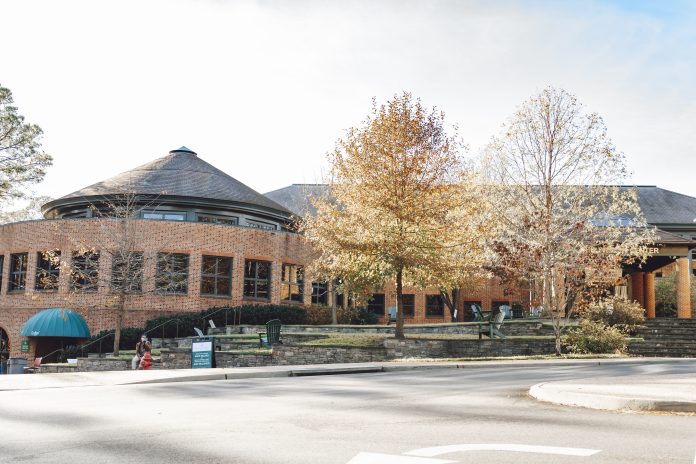
Friday, April 10, the William & Mary Scholars Undergraduate Research Experience hosted the College of William and Mary’s sixth annual WMSURE Undergraduate Research Conference in the Sadler Center.
The event included two sessions of student research talks, additional posters and digital presentations and concluded with declarations of the winners for each session.
The WMSURE program provides support and guidance to undergraduate students at the College interested in pursuing research and is specifically designed to aid William & Mary Scholars, first-generation students and Pell-eligible students. The research projects presented at the conference covered several disciplines and topics.
Anna Diaz ’28 used a survey study design to research alcohol use among Latino college students.
“My project was on adverse childhood experiences, poor attitudes towards professional help and drinking to cope in specifically Latino college students,” she said. “There’s a lot of literature on white students and how they drink. However, there’s next to none on Latino students.”
Based on analysis of survey data, Diaz found evidence of problematic alcohol use among Latino college students, as adverse childhood experiences were correlated with drinking to cope.
Wendy Rios Flores ’27 also conducted research centered on Latino populations.
“My overarching question is: What prenatal care limitations have Hispanic/Latina women with gestational diabetes mellitus encountered in the U.S. since 2005?” she said.
Flores explained the motivations behind her project.
“It’s very important to understand that Latina/Hispanic women have the highest prevalence of this condition in the U.S.,” she said. “If left untreated, gestational diabetes can lead to the development of type 2 diabetes as well as more health complications.”
Rios Flores focused on research conducted between 2005 and 2025 and referenced sources from multiple databases.
“Advocacy for programs that help these underserved groups, especially during maternal care, is crucial,” she said. “Ultimately, health care should be a right and not a privilege.”
Rios Flores found that issues such as technological fluency and linguistic and cultural barriers contributed to care limitations, causing adverse long-term effects and health disparities.
“Overall, these problems kind of stack up on one another, and they kind of create this bigger problem,” she said. “That’s why it’s so prevalent within this community beyond GDM [gestational diabetes mellitus] and Hispanic/Latina women in general.”
Rios Flores said the research process was eye-opening.
“I think what I found most unexpected was how big the disparity is,” she said. “I think I knew it was an issue, but actually researching it and looking at maps and seeing little dots of where these free clinics or places that do have physicians speak Spanish versus seeing everything that doesn’t have it.”
Dawn Harris ’26 conducted her research on misconceptions surrounding food insecurity, inspired by her work with the nonprofit Candy Cares, Inc.
“The most common misconception that we’ve heard was that we must serve a lot of homeless populations, but that’s not the case,” she said. “The second-biggest misconception we heard was that people believe that they aren’t as deserving as others for the resources, or people may need it more than they do, when that’s not the case at all.”
Harris’s project relied on oral narratives.
“To tie it into perspective, I created a list of interview questions to ask participants who are willing to be anonymously interviewed, as well as one Southeastern Virginia Food Bank representative to compile oral narratives for the public to hear the everyday stories of people and for the food bank representative to talk about the type of people that they serve at their pantry,” Harris said.
Her research also involved creating data visualizations using Python and ArcGIS based on Candy Cares’ demographic data from 2022–2024.
“I want to use these maps to convey to the public that the main demographic being served right now are middle-class families or households, and that it’s okay to ask for help,” Harris said. “But in order to make them feel more at ease, I have the oral narrative that shares the stories of the participants I mentioned earlier and the food bank representative.”
For Harris, WMSURE provided guidance and support. While Harris had never used ArcGIS before pursuing her project, she said her mentor, history professor Adrienne Petty, directed her to the College’s Center for Geospatial Analysis.
“They gave me a thorough rundown on how to use it, and they helped me with any errors I came across,” she said. “They definitely made the process smoother.”
Rios Flores said that the program helped motivate her to complete the research project.
“This is something that I’ve always been interested in, but I think I’ve never found the thing to kind of tell me like, ‘You should do this,’” she said. “Being able to work with the WMSURE staff and other students and having my advisor help me out through this process and making sure that they checked in with me throughout the summer, it felt so much more real.”
Diaz credited the WMSURE program with helping her feel prepared to present.
“We had to do a Zoom call where we had to tell about our research a little bit, and I think even though it was terrifying, it helped a lot to figure out how I want to eventually present,” Diaz said. “This is the second time I’ve presented this, we’ve presented in the fall symposium, so I feel like even though it was scary, it definitely taught me how to then present it in front of people and not be so scared.”
