

Lucia Reyes ’29 is a prospective psychology major and creative writing minor. She enjoys writing, reading, playing The Sims and listening to the rock and indie music. On campus, she is involved in Best Buddies, Cheese Club and Oriental Tea Club. Contact her at lareyes@wm.edu.
The views expressed in the article are the author’s own.
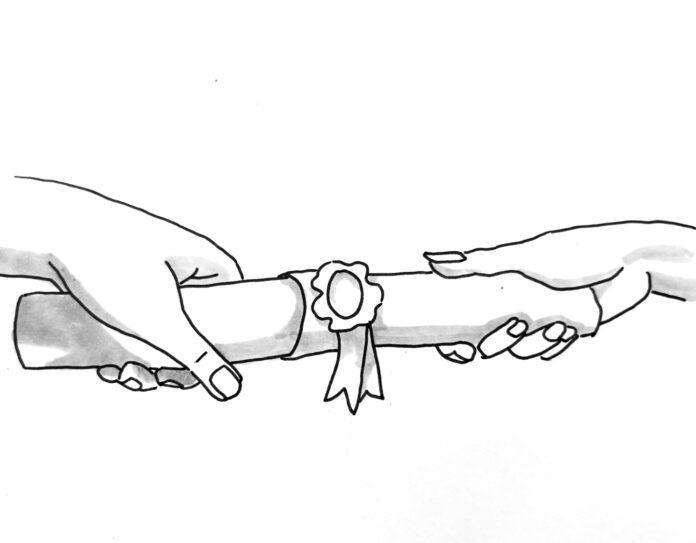
On Charter Day, Feb. 6, 2026, the College of William and Mary bestowed honorary degrees upon Gov. Abigail Spanberger D.P.S. ’26 and filmmaker Ken Burns Art.D. ’26. While it was beneficial to the William and Mary community to have these speakers come to campus, the practice of handing out honorary degrees is largely ceremonial and self-serving. This is characteristic of Charter Day’s superficial nature.
Spanberger and Burns both have very impressive accomplishments that deserve to be honored, and there is much to be gained from inviting such figures to speak to the college community. However, honorary degrees minimize the accomplishments they are meant to honor. Honorary degrees are awarded to a wide variety of people and seem to have no concrete meaning. The College’s website says only that they are given to “distinguished individuals.” These degrees indicate that a person has done some unspecified admirable thing and little else. The list of honorary degree recipients at the College highlights this. When football players, politicians, professors, philanthropists, chefs and opera singers are all winning the same award, that award cannot be particularly meaningful. This year’s recipients, Spanberger and Burns, have incredibly different achievements and legacies. One is the first female governor of Virginia, and one is a renowned filmmaker. Giving them the same award situates them in comparison with each other and dismisses their unique contributions to society. It would be much more appropriate to honor Spanberger and Burns with awards tailored to their achievements. Or perhaps, if the goal is to attract speakers to Charter Day, they could be given a Charter Day award.
Further, the idea of an honorary degree minimizes the very concept of a degree. Degrees are academic qualifications earned through years of study. An honorary degree is a worthless one. Most recipients of honorary degrees already possess degrees from the institutions they chose to attend. They have no use for a ceremonious degree from an institution they often have little or no connection with. As noted on the College’s news page, Spanberger attended the College transferring to the University of Virginia. If Spanberger had wanted a degree from the College, she would have earned one. Rather than awarding Spanberger a meaningless degree, the College should have given her an award related to her accomplishments.
Additionally, Charter Day itself is both grandly ceremonial and wildly misrepresented. Charter Day is the anniversary of the College being given its royal charter. The webpage refers to it as the College’s birthday. But what is Charter Day really about? Fancy robes and speeches? The administration of the College patting itself on the back? Special food in the dining halls? Celebrating accomplishments?
Charter Day seems to be a little bit about all these things, but mostly about pomp. A certain degree of ceremony befits a 330-year-old institution and makes the day feel special. But it does not seem like much substance is under the pageantry of Charter Day, besides the desire to reward donors and raise money.
A better Charter Day could include focused awards for impressive figures from whom the College community can learn. A better Charter Day could invite these figures to engage personally with the community and with the academic departments related to their work. It could celebrate the achievements of faculty and students. It could celebrate all the people, from administration to the dining halls to building services, who do behind-the-scenes work to make the College succeed. A better Charter Day could be wonderfully ceremonious and celebratory, but simultaneously purposeful and enriching.
