

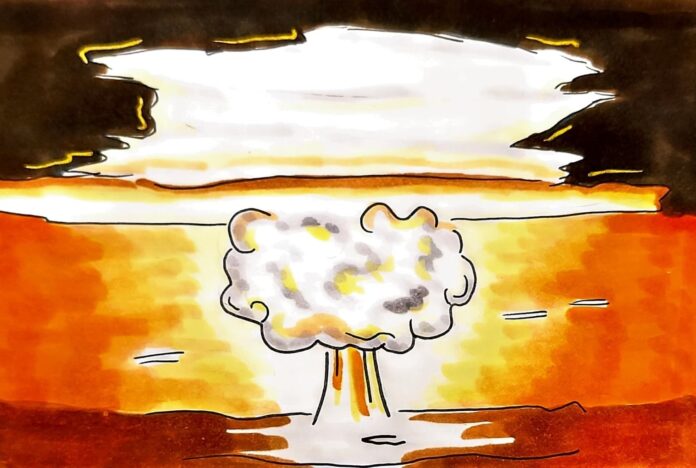
Katherine Bigelow’s newest film, “A House of Dynamite,” has generated quite a bit of conversation in the political mediascape. Telling the story of a potential nuclear threat to the United States, the movie lends an eye to diplomatic responses to a DEFCON 1 situation, the highest U.S military readiness level. Controversially, Bigelow elected to end “A House of Dynamite” moments before the intercontinental ballistic missile made impact, leaving viewers with a slew of unanswered questions. Some critics find this choice to be sloppy and cliché, but I would argue that Bigelow’s ambiguous conclusion creates an important discomfort, the very kind that leaders across the globe have lost sight of.
Following multiple storylines, the movie first brings us to an Alaskan missile defense base led by Major Daniel Gonzalez. As the Intercontinental Ballistic Missile passes overhead, the National Guard attempts to shoot it down with missiles of their own, ultimately failing after two tries. Gonzalez goes through psychological torture following the misfire; he morphs from a composed and vigilant officer to a trembling man, vomiting on his knees out of sheer overload. Even as one of the most powerful people in the nation, Gonzalez is unable to stop the inevitable horror of a nuclear weapon, a realization that does not come until it’s too late.
After dodging Gonzalez’s retaliation attempt, the ICBM continues to approach its final destination — Chicago. A national security crisis quickly unveils, driving Secretary of Defense Reid Baker to suicide. As he fails to evacuate his estranged daughter from Chicago, Baker casually strolls off a rooftop while boarding a helicopter. In the heat of the film this moment gets swept under the rug, but I think it’s one of the more psychologically telling scenes.
Amidst all the protocols, preparations and plans, Baker is left helpless. His untimely death served as a final grasp at controlling the uncontrollable. We watch his face turn from anguish to acceptance as he realizes that the fate of his daughter, and Chicago itself, is out of his hands. Like Gonzalez, his character serves as a representation of just how overwhelming and unpredictable nuclear weapons are. Both men snap in less than an hour, their minds unable to comprehend the weight of what is about to happen.
Gonzalez and Baker’s vicious breakdowns feel jarringly realistic. When asked, “Who got it right?” in predicting the future of nuclear deterrence, New York Times White House and National Security Correspondent David Sanger answered, “historians.” “A House of Dynamite” may not have explicitly referenced nuclear threats of the past, but characters’ harrowing emotional journeys form strong connections to that of WWII President Truman.
Aug. 10, 1945, President Truman met with Secretary of War Henry Stimson. Their conversation marked the president’s first full report on damages to Hiroshima, including photos of carnage and before-and-after images of the city. In an instant, Truman’s attitude visibly changed from pride to horror. Simon further explained that the first hour following detonation saw 100,000 deaths, with more to come from radiation exposure.
Aug. 9, the day preceding Stimson’s report, President Truman issued a second nuclear bomb on Nagasaki. Together, the two explosions killed about 200,000 innocent Japanese citizens.
As the only individual with authority to use nuclear bombs, Truman was responsible for the “hell on earth” that was unleashed in Japan. This knowledge haunted him, and he experienced a decline in physical health shortly following his meeting with Stimson. At the time, the U.S. was preparing for a third nuclear attack, although it never came.
“A House of Dynamite” acts as a standalone piece, but I see ghosts of history’s only nuclear war in the characters’ psyches. Gonzalez, Baker and Truman, three well-respected, powerful men, mentally deteriorate as they lose agency to an incomprehensibly destructive weapon. Whether intentionally or not, Bigelow draws on the past to inform her characters’ — and transversely, our own — internal narratives. We shield ourselves with facades of control, as if advertising ‘big red buttons’ will prevent the inhumane horrors that they truly represent.
If it were up to me, I would mandate that every leader of a nuclear-armed state watch “A House of Dynamite.” Bigelow is able to evoke a sickening discomfort in viewers using nothing more than raw emotion, the kind we can’t access ourselves. Our world relies on nuclear deterrence, and its fallible promises prevent any form of emotional assessment. “A House of Dynamite” forces us to confront the grueling human response to slaughtering 10 million civilians, a realization that may have prevented Truman’s hand in a third strike in 1945. Ending the movie before detonation denies us closure; as the credits roll, we are left with nothing more than a gut-wrenching feeling and unanswered questions.
