

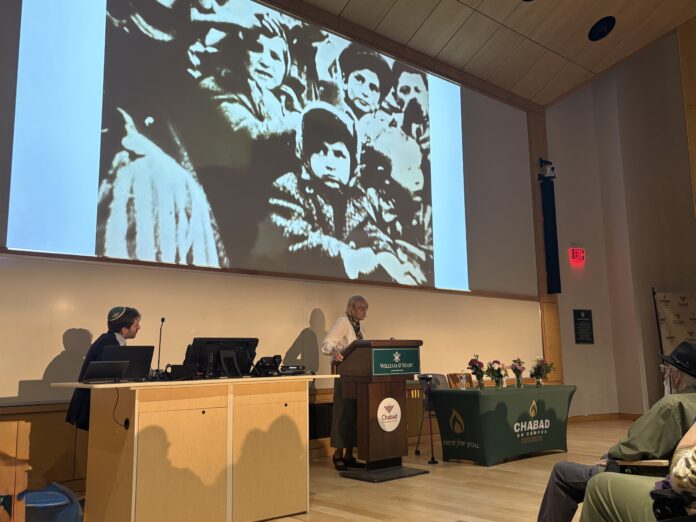
Sunday, March 1, the College of William and Mary’s chapter of Chabad hosted Sora Vigorito, the youngest known survivor of Dr. Joseph Mengele’s twin studies during the Holocaust. Vigorito was one of 89 pairs of twins who underwent Mengele’s pseudoscientific studies at Auschwitz.
Mengele, also known as the “Angel of Death,” was a German physician during the Holocaust who conducted experiments on prisoners at the Auschwitz II-Birkenau concentration camp. At the time, these experiments were rationalized by Nazi ideology.
The event began with Andrew Finkelstein ’26, student association president of Chabad, who described the rare opportunity to hear directly from a Holocaust survivor.
“We are living in one of the last generations where there is a chance to hear directly from Holocaust survivors, to sit in the same room as them, to listen to their voices, feel their emotions,” he said. “As much as history textbooks are great crucial tools, a living testimony uniquely provides a window into the story. We will be exposed to fear, tragedy, resilience and so much more I do not have the words to describe.”
Finkelstein then introduced Vigorito.
“Tonight, we will get a glimpse into one of the worst chapters of humanity. A chapter in which Joseph Mengele was put in a position of power, this so-called doctor that experimented on human beings in the Auschwitz concentration camp,” Finkelstein said. “Among his victims were several thousand children and sets of twins. Very few survived, and Sora, thank God, is here.”
After Chabad campus advisor Rabbi Mendy Heber expressed gratitude for the organizations involved in arranging the event, Vigorito began her talk.
“My goal during these talks is not just to recite over and over again the horrors of the Holocaust,” Vigorito said. “My goal is to share my experience from the heart and soul with trauma and disaster and the knowledge I gained from it to help my fellow human beings increase an understanding within themselves and gain self-confidence and courage to stand up for who we are and what we believe.”
Vigorito began to narrate her early life; she was born in Berlin, Germany, in 1941. Her family was in hiding at the time of her birth.
“To give you a little background, I was born in a very dark era of time,” she said. “Not dark like night, just dark as far as spirit and soul. I was not born in a hospital, and I’m not certain of the date or the exact place.”
Vigorito’s family consisted of her mother Emma, grandmother, grandfather, older sister Haley and twin sister Hanna. Her father was imprisoned in a concentration camp before she was born.
When Vigorito was born, Adolf Hitler had already risen to power and enacted his extermination plans.
“In 1941, trains were rolling steadily,” she said. “For Jewish women to give birth at the time was the destiny of gas chambers. However, twins were directed to a different plan.”
Soon after, Vigorito’s mother and older sister were arrested and taken to Auschwitz. She would never see them again.
“They were taken by the Gestapo, and these are the facts told to me by my Bubbe, my grandmother,” Vigorito said. “She was actually the only mother I only knew. I never knew my mother or my older sister. Many years later, my father was told they were arrested by the Gestapo, and my mother was serving the pleasures of the Nazis. This was the Nazi way.”
About a year after her mother’s arrest, the twins went to live with their grandmother in East Germany.
“Our birth had never been registered to protect us, and till date, I don’t have a birth certificate,” she said. “But the U.S. government gave me citizenship anyway, with a handwritten document stating I was born.”
The twins enjoyed the few weeks there, attempting to build a brief routine.
“We found ways to entertain ourselves and to distract ourselves with the ever-presence of fear,” she said. “We only knew fear in those days. I had no sense of any other emotions.”
Eventually, the Gestapo took the twins and their grandmother to Auschwitz in 1944.
“When they came, their voices were abrupt,” Vigorito recalled. “We shook with terror and huddled in a corner. They shouted, ‘Raus! Raus!’ which meant ‘out.’”
They were loaded into cattle cars, and there were no bathrooms, water or food.
“Some people often said that Jews acted like animals,” Vigorito said. “But we acted as human beings under such conditions when our rights were stripped away. We were made to look like foul animals. That was the Nazi way.”
When the trains stopped, they were then herded to the selection line, where the twins would eventually be separated from their grandmother. In selection lines, the Nazis picked out those who looked capable of work. Children and pregnant mothers were exterminated immediately.
And then, there were the twins.
“Bubbe whispered to us, ‘Hold onto my legs, don’t let the big man see you,’” Vigorito said. “Suddenly, Hanna stumbled, and a guard grabbed her and shouted, ‘Twins!’”
Vigorito recalled the exact moment Mengele laid his eyes on her.
“Joseph Mengele took me in his arms and looked at his assistant, who held on to Hanna. I remember the piercing, dark eyes. He turned towards Hanna, looked at me and had an indescribable, strange smile on his face, like ‘I got what I wanted.’”
This was the last time Vigorito’s grandmother saw Hanna.
“Before he handed me over to his assistant, we started screaming, but in vain, as we were taken away from our Bubbe, who stood pleading with tears in her eyes,” Vigorito said.
Vigorito and her sister were then taken to a hospital, where Mengele conducted his psuedo-experiments. They were placed together in a wooden cage.
“This became our home until the end, and it became Hanna’s deathbed,” Vigorito said.
There, the twins received injections, mostly spinal injections, blood draws and skin samples. They caused third-degree burns.
One day after the injections, Hanna began to have seizures.
“She shook all over her body and quivered,” Vigorito said. “It happened several times. Then, she became still. I knew she was gone.”
Vigorito refused to let Hanna’s body go, and she slapped Mengele’s face when he tried to take her away. He later returned and smashed four fingers of her right hand, breaking all the bones and cutting off her middle finger.
“Shortly after I lost Hanna, I thought, ‘How do I go on?’ We were like one. I lost my other half. We were always together. And her getting torn away from me tore everything away. I didn’t feel anything anymore,” Vigorito said.
In those days after Hanna’s death, the only thing that kept Vigorito going was a song she heard while still in the cage. She sat directly above the long lines of prisoners going to the gas chambers, and they sang a hymn as they approached their death.
“I didn’t know the song, just the melody,” Vigorito said. “But the very nature of the song was a lullaby to me. It made me calm down. I would fall asleep and wake up and still hear the streams of people below me on the way to the gas chamber. That [melody] was ‘Ani Ma’amin’ [‘I Believe’].”
The melody, Vigorito said, is attributed to Azriel David Fastag. He wrote the song in a cattle car while being taken to Treblinka. Dozens of Jews sang the song as they marched to the gas chambers in the Nazi death camps. Today, it has become one of the most famous hymns in Jewish culture.
One day, Vigorito noticed people starting to leave. Then, a woman came to the cage to free Vigorito.
“She lifted me and carried me out. I don’t know if she was a prisoner or someone else,” she said.
After the war, Vigorito was taken to a hospital, where she reunited with her grandmother.
“I don’t know how she survived the war, and how she found me, but she did,” Vigorito said. “My grandmother walked in one day, she saw me and I was placed in her arms. We both cried, and we seemed to already know — both of us — that Hanna was gone.”
Vigorito and her grandmother returned to East Germany, and she reunited with her father, who was freed by American troops.
After meeting her father for the first time, he and Vigorito eventually immigrated to Canada, then the United States. She didn’t speak English, and it was difficult to adjust.
“My father felt like a total stranger, and it wasn’t easy being an immigrant child that was filled with fear,” she said. “I had no sense of trust.”
Eventually, her father could no longer care for her because he was facing his own trauma, and she was put into the New York foster care system.
In her journey throughout foster care, finding a job and eventually starting a family, Vigorito grappled with her trauma. She shared moments that made what she thought was a void soul begin to feel alive again.
“My life finally became more than just survival — it became about living,” she said.
Vigorito married and had three children of her own, with whom she shared her stories. Now, she has nine grandchildren.
“The light that was gone then is present today,” she said.
Vigorito concluded the talk, describing how her reconnection with her Jewish faith, as well as sharing her story, allowed her to heal.
“Thank you for listening,” she said. “Thereby, you have helped me to heal.”
Following the talk, Finkelstein shared the intention behind creating this event.
“For a lot of people in school, it’s probably mandatory to learn about the Holocaust,” he said. “But when we have a living speaker come to share her story like Sora, we’re able to have a true window into the human aspects of emotion, experience and just get a feel for what truly happened because the important part of Holocaust education is to not repeat it. It was done by humans just like us. And it’s essential that we know that we should never have done such a thing.”
According to Finkelstein, to plan the event, Chabad’s campus advisor Rabbi Mendy Heber contacted Vigorito “over three months in advance.”
“She lives in Orlando, and she flew to Richmond to come here,” Finkelstein said. “She had been speaking at different college campuses, and we were really lucky to have William and Mary included in that.”
Williamsburg community member Gay Myers learned about the event in an email she received, and she was immediately interested.
“I was born during World War II and the Holocaust, but I was just an infant,” Myers said. “But I have been to Dachau [concentration camp], and I’ve been to parts of Europe, and it’s always fascinated me. I just didn’t understand how these people survived. Their stories are so critical and important for the rest of us to know about. And I admire her [Vigorito] so much.”
allopurinol 100 mg tablet generic
allopurinol 100 mg tablet generic