

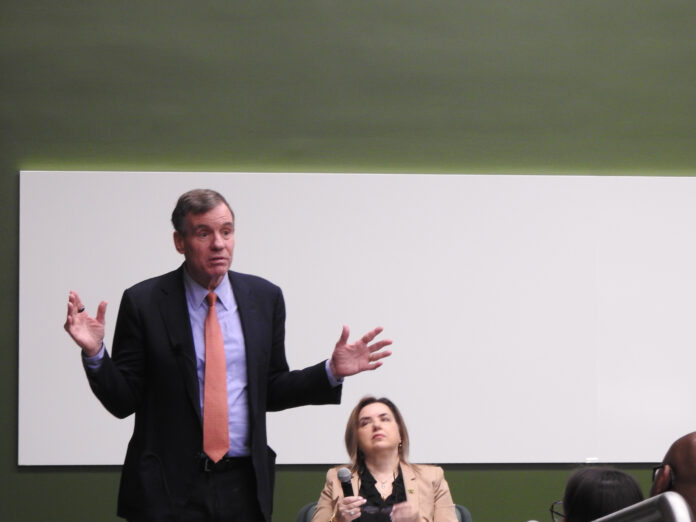
Monday, March 2, the Global Research Institute and School of Computing, Data Sciences and Physics welcomed Sen. Mark Warner to the College of William and Mary’s Integrated Science Center 4 auditorium for a conversation on war powers, artificial intelligence and the future of national security. Provost Peggy Agouris moderated the talk.
Currently serving as Vice Chairman of the Senate Select Committee on Intelligence, Warner began by addressing escalating U.S. military action against Iran, criticizing President Donald Trump’s decision to authorize strikes without what he described as an imminent threat to the United States.
“I guess I should start with the war,” he said. “We’ve followed the circumstances in Iran for ages, and let me acknowledge on the front end, I think the Iranian regime is brutal, was brutal.”
Despite the brutality of the regime, Warner called the action a “war of choice,” arguing that the Constitution requires congressional authorization before initiating such a conflict.
“The Constitution is extraordinarily clear,” he said. “If there is a war of choice, the president can’t arbitrarily start it. The president has to come to Congress and to the American people and make the case.”
Warner emphasized that the administration had offered shifting justifications — from dismantling nuclear capabilities to targeting missile programs to pursuing regime change — without presenting a clear, consistent objective to Congress or to the American public.
While condemning the Iranian regime, Warner expressed concern about the lack of a long-term strategy.
“I shed no tears that the supreme leader and some of the Iranian military leadership has been killed,” he said. “But we have so little visibility about what’s next.”
Warner also criticized Trump’s earlier foreign policy decisions, particularly his focus on Venezuela. In January, he argued, the administration lacked sufficient military positioning in the Middle East because resources were diverted elsewhere.
“We literally had 20% of our fleet off the coast of Venezuela,” he said, calling it “another Donald Trump folly.” That misalignment, he suggested, limited U.S. options when unrest surged in Iran earlier in the year.
Warner announced his intention to support a War Powers Resolution requiring a cessation of hostilities unless Congress formally authorizes continued military action. Agouris then shifted the conversation to technology and national security.
“You have said in the past that national security is a technology race against China,” Agouris said. “I’m going to take one step further and say it’s a race against tech firms and technology itself, which sometimes might align and sometimes might not align with the interests of our democracy. So, how can our students contribute to creating a better environment for sharpening the truth, for avoiding conflict and being misinformed in situations like this?”
Warner framed modern national security as fundamentally technological.
“My view of national security is not simply who has the most tanks and guns and ships and planes,” he said. “It’s who’s going to win the technology competition.”
He compared the U.S. and China, describing the latter as “our near peer on the overall economic basis” and a formidable rival in AI, quantum computing and telecommunications.
However, he emphasized that American strength depends not only on innovation but also on alliances and immigration.
“Our secret sauce in our country has not only been innovation in great universities, but the fact that we attract talent from around the world,” he said.
Warner then expressed concern about concentrating advanced AI tools within government agencies without adequate ethical guardrails.
“We turn over the AI tools to a defense department where there’s not somebody with good moral judgment,” he said. “And we have the ability to look at all of your personal information or create these weapons without any human input. We’re talking about scary stuff.”
He then pointed to domestic surveillance concerns, referencing a recent case involving the Department of Homeland Security. Warner referenced a woman in Minnesota who was denied a Global Entry pass after DHS identified a photo of her attending a protest.
“This is not the way America should work,” he said. “I could care less whether you’re a Democrat, Republican, independent, libertarian, vegetarian — this has got to shape you into activism. This has got to shape you into activity.”
Social media, he argued, also offers a cautionary tale.
“One of the great mistakes we made was not putting some guardrails on social media,” he said.
Without early regulation, platforms developed in ways that harmed young users and amplified misinformation. Compared to AI, however, he described social media as “tiny” in scale and consequence.
Warner described himself as “long AI,” emphasizing that he believes AI will ultimately create new jobs and drive economic growth. But he cautioned that the short-term impact could be severe, particularly for college graduates.
“For the next five to seven years, I think AI is going to be a massive job killer,” he said. “And the jobs it’s going to kill … it’s going to be college graduates.”
With recent college graduate unemployment already elevated, he warned that the figure could spike dramatically if companies automate entry-level roles in finance, consulting and law.
Throughout the session, Warner repeatedly returned to the role of students. He urged students to remain civically engaged and informed about the intersection of technology and democratic accountability.
“You guys, this has got to shape you into activism,” he said. “We can’t let this kind of process go along without raising our voices.”
Josie Binkley ’26 initially attended the talk for extra credit, but she found Warner’s comments on AI and Iran to be interesting.
“I did want the extra credit, but I also thought it would be interesting to hear what someone from Congress thinks about everything that’s going on right now,” Binkley said.
Binkley shared her reactions to AI’s effect on employment rates, per Warner.
“I thought that the mention of unemployment rates going up in the next few years was pretty jarring,” she said. “He mentioned that the figures companies are putting out to the public are inaccurate when compared to the ones the companies are sharing with Congress and personally projects 30% college graduate unemployment in the next five years. That definitely stood out to me.”
Adrian Ryan ’27, president of the College’s Young Democrats, also recalled Warner’s comments about AI’s effect on the job market.
“His notes on AI and employment possibilities for recent college graduates were most striking,” Ryan wrote in a statement to The Flat Hat. “The senator mentioned that roughly 9% of recent college graduates are currently unemployed, a number he expects to reach 30% as a direct result of AI integration in the workforce. Senator Warner stated that it is the duty of Congress and other lawmakers to address this issue to maintain the strength of the domestic economy and ensure that investments in college education continue to prove worthwhile.”
Ryan learned of the event from Warner’s team directly.
“I heard about the event from one of Senator Warner’s staffers, who requested that I share it with the W&M Young Democrats’ membership,” he wrote.
He wanted to attend the event because he thought it was a unique opportunity to hear from a senator on current issues.
“It is always a privilege to hear from any United States Senator,” Ryan wrote. “With recent American strikes on Iran, capture of the former Venezuelan president, and other recent rises in international tensions, it is crucial to hear from leaders like Senator Warner who are privy to the most sensitive information regarding our country’s positions in these affairs.”
Ryan commented on how it is important to hold leaders like Warner accountable, as Warner begins his reelection campaign this fall.
“Though the President uniquely authorized the Iranian and Venezuelan operations — not Congress, as is mandated by the U.S. Constitution — the Senator still plays a significant role in what America’s next steps will be,” he wrote. “As Americans, it is further our duty to hold leaders like the senator, President, and others to account for their work and decision-making.”
Binkley also referenced Warner’s comments on Iran.
“I was not surprised at the Iran discussion, since it is such a relevant thing,” Binkley said. “I think he gave a pretty good statement that communicated the issue with how Trump went about it without taking a clear stance on if we should be at war or not. I think not being overly partisan could be a big strength when there’s so much polarization across the country and disrespect for our country’s legal systems from Trump.”
Associate Director of the GRI David Trichler described the planning behind the event, which was originally intended for last fall.
“Senator Warner’s staff reached out to William and Mary in the fall, expressing the senator’s interest in engaging directly with our students,” Trichler said. “While we originally planned to host him then, the fall government shutdown required a postponement.”
Trichler emphasized that the event reflected the senator’s unique position at the intersection of national security and technology, making it a natural fit for an interdisciplinary audience.
“This was a cross-campus effort,” he said. “Because the senator sits at the intersection of national security and tech, there was a natural synergy between the Global Research Institute and the School of Computing, Data Sciences and Physics.”
Trichler also connected the event to the College’s Year of Civic Leadership.
“As part of the university’s Year of Civic Leadership, GRI is an active participant in W&M’s efforts to be a public square that engages voices across society,” he said. “The audience included students researching the ethical and strategic implications of these technologies in classes and research labs on campus.”
antibiotics for bronchitis
antibiotics for bronchitis