
As war escalates in Iran, Iranian American students at the College of William and Mary are balancing campus life with concern for family abroad.
For Ida Guerami ’27, Sarah Morid ’27 and Arvin Rajabzadeh ’26, these worries are inseparable from a profound connection to their heritage.
“In general, the Middle East is more than the headlines that we see,” Morid said. “We’re lands of poets, mathematicians, engineers, adventurers, and we’ve been on this land for generations, rebuilding and loving it.”
Guerami echoed a similar sentiment.
“It’s a culture of depth, of excellence, of knowledge, of richness, of such good food,” she said. “There’s just so much love, and so I’m sad to see that this love is being overshadowed by such divisiveness.”
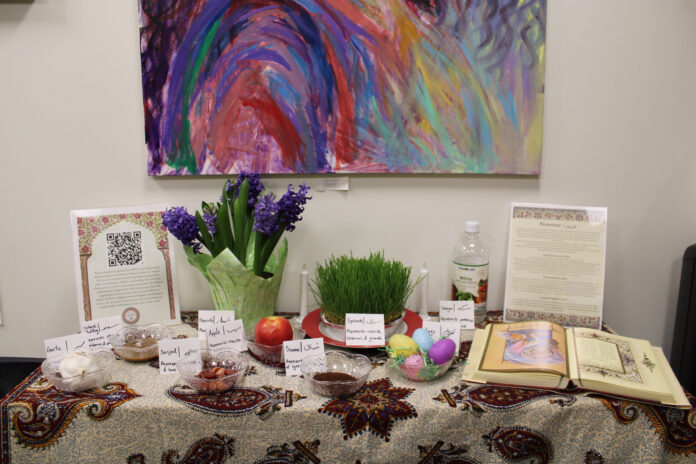
Guerami also noted that the timing of the war coincides with the Iranian New Year, which will take place Friday, March 20.
“We’re at the most important time of the year for us, waiting for these new beginnings, a start for something better for our people, our reset,” she said. “But we’re starting it in a time of mourning, a time of cognitive dissonance between so many people.”
Morid emphasized that opinions on the war vary widely within the Iranian community.
“Iran is such a huge country, and there are so many Iranian voices,” she said. “Part of listening to Iranian voices should be listening to the diversity of the voices as well.”
For Guerami, Morid and Rajabzadeh, these perspectives are personal. Each has immediate family in the United States and extended relatives in Iran.
Morid and Rajabzadeh’s families are from Iran’s southwestern Khuzestan province, the primary battleground during the Iran-Iraq War in the 1980s. Guerami’s father’s family is from Isfahan in central Iran, and her mother’s relatives are from Kerman in southern Iran. Both of Guerami’s parents lived in Tehran.
Guerami, Morid and Rajabzadeh have each visited Iran.
“It’s a beautiful place with a clear, deep-rooted, thousands-of-years-old culture, and the people are probably the most welcoming and hospitable you’ll ever meet,” said Rajabzadeh, who last traveled to Iran when he was 14 years old.
Morid has visited her family in Iran three times, most recently in 2023.
“Every moment I can spend with them is so valuable,” she said. “There are so many people who are Iranian who don’t get the chance to visit Iran because of circumstances, so I’m just really grateful whenever I can visit.”
Morid described the differences she noticed between Tehran and Khuzestan and said the latter was “a lot more traditional and rural.”
Upon arriving in the province, she remembered seeing billboards displaying the faces of individuals who died during the Iran-Iraq War, some of whom her mother had known personally.
Morid also recalled passing buildings that were never rebuilt following the Iran-Iraq War, including her mother’s old school.
“My Iranian background is one filled with a lot of these hard stories, but through these stories, there’s so much resilience and love for the country,” Morid said. “Despite all of this, we’re still in Iran, we still love Iran, and we still wish the best for Iran.”
Morid highlighted this resilience as essential to her Iranian American identity.
“Each generation has their own stories of resilience and the ability to stay optimistic despite how horrible things are,” she added. “To me, being Iranian is being resilient, still loving each other and being there for each other despite hardship.”
Like Morid, Guerami has visited Iran three times. Although she last traveled to Iran in 2010, Guerami remembers being surrounded by family.
“I’m so glad I was even able to smell the way the street was or taste how different the saffron is there or just hear the voices of family members that I don’t know if I’ll get in contact with again,” she said.
Guerami hopes to return to Iran in the future.
“I miss it because I know what I’m potentially missing out on,” Guerami said. “I can’t even imagine how much better it will be now that I’m older and understand things better and am ready to be surrounded by my family.”
Guerami, Morid and Rajabzadeh identified Iran’s frequent internet blackouts as a major barrier to staying connected with family.
During uprisings, the Iranian government often utilizes internet shutdowns to limit communication and access to information. For over two weeks in January, the regime imposed an internet blackout. Since then, the shutdowns have remained intermittent and unpredictable.
“I’m always checking my phone to see updates,” Morid said. “I don’t really know how my family is doing until we get bursts of internet again, and it’s just really looking at your phone and seeing where in Tehran they hit, where in Khuzestan they hit.”
Rajabzadeh said his family in the United States has experienced minimal impacts other than the blackouts.
“That has pretty much been the single biggest effect, other than uncertainty,” he added.
In the absence of consistent communication from family members abroad, Guerami said she has found support in her friends at the College.
“I had friends asking me during the protests, before everything else in between, if I could help explain what’s going on from my perspective and understand the nuances from my perspective, and see how it’s hurting me,” she said. “They’ll be there for me.”
Guerami hopes the current conflict will encourage people to educate themselves about the Middle East.
“It’s a time to take action, to be inspired by people who are fighting within the country itself, to be better, to learn more, to be curious about it,” she said.