

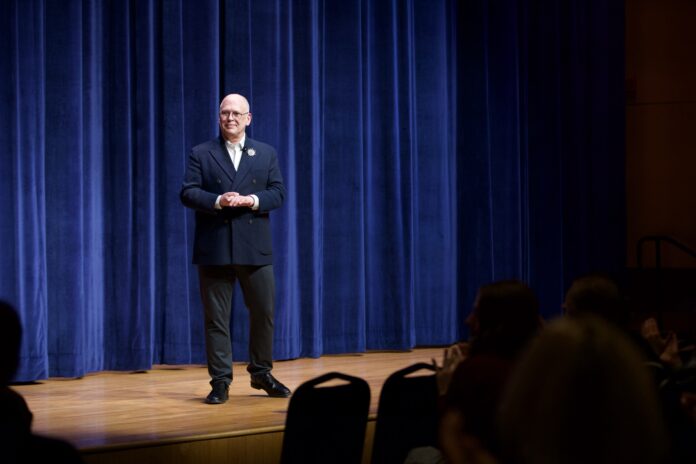
Wednesday, March 18, Jim Obergefell delivered a lecture, hosted by Alma Mater Productions, on his journey to becoming a nationally recognized LGBTQ+ rights activist.
Obergefell is the plaintiff in the landmark 2015 Supreme Court case Obergefell v. Hodges, which legalized same-sex marriage. He spoke as a part of the College of William and Mary’s Atwater Lecture series, supported by the Janet and Peter Atwater Lecture Endowment, which brings public leaders onto campus to discuss contemporary issues.
Obergefell opened by explaining how he finds experiencing the unexpected to be a common theme in his life.
“I also never thought I would sue the state of Ohio,” Obergefell said. “I never thought I would go to the Supreme Court. And as a young out gay man, I wasn’t sure I would ever find love, but all of those things happened.”
Obergefell recounted a time when even admitting to himself that he was gay did not seem like an option.
“Around the age of 10, I started to realize, ‘Jim, you’re a bit different,’” Obergefell said. “I could just tell from society that it was something I had to keep hiding, so that’s what I did.”
Obergefell attended college during the AIDS epidemic and went on to teach in southeastern Indiana. The prospect of coming out remained unfavorable for him at the time.
Because of this, when he was first introduced to his future husband, John Arthur, he felt worried about being recognized for his sexuality.
“John terrified me because I was still deep in the closet, even though I knew I was gay, and John was so comfortable in his skin as an out gay man,” Obergefell said. “I thought for sure he’s going to say, ‘Oh, come on, Jim. We all know, come on out.’”
While attending graduate school at Bowling Green State University in Bowling Green, Ohio, Obergefell described how he felt safer and more comfortable coming to terms with his sexuality.
He recounted the moment when he first opened up to a friend about his sexual identity. On a road trip, a friend asked him if he was gay. Obergefell decided to answer honestly.
“I remember thinking, ‘How are you going to answer, Jim?’” Obergefell said. “‘Are you going to say straight and continue living a lie, or are you going to finally admit who you are to yourself, out loud to another person?’ And I did, I said gay.”
After coming out, Obergefell started talking to Arthur more and eventually mentioned dating. However, Arthur was hesitant because of past failed relationships.
“But I refused to be talked out of it,” Obergefell said. “I said, ‘No, we are doing this. We are dating.’ Seven weeks later, he gave me a diamond ring.”
Although the couple wanted to get married, they did not think doing so was a possibility, as the 1996 federal Defense of Marriage Act prevented states from recognizing same-sex couples.
“We looked at each other and said, ‘Well, we can’t do that anywhere, and we’re not sure we ever will,’” Obergefell said. “So we just kind of stopped thinking about marriage, and we just built our life together.”
That reality changed after Arthur was diagnosed with Amyotrophic Lateral Sclerosis, which forced the couple to confront legal barriers to their relationship.
“I was John’s full-time caregiver, and caring for someone who’s lost every physical ability isn’t easy,” Obergefell said. “It’s overwhelming, it’s tiring, it’s scary, but above all, it was my pleasure to care for John, because that’s what you can do when you love someone.”
One day while caring for Arthur, the couple watched the news as the U.S. Supreme Court struck down the federal Defense of Marriage Act.
“I realized we hadn’t talked about marriage since the mid ’90s, but this decision finally gives us part of what we wanted,” Obergefell said. “The federal government would see us, would recognize us, would treat us as a married couple. So I leaned over, hugged and kissed John and said, ‘Let’s get married.’ And luckily, John said, ‘Yes.’”
Obergefell and Arthur decided to get married in Maryland. They were flown out by a medically chartered jet with the cost covered by friends and family.
“Here we are in this cramped airplane,” Obergefell said. “John’s on this really uncomfortable gurney. We sat him up, and I got to take his hand, and we got to say the words we’ve wanted to say since the mid ’90s: ‘I do.’”
Obergefell emphasized the ceremony’s emotional significance.
“It really was the happiest moment of our almost 21 years together,” Obergefell said. “It just made us feel different, more complete.”
While enjoying their new marital status, the couple was contacted by Al Gerhardstein, a mutual friend’s lawyer who heard about their marriage and wanted to meet. In their meeting, Gerhardstein explained that Arthur would be listed as unmarried on his death certificate because of Ohio’s statewide Defense of Marriage Act, which only recognized Ohio marriages as being between one man and one woman.
“That death certificate and understanding what would happen when John died took our understanding of Ohio’s Defense of Marriage Act from being abstract to being something very clearly harmful,” Obergefell said. “It broke our hearts, but I think more importantly, made us angry.”
Gerhardstein gave the couple the option to try to fix Arthur’s future death certificate by filing a lawsuit in federal district court and suing Ohio Gov. John Kasich, Ohio Attorney General Mike DeWine, and the City of Cincinnati.
“We discussed it for less than a minute before saying yes,” Obergefell said.
In Ohio, certain marriages were illegal, such as underage ones or those between first cousins. However, if a couple that fit that criteria got married in a different state and returned to Ohio, their marriage would then be recognized.
“Our legal argument was, ‘Ohio, you are creating different classes of citizens by recognizing some out-of-state marriages and not others,’” Obergefell said. “And it was such an easy thing to explain to people, and I think that was really part of the power of this.”
After an initial victory in federal court, the ruling ensured that Arthur’s death certificate would recognize their marriage. Arthur died just three months later.
“He died a married man,” Obergefell said.
The case continued in the Sixth Circuit Court of Appeals, this time ruling against Obergefell in a 2-1 decision. Gerhardstein called Obergefell after the decision to ask if he wanted to continue fighting.
“My immediate answer was, ‘Of course, I want to keep fighting,’” Obergefell said. “‘If I don’t, I’m not living up to my promises to love, honor, protect John.’”
The U.S. Supreme Court agreed to hear the case, consolidating it with cases from other states. After oral arguments and an almost two-month wait, Justice Anthony Kennedy announced the case decision.
“He kept reading [the decision], and it really sunk in that we won,” Obergefell said. “And I burst into tears. I could hear people around the courtroom crying.”
Obergefell recounted the bittersweet moment.
“My first thought was, ‘John, I wish you were here,’” he said. “‘I wish you could experience this. I wish you could know that our marriage can never be erased.’”
Beyond the personal significance of the decision, Obergefell also felt a sense of equality.
“But what I wasn’t expecting was after that, the next thought I had,” Obergefell said. “For the first time in my life as an out gay man, I felt like an equal American.”
Leaving the courtroom, Obergefell was welcomed by supporters celebrating the decision.
“We step out into this crowd, and to say the air is electric just doesn’t capture it,” he said. “I mean, it was an explosion of joy.”
Since the decision, Obergefell’s life has changed drastically.
“People still recognize me,” he said. “They stop me, they hug me, they show photos, they talk about their family, the people they love, and how important this decision was for all of them. And I love that, it’s never gotten old.”
Obergefell recounted an interaction with a student after he spoke at the University of Tennessee, Knoxville.
“She came up, and she said, ‘Jim, I just want you to know if it weren’t for the lawsuit, I would have committed suicide,’” Obergefell said. “‘Marriage equality gave me a future, where before I saw no future for myself, it gave me a reason not to take my own life.’”
Obergefell explained that filing the lawsuit was not a difficult decision.
“It was a really easy decision, because we deserve to exist,” he said. “Every person in this room, every marginalized person in our nation, deserves to exist and deserves to be part of We the People. And that’s what I and all those other plaintiffs on this case, that’s what we fought for, simply to exist and to be seen by our government.”
Lauren Layne ’26 said Obergefell’s visit felt especially important given ongoing concerns about LGBTQ+ rights.
“I think it’s great Jim came here, and so many people showed up for it because it’s not an issue that’s ever ending,” Layne said. “It could be overturned, and thinking about that is really scary, but he gave us a lot of hope, so that’s really nice.”
Charlie Miller ’29 said he attended the lecture to better understand the human side of constitutional law.
“It was really what I was hoping for,” Miller said. “I wanted to see the personal side of the judicial process, especially having a case in front of the Supreme Court.”
Ryan Healy ’26 said the talk highlighted the power of resilience and love.
“I thought the talk was very inspirational and showed that even in times of hardship, hope can still prevail, and love can be a very powerful force,” Healy said.
Obergefell closed the talk by reflecting on the journey as a whole.
“It’s been an amazing experience for me to go from someone who wasn’t an activist, who never wanted to do anything like this, to saying, ‘Yes, let’s do something,’ and to take that all the way to the Supreme Court,” he said. “It simply was because John and I loved each other, and we deserve to exist, just like every single person does.”
