

Alexandra Hill ’28 is a prospective English major and creative writing minor. She does research at the IIC Conservation GIS lab and is a member of Vox. When she’s not submitting her columns late, you can find her yapping, daydreaming or dancing really badly. Contact her at abhill@wm.edu.
The views expressed in the article are the author’s own.
I used to run track. I know, I know. Running, for fun? Who would ever do such a thing? Trust me, I ask myself the same question.
Track boggles my mind, not just because it involves people running on purpose, but because it shows an incredibly wide range of what humans are capable of. At the same meet, you have people hurling weights (that’s shot put), leaping into a sand pit (long jump) and flying into the air (that’s Superman — sorry, pole-vaulting).
Athletes in each of these events have one goal: to push their body and mind to their limits. I do not have statistical proof, but I anticipate track is ranked high on the list of “Sports That Make People Throw Up.” It is not uncommon to see athletes (particularly the runners) cross the finish line, weave for a few steps in a way that would definitely not convince any police officers of sobriety and collapse onto the turf.
Is this healthy? Probably not. But who am I to say?
What’s curious is that sprinters who race the 100-meter dash and distance runners who do the two-mile event look remarkably similar after finishing. They are weak-kneed, wobbly, strained, exhausted. Every muscle worked to the point of exhaustion, they stumble to a resting spot and sip a Gatorade in between pants. Their throats burn; their eyes sting with sweat. They are depleted.
The key to running is pacing. A sprinter in the 100-meter dash leaves the starting line going almost as fast as they possibly can. A runner in the mile race wants a start that puts them in a solid position, but not one that destroys their energy for the rest of the race. They settle into a rhythm they can maintain, then apply the rest of their stores to a final lap. They are aware of their limits and where they can push those boundaries. They have a “race pace” that fits the event in mind.
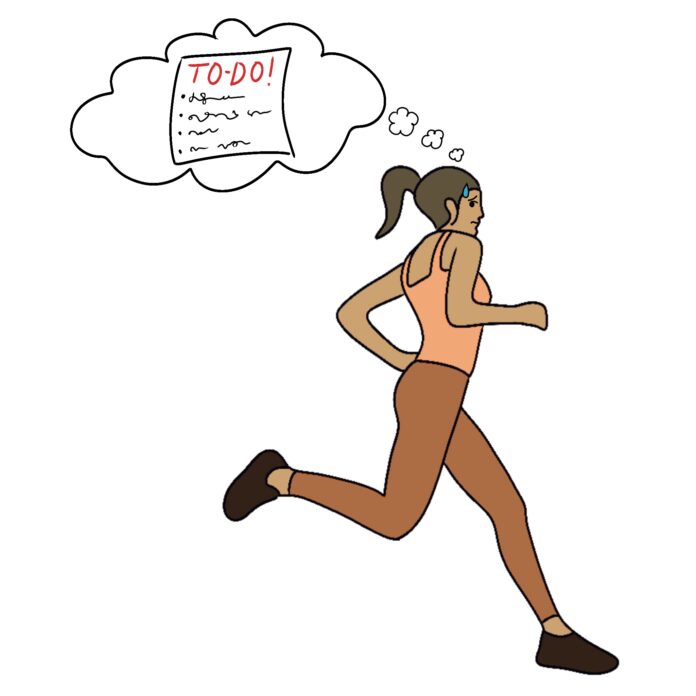
Ideally, students treat their academic life as a “distance race.” Like an experienced runner, they carefully plan how far they will run by a certain time. They set off with a steady, yet determined pace. As they run, they aim for a zone between too easy and too difficult.
This is how I think of my friends who are excellent at time management. They make a calendar at the beginning of the semester. They outline their essays in advance, check in with professors during office hours and maybe even have time for a second draft. They study and tackle assignments in small steps.
Then, there are the sprinters. On occasion, I am one of them. These are the people who check the assignment instructions within a day of a big deadline. As they realize they misheard their professor’s request for a 10-page paper as a four-page one, their life flashes before their eyes. The last week of fun and awesome appears before them: scrolling on Instagram reels during their Earl Gregg Swem Library “study session,” watching all of “The Twilight Saga,” going online shopping for socks with College of William and Mary President Katherine Rowe’s face on them. So many regrets!
A sprint, on occasion, can be a reasonable strategy. Hours on end in Swem? Not my ideal afternoon. Sometimes, though, circumstances call for a solid 100-meter dash.
The problem is when we are always sprinting. When we are always present when the Swem closing announcement plays (oh, the horror!), when we are always buzzing with caffeine and stress, when we are always fighting the clock.
Like an evil version of whack-a-mole, another assignment pops up as soon as one is completed. We are always three steps behind where we should be, and we cannot rest until everything is done.
Full speed ahead can only go on for so long.
Heck, even distance runners cannot keep going indefinitely.
No one can run forever.
With this truth in mind, it is nice to have a finish line in sight. For many students, the end of finals is that finish line. For the seniors, it’s graduation. Together, we cross our fingers and hope we can make it. Complete projects, nail presentations, pass exams. Soon, a carefree summer will be in our grasp!
The terrible reality is that, for many people, summer is not carefree. Summer is internships, familial obligations, jobs, financial considerations, classes, worries. Summer can be fun, but it is not always a break.
At a campus coffee shop, I overheard a snippet of someone discussing their post-grad plans. They are starting work almost immediately after graduation. They said something along these lines: “When do we ever get a break? It’s going to be like this for the rest of my life.”
In a race, the goal is burnout. The goal is to have just enough energy to cross the finish line. The goal is to have nothing left. Seriously, my middle school cross country coach used to say, “Your mind quits before your body does,” in an attempt to inspire a group of tweenagers to run faster.
But is that the goal of school? Of work? Of life?
No one can run forever, yet we try. We move at an unsustainable pace. Whether sprinters or distance runners, our legs tire, our motivation drains and our steps feel heavier.
If responsibilities keep flying at you like bugs on the highway, it is essential to try a back road. When life is going splat into your windshield, it is time to pull over somewhere safe and let the engine cool, so nothing weird and smoky starts to happen under the hood.
If the world won’t rest, we can choose to. We can replenish ourselves before getting flat tires. We can move at a pace we can keep up, not with a superhuman display of willpower, but with enjoyment and ease.
Check the fuel gauge before you need to push your car up a hill. Stop at the gas station often. Downshift. Put your vehicle in park.
The road is long, and speeding is not the most effective way to get to your destination. The Burnout Police are very vigilant about people exceeding the speed limit!
I understand this is an oversimplification. Academic work is never the only thing people have on their plates or on their minds. It’s not always possible to have a “full cup,” but there are small ways to add a few drops to it.
This is not a race. We are not runners (unless you are, in which case, I have nothing). We do not have to break any records, especially not at the price of tearing a hamstring or getting shin splints. We can step off the track and explore some wooded trails. We can stretch. We can recover. We can breathe. We can look up at the funny shapes in the clouds and think, “Isn’t this crazy, this thing called life?”
