

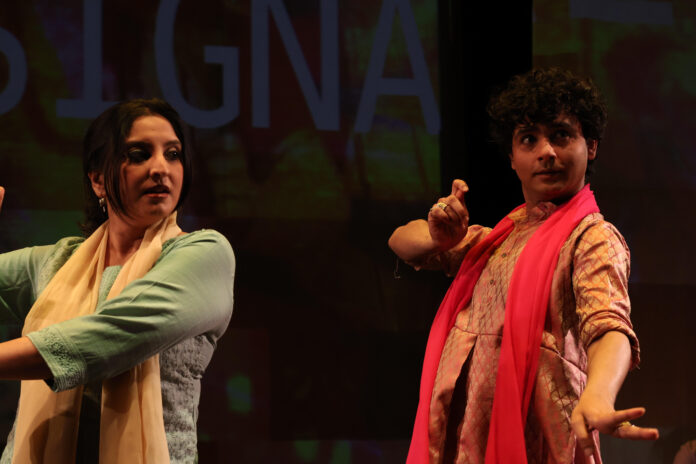
Friday, March 27, the Art and Science Exchange sponsored “Rasa Across Borders,” a theater performance held in Phi Beta Kappa Memorial Hall. The performance opened with upbeat, plucky music as the stage lights turned on, and four performers in kurtas walked on stage. There were four sheets of fabric draped from the ceiling, which projected videos from Pakistani and West Bengali dancers and activists. Throughout the performance, stories were communicated through monologue, projected videos, Bharatanatyam, Kathak, Sufi Dhamal and Mujra influenced dances, and classical Bharatanatyam-inspired dance on stage.
Some memorable moments included a projected video of Palash Dutta, a West Bengali dancer and Kothi youth activist, dancing in a field of flowers. These calmer moments were juxtaposed with more tense scenes. One such scene projected a patchwork of TikTok videos, headlines and news clips looping audio that overlapped while performers stopped dancing and distressedly stomped. There were also somber moments where performers told difficult stories about their experience with religion and mental health. Interspersed were stories from the collaborators in West Bengal and Kolkata, told in Urdu. And there was the joyous dancing to “Pink Pony Club” by Chappell Roan.
One of the videos used in the performance was of Leila, a Pakistani transgender writer and performer, who explained that rasa represented elemental human emotions. These emotions were learned in childhood and relearned later in life. She shared that rasa is a powerful tool to connect with other people. Thus, rasa can give people courage to show the world who they are. The show explored these themes of elemental human emotions across experiences of gender, sex, caste, sexual orientation and continents. Through these various stories, Rasa stitched together themes of LGBTQ+ struggle, resilience and resistance. More specifically, Rasa shares stories of family abandonment, violence and perseverance.
This performance started out as an idea between Associate Professor of Theatre and Performance and Gender, Sexuality and Women’s Studies Claire Pamment, Assistant Professor of Applied Science Indranath Mitra and Assistant Professor of Sociology and Gender, Sexuality and Women’s Studies Diya Bose. Bose wanted to explore transnational dialogue and synergies through their research and networks with South Asian gender expansive communities. They formed community partnerships with the Gender Interactive Alliance in Karachi and the Kolkata Anandam for Equality and Justice. They were then joined by students Ash Kelley ’28 and Nikhil Vattathara ’29.
Performers noted that creating this theater piece was collaborative in nature. Mitra explained that rehearsals often started with watching video submissions from activists and performers from West Bengal and Pakistan and reflecting on them. These rehearsals consisted of exercises and questions from “How are we all feeling today?” to “Where are we, who are we and what stories are important to us?”
A lot of these exercises centered around sharing vulnerable, personal stories.
“I would tell my story, and then Claire would listen to me,” Mitra said. “That was very important, and then she would share her story, and I would listen to it. So then what happens is that expands my safe space from just around me and brings one more person. In the same way, the stories from these rehearsals got shared and the safe space kept expanding, and tonight, everybody who came to the show is in my safe space.”
The process of incorporating these stories in the performance was difficult at times, especially when they centered around sensitive topics. Vattathara attributed a lot of the success of handling these stories with care to their director, Pamment.
“Without her patience and guidance, this project would’ve been impossible,” Vattathara said. “We dealt with some topics and stories that were extremely heavy and difficult, and I think we understood when people needed some space from a scene, or when people were feeling uncomfortable. We did a lot of exercises that helped us stay emotionally and physically healthy.”
For many performers, this was their first experience in a devised theatre project. Vattathara noted that this project helped him develop as a performer and change maker.
“I remember being extremely frustrated and angry at how much the people I love had to go through for just wanting to live as their authentic selves. And the more I got into acting, the more I realized how powerful performance can be in influencing minds and inspiring change, and I hope that I can make the world a better place for everyone through that,” Vattathara said.
Kelley explained that she signed up to be a performer, not knowing what it would become and how great of an impact it would have on her.
“It has been one of the pieces of theater I have worked on that is perhaps one of the more foundational pieces to me, and it is something I will continue to take with me for as long as I continue to do theater,” Kelley said.
The following panel discussion strongly emphasized performance as a form of protest and resistance. Many of the performers highlighted that individual expression was a way to welcome others into their protest. The moderator of the panel, University of Massachusetts Amherst Associate Professor of Women’s, Gender and Sexuality Studies Svati Shah, described how the performance reflected syncretism, or an amalgamation of religions, cultures and identities.
“Syncretism is a way to describe, among other places, South Asia. Syncretism is the concept that allows us to understand how so many histories, art movements, philosophies and ways of life can exist in one place over millenia. Syncretism is a very human concept,” Shah said.
Shah also touched on the significance of art in certain political climates.
“Syncretism is also a thing that fascists hate. Syncretism is too fluid, too unruly, too undisciplined. Fortunately for us, it is not something that can be so easily be repressed because it is human,” Shah said.
The performance and discussion afterward expressed disappointment with India’s Transgender Persons Amendment Bill of 2026, which reversed India’s expansive acknowledgement of trans rights.
“There is something to performing that is its own protest. And I firmly believe it is our role as people who perform in whatever capacity, whether it is sitting behind a light board or it’s dancing on stage; it is our job to fight back in any way we can,” Kelley said.
Bose shared lessons from engaging in theater for the first time. Bose’s artistic expressions of her authentic self were poetry and dance. As a dancer trained in classical Bharatanatyam, she was used to telling stories in dance form. She explained that Bharatanatyam was well-equipped to tell stories because of its three pillars: Bhava (another word for rasa or embodied expression), Raga (musicality) and Taal (rhythm). This project was the first time she was applying her dance storytelling to theater.
“Theater has been a beautiful metaphor for the activism I’ve been working with for all of these years,” Bose said.
In terms of future direction for the project, Pamment said the performers in West Bengal and Pakistan will be working with local organizations to stage their original devised theatre projects in Karachi and Kolkata in May. These performers will draw upon the College’s work and create response pieces to their art.
“The project contributes to transnational dialogue and movement building across borders, especially important at a time when violent anti-trans legislation and sentiments are bounding across national borders,” Pamment said.
Vattathara noted what people should take away from the performance.
“I hope that everyone who saw it, or really everyone in general, knows how important telling your stories can be. I remember so much in my life how much I’ve been inspired and comforted by others’ stories. As difficult as things may be right now, humanity is beautiful because we’re all so different, yet all so deeply connected,” Vattathara said.
Kelley added their perspective during the panel.
“If you are looking for reassurance about speaking up when the entire system that you’re speaking against is doing all it can to silence you,” Kelley said. “If you speak up, you are not alone. The only time you can actually be alone is if you don’t say a word.”
For those interested in queer theater, Pamment said she will be offering a course next fall called “Devising Queer Theatre” to create a theater project on the College’s queer histories.
