

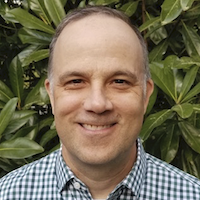
Isabelle and Jerome E. Hyman Distinguished University Professor of Government Paul Manna radiates a desire to achieve more equitable education. This passion drives his dynamic teaching and research for the College of William and Mary’s government department. He also extends his educational efforts into the greater Williamsburg community through WHRO Public Media.
Manna joined the campus community in 2003 as an assistant government professor. Manna said he was drawn to the College’s comprehensive teaching style.
Manna’s journey to the College, however, was far from linear. Manna taught at his former high school before earning his Ph.D. in political science from the University of Wisconsin in 2003.
“I enjoyed teaching high school, but I didn’t enjoy that much teaching,” he said. “Five classes a day, every day, is a lot.”
Manna said the balance of teaching and research ultimately drew him to the college classroom.
During his time at the College, Manna’s research has focused on K-12 education policy.
“My main area of interest is how policies get carried out,” he said. “I use the word ‘implementation’ a lot to describe that.”
He outlined his publication history, mentioning two of his books.
In “School’s In: Federalism and the National Education Agenda,” Manna wrote about the federal government’s involvement in education.
“Almost all the money for education comes from states and localities, yet there is this arc of time, over about 50 years, from the ’60s to the end of the 20th century, where the federal government started to get a lot more interested and involved,” he said. “My first book was trying to explain how that happened and why it happened.”
In his second book, “Collision Course: Federal Education Policy Meets State and Local Realities,” he wrote about the federal government’s achievements in education legislation.
Manna has also co-edited a book on education governance, co-authored an American government textbook and published other articles on education, policy and politics.
Crucial to his interest in education, Manna has led student research teams in library sourcing, dataset construction and independent studies.
Manna highlighted a particularly influential project.
“We went to Illinois for two weeks, and we rented a minivan and drove around the state interviewing a bunch of politicians and state officials,” he said.
Manna described an emerging research project of his that is still in its early stages, tentatively named “learning beyond the instructional core.” The term “core” refers to teaching and curriculum.
“The evidence does show that if you have [effective] teachers, if you have a high-quality curriculum and teachers know how to use it, that actually does help students learn, help them succeed,” he said. “But there are also a lot of other things in school that can shape achievement, and not a lot of people pay a lot of attention to those.”
For this project, Manna said he plans to explore subsets of external influences on K-12 education, investigating the effects of principal quality, standardized vision tests and modern school infrastructure such as heating, cooling and lighting. He said he hopes to use the research to help guide curriculum implementation in school districts.
Manna said he aims to support his emerging research with grants or related funding sources to promote student involvement.
In addition to his research, Manna created 19 educational podcast episodes last spring related to civics in a series titled “Democracy in Five Minutes.”
Manna has also appeared on Civics Minute, a 90-second section within NPR Morning Edition’s commercial break in collaboration with WHRO Public Media. Locally, the broadcasts can be heard on FM channel 89.5 WHRV and NPR’s website.
Manna explained the premise of his educational podcasts, which are done in collaboration with the College’s Strategic Cultural Partnerships Office.
“We came up with an A-to-Z format where each spot is a different civics concept that begins with a different letter of the alphabet,” he said. “We initially did the first eight letters of the alphabet, and that was going to be a trial run with WHRO because we do one a week. That way, they could have one a week leading up to election day.”
WHRO recently extended the project to complete the alphabet, meaning it will run until March 2027.
“The goal was to be very concrete, to say to people, ‘These aren’t just textbook ideas, but they are things that could be relevant in your own life,’” said Manna about Civics Minute.
Manna concluded by discussing his own philosophy on applying change to make positive impacts on individual’s lives.
“We have to actually do things,” Manna said. “Just because we have a right or a law on paper doesn’t mean that it really means anything until someone puts it into practice or acts.”