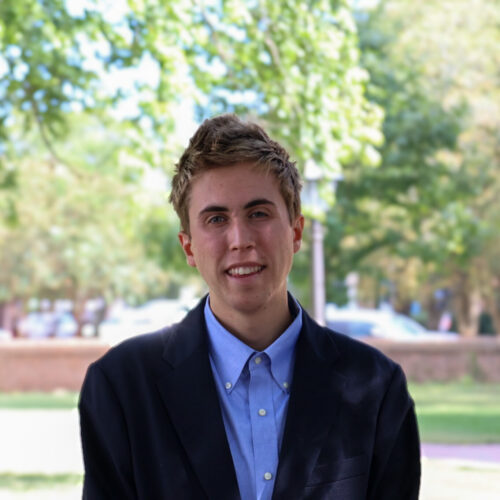

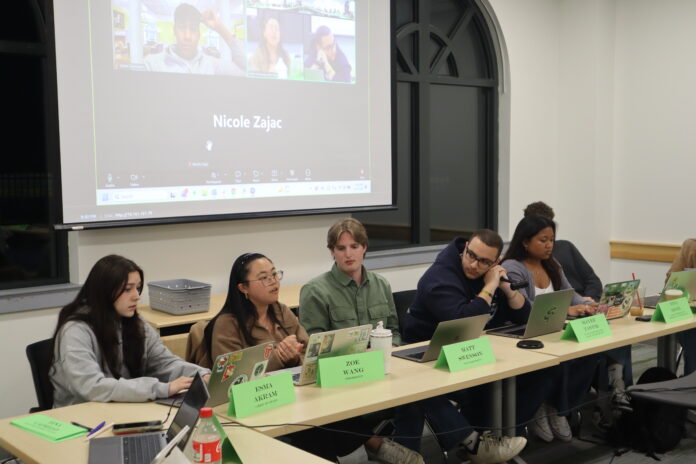
Tuesday, March 24, the College of William and Mary’s Student Assembly Senate passed the ZeroEyes Referendum Act, sponsored by Sen. Danny Otten ’23 Ph.D. ’27.
The ZeroEyes surveillance bill includes a referendum question on the Monday, April 6 ballot asking students whether they support the College of William and Mary ending its contract with ZeroEyes.
ZeroEyes is a surveillance company that specializes in firearm detection through the use of AI software embedded into cameras.
The College pays an annual fee of $82,600 to host the company’s firearm detection software in up to 400 security cameras around campus, per its contract with the company.
If the ZeroEyes AI-detection software notices a weapon, it takes an image from the security camera footage. The company sends an alert to its security monitoring team, which independently verifies whether the weapon represents an authentic threat. If ZeroEyes verifies the threat as authentic, it sends an immediate alert to the police and the customer about the detected weapon.
Despite ZeroEyes incorporating human verification into its weapons detection process, there have been multiple recorded instances of the company alerting police to false emergency situations.
A key privacy concern of ZeroEyes referenced in the ZeroEyes Referendum Act is whether the campus images the company collects and stores include the faces of students or community members. ZeroEyes could capture this data in a situation where its software detects a weapon.
Regardless of whether a crime is being committed, ZeroEyes would take a screenshot of the security footage and store the information, according to its website.
Although ZeroEyes does not place any time limit on its usage of customer data, it claims it will apply all relevant privacy laws in using the data for its services. According to the subscription agreement between the College and ZeroEyes, the surveillance company may use anonymized or aggregate consumer data for its business operations or training AI software.
Otten’s original proposal placed the ZeroEyes referendum on the ballot for the spring Student Assembly general election, which would have given two days between the measure passing the senate and students voting on the referendum. Multiple senators raised concerns that this quick turnaround would not allow enough time for students to be properly informed about the effort.
The senate first considered the ZeroEyes Referendum Disavowal Act, also sponsored by Otten. Otten explained that this bill would afford the senate the opportunity to reconsider its support for the referendum following a scheduled meeting with Associate Vice President for Public Safety Cliff Everton ’96.
Class of 2027 President Nico Giro-Martin ’27 expressed his discontent with the quick turnaround time of Otten’s bill.
“I think this specific disavowal act is setting a dangerous precedent for this body, as it’s directly in contrast with the bill that we are voting on today,” he said.
Sen. and Chair of the Senate Mayer Tawfik ’27 also disapproved of the bill. He said he does not see the point in the senate retroactively considering its support for the ZeroEyes Referendum Act if it passes.
“In people’s mind, that’s still going to be a Student Assembly referendum, whether it has the official legislative promotions or not,” Tawfik said.
Tawfik assigned the ZeroEyes Referendum Disavowal Act to all senate committees. Debate then shifted to the ZeroEyes Referendum Act.
The senate Committee Chairs, representing Finance, Student Experience and Policy and Student Rights, explained their committee discussions on the bill. There was general support for the bill’s content. However, members expressed concerns regarding biased language in the ZeroEyes referendum and the short approval-to-voting window Otten proposed.
Giro-Martin motioned to table Otten’s bill.
In response to Giro-Martin’s comment, Otten threatened to submit the referendum to the Independent Elections Commission, regardless of whether the senate voted to delay it. He explained that he had already met the required 250 student signature threshold for placing a referendum on the ballot.
“This will be going on Thursday’s ballot no matter what,” Otten said. “The only reason that I have not put it on the ballot yet is because I wanted to give Student Assembly a say on the matter.”
Otten also said that he would publicly disclose the votes of anyone who chooses to delay or vote against his bill to the students who have signed his ZeroEyes petition.
“I want to make it clear that everyone who votes to delay this bill or votes against this bill is implicitly voting against educating the campus on this matter,” he said.
Giro-Martin responded to Otten by reiterating how he sees only giving two days between senate approval on the bill and students voting as insufficient time to educate community members.
Other senators echoed this sentiment.
Sen. James Holden J.D. ’27 — sworn into the senate just that day — criticized Everton on behalf of the College of William and Mary Law School.
“I understand I’m new here, but I have had a chance to look over the clips sent of [Danny’s] meeting with Everton,” he said. “Quite frankly, I am sort of appalled by [Everton’s] answers.”
Sen. Brooks Alderman J.D. ’26 proposed an amendment to Otten’s bill, which would instead hold the ZeroEyes referendum on April 7, two weeks following the current senate meeting. To hear Alderman’s amendment, the senate unanimously rejected the motion to table Otten’s bill.
“If we don’t pass anything, then someone could make the argument that we don’t want a referendum to occur or have people being informed,” Alderman said. “This shows that we do.”
Class of 2029 President Daria Lesmerises ’29 reiterated that she did not want Otten to publicly release any vote counts if his bill were to be tabled.
“With the elections being on Thursday, I don’t want to vote with how I actually want to vote if I’m being on the low blackmailed,” she said.
Otten responded to Lesmerises by refusing to say whether he would publicly disclose the information.
“I don’t feel comfortable making a promise either way. I believe the entire student body has a right to know what occurs here at Student Assembly,” he said.
Holden also said that he does not see the need to contact College administrators before voting on the ZeroEyes referendum.
“I think that if we’re going to have these sorts of referendums, we need to have the courage to pass them and present them to the administration regardless of what they are going to do,” he said. “Let them be the ones who have to bear the social costs of defying the will of students.”
Student Assembly President Zoe Wang ’25 MPP ’26 stated she would not support the ZeroEyes referendum if it were placed on the Thursday ballot, also commenting on her experiences with the College administration.
“In my four years of working in this body, the meaningful progress I’ve seen our body accomplish has been done because of our relationships with this admin,” she said. “I truly mean that they have the students’ best interests at heart.”
Tawfik noted that it could be difficult for senators to try collaborating with College administrators.
“Sometimes you don’t get answers from them for weeks,” he said. “They’re busy, you can’t get a meeting with them, they give you B.S. answers all the time. It [comes with] the nature of working with administrators.”
Tawfik emphasized the importance of building positive relationships with administrators, as they ultimately ensure that policy provisions are accomplished.
“It’s good to put pressure on them, but we have to do it in a way that is intentional, and that is something respectful to their profession and line of work,” he said. “Even if you digress with them or disagree with their character, we also have to be strategic.”
Otten disagreed with Tawfik’s assertion.
“What Mayer said about, ‘Sometimes, you get B.S. answers from administration officials, and that’s just how it is,’ I reject that wholeheartedly,” he said. “We need to demand better from our William and Mary administrators.”
Sen. Quinn Clancey ’27 reiterated that he was strongly opposed to Otten publicly releasing senators’ votes.
“I think it’s a little distasteful to reveal the names of people who are voting on this,” he said. “Especially under the guise that it is about transparency when it obviously is not.”
The senate ultimately passed the amendment, extending the referendum election date by two weeks.
Holden, Otten and Sen. Rhys Runnels ’29 were the only opposing votes. Sen. Ryan Ponmakha ’28 voted present.
The debate shifted to the now-amended ZeroEyes referendum bill. Giro-Martin asked Otten whether he would still be submitting his signatures for the referendum on the Thursday general election ballot if they chose to pass his amendment bill. Otten did not provide a direct answer, and Giro-Martin refused to lend his support for the bill.
Tawfik agreed with Giro-Martin.
“I also cannot vote yes on this bill,” he said. “I just would want an assurance that there would be time to actually educate people. For lack of a better word, and I don’t mean this disrespectfully, [Otten] is blackmailing us.”
Otten eventually said that he would not submit his referendum petition if the senate passed the amended bill.
After Otten gave his word, his amended referendum bill moved to a vote, where it passed unanimously. Sen. Christine Hwang ’28, Runnels and Sen. Jenny Wang ’29 all voted present.
When contacted by email for comment on the College’s use of the ZeroEyes system before the senate meeting, Everton described the system as a proactive approach in dealing with possible threats of gun violence against the campus community.
“Any of the safety resources we utilize is an investment in the safety of our community and campus and a proactive effort to provide critical time and space for W&M Public Safety to assess and respond to a potential threat,” he wrote. “The ZeroEyes service is a firearms object detection capability designed to enhance the university’s situational awareness across campus.”
When asked about the possibility of ZeroEyes giving a false positive on the College’s campus, Everton pointed to the ZeroEyes security monitoring team as helping to prevent incorrect alerts.
Everton declined to comment on whether the College had independent mechanisms in place to deal with possible false positives, particularly if the ZeroEyes human verification fails.
“There are measures in place, but we will not discuss publicly the procedures associated with police response,” he wrote.
Everton also could not comment on the specific number of security cameras around campus that feed into the ZeroEyes system.
When asked about the extent to which ZeroEyes gathers personally identifiable information, Everton did not deny or respond to the fact that ZeroEyes can capture images of faces when it detects a potential weapon. He wrote that it is not the software’s main purpose.
“The ZeroEyes system doesn’t take an image unless and until a potential weapon is detected,” he wrote. “The tool focuses on potential firearms in hands, and images do not routinely focus on faces.”
Everton wrote that campus data used for purposes other than ZeroEyes services does not contain personal information.
“Any use of data generated at William & Mary for purposes other than providing services to William & Mary can only be done in an aggregated and anonymized format,” he wrote.
Everton disagreed with the assertion that the technology violates privacy rights.
“We are conscious of privacy concerns, and cameras that are part of this system are in public areas without a reasonable expectation of privacy,” he wrote. “This is only one capability of a layered approach to our safety and security at William & Mary.”