

Carson Burch ’27 is considering a government major. He likes reading about historical and current events, as well as dinosaurs. Contact him at ceburch@wm.edu.
The views expressed in the article are the author’s own.
One of the most common political cliches of our era is Trump Derangement Syndrome. It is also one of the most revealing — but not in ways its users might espouse.
For those who are unaware, the term Trump Derangement Syndrome is a way for the president’s supporters to dismiss criticism of him. It is derived from the term Bush Derangement Syndrome, which conservatives similarly used to disparage critics of George W. Bush as irrational. TDS is a far more prominent part of our outrage-driven, trolling-based political culture than BDS ever was in the aughts; however, Republicans in Minnesota even attempted to declare TDS a recognized mental illness.
Ignoring the fact that declaring opposition to rulers a psychiatric problem was a Soviet tactic to delegitimize critiques of communism and something we should be uncomfortable employing in a free society, this insult is one I have always found fascinating as I think it might come close to revealing something true about modern political discourse. However, those most eager to throw the term around fail to recognize something critical: they too have been afflicted by TDS. In fact, when properly understood, TDS is a condition with which large swathes of the American body politic are afflicted.
There are absolutely some liberals whose disdain for Trump has led them down wild rabbit holes. “BlueAnon” conspiracy theories about Trump have not received the same attention as right-wing ones, but they can often mirror each other eerily well — conspiracy theories that the 2024 election was stolen serve as a good example. Much like 2020 election deniers, proponents of these theories cannot accept that their political preferences are not the same as all American voters, and they are engaged in an enterprise of contorting reality to make it conform to their narratives, rather than grapple with the fact that their side didn’t win the election.
However, some of Trump’s supporters have been infected as well. Their eagerness to use the term as a means of delegitimizing criticism of their preferred candidate is actually proof of something wrong. As Conor Friedersdorf argues in The Atlantic, the fact that Trump causes many American citizens to become unhinged is a mark against his leadership, as real leaders should unite rather than divide. I’d go a step further and say it reveals that some of his supporters have become so obsessive about defending him that they cannot see how the very tactics they use to argue for him actually can be used to argue he is unfit for high office.
The namesake of the term “BlueAnon” is another good example of this phenomenon. Core to QAnon was the idea that opposition to Trump was primarily driven by a Satanic deep state involved in an international plot to abuse children — something which is clearly intended to delegitimize opposition to a politician its adherents support. It is also a worldview made slightly risible in face of the current administration’s initial reluctance to release the Epstein files (which just so happen to contain information which makes Trump and his key associates look bad).
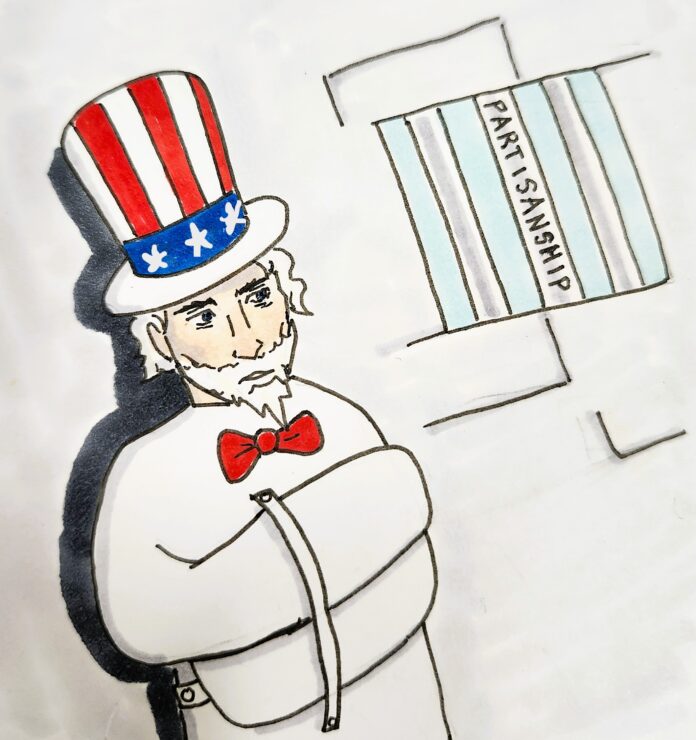
The concept of derangement syndrome ought to just be abandoned as a mental model. As stated earlier, it undermines democratic discourse by making all opposition to a politician appear to be a mental illness, reframing what could be a dialogue between rational individuals into a competition between the clinically insane and the normal. Since our democracy requires that people of opposing viewpoints be able to disagree and discuss issues together productively, the very notion of TDS is actively dangerous to it because it forecloses this recognition.
If TDS will remain part of our national discourse despite its toxic nature, its usage at least needs to be broadened to explain the phenomenon by which Trump’s rise to power has resulted in bipartisan collective insanity. The reality is that his very nature as a brash, petty and narcissistic man of absent moral character has the effect of bringing out the worst in our country when he is allowed to monopolize our political culture, as has been the case for a decade now. Until we grapple with this as a nation, as well as the fact he has been a candidate in three consecutive elections despite it, our country will only continue to grow more polarized.
