

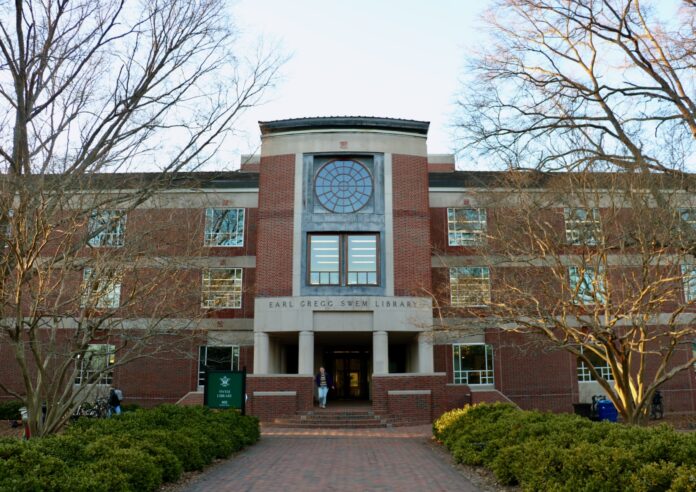
Thursday, March 26, the College of William and Mary hosted United States Army soldier, historian and author Col. Nathan Finney in Swem Library’s Hive Event Space. Finney discussed his 2025 book titled “Orchestrating Power: The American Associational State in the First World War.”
Finney serves as an affiliate at the College’s Whole of Government Center and is a senior mentor for the Project on International Peace and Security. He is also a member of the Council on Foreign Relations, an American foreign policy think tank, and serves as the director of the Commander’s Initiatives Group for the U.S. Army Western Hemisphere Command.
Finney received a B.A. in anthropology from the University of Arizona. He also holds two master’s degrees in public administration from Harvard University and the University of Kansas, as well as a Ph.D. in history from Duke University.
For his service in the army, Finney won the 2021 Gold Order of Saint Gabriel from the United States Army Strategist Association. This award recognizes individuals with extraordinary, career-spanning contributions to the U.S. Army’s strategic plans and policy community.
Finney’s research focuses on national security decision-making, strategy, civil-military relations, military policy, mobilization and war. His book explores the American mobilization efforts relating to World War I, focusing on the role of private and state-level organizations in war preparations. Finney analyzes North Carolina’s Council of Defense System to illustrate the role that institutions other than the federal government played in the World War I effort.
Finney explained how he drew inspiration for his book from a project he pursued in 2014, when the U.S. Army was under significant pressure to downsize and experienced intense congressional sequestration. The Army chief of staff at the time, Gen. Raymond Odierno, assembled a small team to analyze the idea of reconstitution: the study of how the army has historically grown rapidly in size. Finney was a member of this team and quickly became interested in reconstitution and mobilization during World War I.
“Orchestrating Power” is constructed through four narratives. The first details the story of Joseph Hyde Pratt, who convinced the North Carolina governor to establish a council of defense. The second analyzes the building of military power and draft processes through the efforts of John Langston. The third focuses on the politics of partial inclusion and the role of women in war mobilization efforts while maintaining a gendered sociopolitical order. Conversely, the fourth centers on the politics of exclusion, discussing the barring of Black North Carolinians from mobilization.
After discussing his book, Finney gave the floor to audience members for a question-and-answer session. Attendee Eileen Ackley ’26 said she found the discussions of the four separate stories most compelling, along with the diffusion of responsibility to different states as a result of a weak federal bureaucracy.“When push comes to shove, there is a lot of power in the individual civilians, as well as your local and smaller systems of government, in mobilization and also achieving a greater war effort,” she said. “It really comes down to people being able to step up at the end of the day, as seen by these councils of defense in generating military power.”
Nina Appicello ’26 spoke on the diversity of the College’s Global Research Institute, one of the event’s organizers.
“What I found most interesting about the talk is that the Global Research Institute is so entirely interdisciplinary that even though it was a talk about history, he was getting asked many questions about the applications of technology and future implications,” Appicello said. “What I am taking away from this event is that there are so many careers where one can pursue research in a non-academic setting.”
Teaching professor and Associate Chair of Government Dennis Smith also attended the talk. Smith works closely with Finney through the College’s PIPS program.
“You normally think that something as important as mobilization is being handled by the government, like state and federal bureaucracy,” Smith said. “But the fact that this was really about trying to tap into political and business networks at the state and local level, that was surprising.”
Smith found the topic of social groups to be particularly insightful and relevant.
“I really think it’s about the importance of social groups in how the government achieves big things,” he said. “Normally, when we think in terms of politics, we think of political parties, we think of bureaucracies, but we don’t really think of social networks.”
Throughout the event, Finney mentioned he has always felt like a member of the Tribe. He said that every visit to the College feels like returning home. Finney’s writing journey does not end with “Orchestrating Power,” however. He is currently working on his next book, which centers on Cold War Taiwan.
