

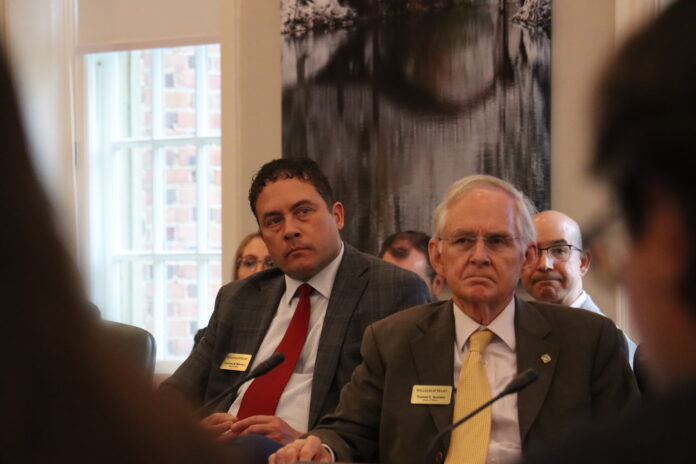
Wednesday, Sept. 23, to Friday, Sept. 25, the College of William and Mary’s Board of Visitors met for its first session of the 2026-27 academic year in Blow Memorial Hall. The Board held several committee meetings regarding topics including new degree offerings, admission statistics, student attitudes and plans for tuition increases.
Committee on Academic Affairs
Thursday, Sept. 24, the Committee on Academic Affairs resolved to approve a new Master of Science in cybersecurity risk management.
The resolution said the degree is “designed to equip students with the skills and knowledge necessary to identify, quantify, communicate, and manage cybersecurity and artificial intelligence (AI)-related risks in organizational settings.”
The program would primarily target executives and would operate out of the College’s Washington Center, with ties to the computer science program in the School of Computing, Data Sciences and Physics. The program would also require hiring up to three adjunct staff members and no new full-time faculty.
The College hopes to target the expanding cybersecurity sector and draw in new sources of revenue, as has been done at other universities in the commonwealth of Virginia.
The new degree program was approved by the Board Friday, Sept. 25.
Committee on Student Success
Thursday, Sept. 24, the Committee on Student Success heard a presentation from Vice Provost for Enrollment Strategy Lisa Keegan that covered admission statistics, student enrollment experiences and post-graduate outcomes. The committee also invited four student panelists to share their experiences.
Keegan said the university’s enrollment strategy should account for the entire student experience, from recruitment through graduation, rather than focusing exclusively on enrollment numbers.
Keegan said students who enroll at the College most frequently cite a sense of community and belonging, campus feel, connections made during campus visits and academic rigor and reputation as reasons for choosing the school.
Keegan explained that the College conducts surveys of each incoming class to understand why students choose the College and whether those reasons align with the school’s messaging.
“Overwhelmingly, their reasons for selecting us align with the value proposition that we’re communicating,” Keegan said.
The presentation also addressed the College’s U.S. News & World Report ranking and its relationship with application volume. Keegan said fluctuations in the College’s ranking have corresponded with changes in application volume, cautioning that the data doesn’t demonstrate causation.
The committee then heard from Noah Wright ’28, Conor Newberry ’30, Gracen Covington ’27 and Zuyemi Cortez-Cardenas ’28. Committee members asked the student panelists if they saw differences between the College’s presentation to prospective students and their actual experiences.
Newberry, a first-year Democracy Scholar, said campus visits were central to his decision to attend the College. During an admitted student event, he spoke with students in the Makerspace and said their responses about the College consistently centered on its community.
Newberry said the campus atmosphere and the size of the school ultimately helped him decide that the College was the right fit.
Newberry struggled to articulate any significant problems he has experienced since arriving at the College. He cited an air conditioning issue in his residence hall as a complaint.
Cortez-Cardenas, a transfer student, emphasized the importance of creating a sense of belonging for students entering the College after starting higher education elsewhere. She said transfer students can have difficulty integrating into an established campus community, particularly when arriving in the spring.
“Although we did come in a little bit late to the party, we do still want to feel like we’re involved,” Cortez-Cardenas said.
Cortez-Cardenas also said the College’s community was one of its strongest qualities.
Keegan responded to Cortez-Cardenas by saying that transfers represent an important part of the College’s enrollment strategy and could help offset fluctuations in the traditional fall entering class. She said the College is considering proposals for a transfer center and additional transfer scholarships.
Wright, a student-athlete and Raymond A. Mason School of Business student, said underclassmen interested in business could benefit from taking business courses earlier in their undergraduate careers. He said other universities tend to offer more business courses for underclassmen.
Wright pointed to relationships with professors, classmates and alumni as a highlight of his experience at the College.
Covington, who spent two years at the University of St. Andrews through the College’s Joint Degree Programme, said she thinks the program could be marketed more heavily to prospective students interested in international relations.
“I would love to see some more funding opportunities for the JDP just to make it more accessible,” Covington said.
Covington similarly highlighted the College’s alumni network. She specifically mentioned the connections she made through internships and the College’s Washington Center and Washington summer programs.
The committee adjourned after the student panel.
Committee on Administration, Buildings and Grounds
Thursday, Sept. 24, the College’s Chief Business Officer Sean Hughes shared dining updates with the Committee on Administration, Buildings and Grounds.
Initially slated to open at the start of the fall 2025 semester, the West Woods Dining Hall has been delayed three separate times.
Hughes discussed possible reasons for the delays.
“A lot of this has to do with the structural format of the contract and the acquisition strategy that we use,” Hughes said.
The College ultimately settled on a public-private partnership for the construction, issuing a land lease to third-party owner Provident Resources Group.
“That third-party owner in turn hired the developer, who in turn hired contractors and architects,” he added. “So right off the top, one of the lessons learned is we are trading away some control in this situation.”
Hughes also attributed the delays to missing equipment, incorrectly calibrated air conditioning systems and refrigeration issues.
“We’ve made it clear that this is unacceptable,” he said.
Hughes expressed confidence that the West Woods Dining Hall will open in spring 2027. He also said the Food Hall at Sadler — which was converted to a retail food hub this fall — will not revert to an all-you-can-eat cafeteria this academic year. Morning Musings and the Marketplace at Campus Center will also continue operating during the 2026-27 school year.
For future projects, Hughes mentioned exterior refurbishments to five buildings surrounding the Sunken Garden, the installation of roughly 400 geothermal wells below the Sunken Garden and renovations to Boswell Hall.
The committee also passed two resolutions. The first authorized College leadership to engage in a real estate exchange with the William and Mary Foundation, and the second approved an updated charter for the William and Mary Retirement Committee.
Committee on Financial Affairs
Thursday, Sept. 24, the Committee on Financial Affairs unanimously approved updated six-year plans for the College and the Virginia Institute of Marine Science.
The College’s six-year plan includes tuition increases of 2.9% for both in-state and out-of-state undergraduate students, which the Board approved in April. The decision was met with student pushback, including a peaceful protest during the April meeting.
“We’re doing our best to keep tuition from rising as fast as other places,” Chief Financial Officer Sean Galloway said after the September meeting.
Galloway said the College updated the plan using assumptions provided by the State Council for Higher Education of Virginia. This includes a 2% salary increase and a 1% increase in employee health insurance premiums.
In response to an ongoing budget deficit in appropriated funds for state initiatives and significant cuts to federal funding, VIMS’ six-year plan calls for a base budget increase.
VIMS currently faces an annual operating cost deficit of $4.1 million and has requested a base budget increase of the same amount. According to the plan narrative, the funds would support recruitment and retention of scientists, advance high-impact initiatives and maximize the state’s return on investment.
“I don’t expect to get that $4.1 million,” VIMS Dean and Director Derek Aday said. “If the state is able to give us 10% of that, 50% of that, anything that they do allows us to operate in a way that we have always operated and to deliver the actual science that they depend on us to do.”
Committee on Institutional Advancement
Thursday, Sept. 24, the Committee on Institutional Advancement discussed the College’s strategic planning.
Committee Chair Jennifer Tepper Mackesy ’91 opened by discussing the College’s work on developing the next long-term university plan.
“Our focus has remained on our four pillars: driving student demand, building brand awareness, strengthening engagement and philanthropy, all on the foundation of the outstanding talent of our faculty and staff,” Mackesy said.
Senior Vice President of University Advancement Matthew Lambert ’99 then gave a presentation about the College’s performance on key institutional advancement indicators.
The first performance indicator Lambert discussed was philanthropy. He said donation amounts to higher education have fallen across the country.
Lambert characterized the College’s current donor situation as positive.
“Our aim is by the end of 2030 to be at [a] 68% [giving rate], which is well beyond a national benchmark,” he said.
Lambert then mentioned the College’s institutional reach and awareness indicator. He said the College set a goal to increase its reach by 5% annually, which it exceeded this year.
In terms of internships, Lambert said more students have taken advantage of the College’s Funding for Unpaid and Underfunded Student Experiences program.
“The number of students requesting, seeking and receiving funding for unfunded or underfunded internships has increased pretty dramatically,” Lambert said. “This most recent year, [it was] almost $400,000.”
The fourth and final performance indicator Lambert mentioned to the committee was alumni engagement.
“We are connecting with those alumni, and we’re roughly double the rate of engagement that institutions are globally,” he said.
The meeting then turned to Provost Peggy Agouris, who discussed guiding principles shaping the College’s new strategic plan.
“A strategic plan is a path towards establishing and preserving and documenting identity in the landscape of external forces that keep changing,” she said.
Agouris said the College is focusing on student demand, research, academic excellence and outcomes as it develops its new strategic plan. She said the College is communicating initial proposals to the community based on feedback collected from working groups.
Carlane Pittman-Hampton, chief of staff to College President Katherine Rowe, expanded on this community engagement.
“This cannot be something that’s driven by a couple people,” she said
Pittman-Hampton said hundreds of groups have submitted survey information responding to parts of the College’s strategic planning. She also said the College aimed to continue gathering feedback over the summer break.
“We did town hall, surveys, focus groups and we did live polling,” she added.
Pittman-Hampton said the College is still gathering student feedback.
“Hopefully in November, we can talk a little bit more with the board about what we’ve come up with,” she said.
Lambert then circled back to philanthropy, emphasizing the College’s recent success in collecting donations.
“2025 was the single largest year for philanthropy at William and Mary with $240 million,” he said. “But this past year, 2026, was also a milestone for us. And that’s because last year was the first year in our history that we raised more than $100 million with gifts under $5 million.”
Lambert also touched on the endowment’s growth, which he said now sits at $1.9 billion. He said the William and Mary Foundation has contributed $175 million in budgetary support to the College this year.
“We need probably eight times as much endowment to meet all the wishes and desires of our president [and] our leadership team,” Lambert said. “We will get there over time.”
The committee meeting then moved to closed session.
