

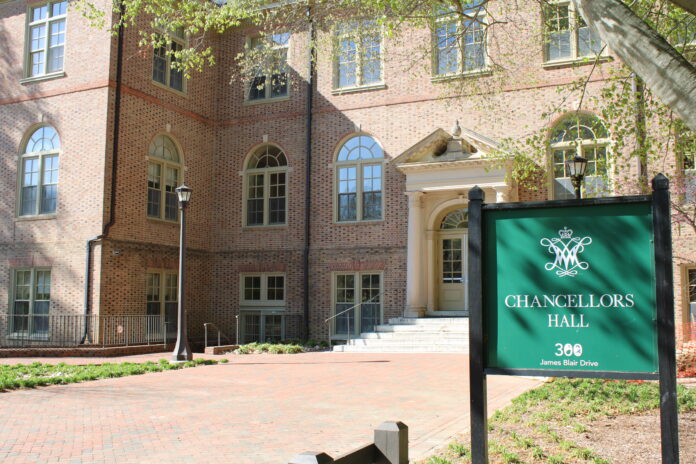
Thursday, April 23, the College of William and Mary hosted Class of 1935 Professor of Government John McGlennon for a talk regarding Virginia’s electoral system and unique history in Chancellors Hall. The event was arranged by the College’s chapter of the NAACP.
Chair of the Political Action Committee Dakota McCoy ’27 spoke about motivations for hosting the event.
“When the NAACP chapter hosted the Election Day watch party, we noticed a lot of people in attendance did not know their delegate and did not know their representative. Yet, they voted for these people,” McCoy said. “We wanted to have an event and something that people could take home with them — a pamphlet — that would tell people who their representatives are and what they’re supposed to be doing.”
McGlennon has taught government at the College since 1974. He ran for the U.S. House of Representatives twice, served on the James City County Board of Supervisors for 29 years and described himself as a member of the NAACP for life.
”I’ve enjoyed my involvement with our local chapter quite a bit over the years and really have found it to be a great organization,” he said.
He began his talk by describing how he started his career during former President Richard Nixon’s call for impeachment amidst the 1974 Watergate scandal. He compared this to the current demands for what would be President Donald Trump’s third impeachment.
“It’s been an interesting ride, just seeing the way things have developed,” he said.
McGlennon spent much of the talk interpreting the 2026 Virginia redistricting amendment, which allows the state to redraw its congressional districts outside the standard cycle. He provided context for the referendum vote. The amendment was a direct response to redistricting moves in Republican-led states after Trump pushed Texas to redraw its congressional map outside of the census to add five Republican seats. California Gov. Gavin Newsom responded by placing a redistricting measure on the ballot for voters to approve.
McGlennon pointed out a key difference in California from the redistricting done by Texas’s legislature.
“In California, the governor said, ‘No, we’re going to do it differently. I’m going to go to the legislature and ask them to put this on the ballot, and we’re going to go ahead and have an election for the voters to decide if they want to do this,’” he said.
Virginia’s Democrat-led government followed California’s lead, and voters approved the measure. They produced a new map with 10 districts likely to elect Democrats and only one likely to elect a Republican.
While McGlennon said this is not an accurate representation of Virginia’s government or population, he acknowledged the practicality of the decision.
“It is the only way we can get a fair balance nationally to offset what’s happening in these other states,” he said.
Virginia’s constitution makes this process especially difficult. Unlike most states, Virginia requires a proposed constitutional amendment to pass the legislature twice before going to voters. That same process had previously produced an independent bipartisan redistricting commission, which the new amendment temporarily suspends until the 2030 census.
McGlennon explained the hesitation of some Democratic voters who had supported the original bipartisan commission but remained uncertain about partisan gerrymandering.
“That sort of restrained some Democratic enthusiasm, caused a little bit of a depression of the Democratic vote, primarily among suburban voters who were really very supportive of a kind of fairness notion,” he said.
In regular candidate races, Virginia Democrats typically win by far larger margins, McGlennon said. Gov. Abigail Spanberger won the governor’s race last year by around 15 points.
Though there was a slim margin in Tuesday’s results, McGlennon drew a greater conclusion.
“The election really became framed on the question of, ‘Do you really want Congress to continue to just let Donald Trump do everything he wants to do?’” he said. “And on that basis, Virginians said no.”
After the election proceeded, a judge in Tazewell County, Va., sought to block certification of the result. McGlennon said the Virginia Supreme Court is expected to issue a final ruling on the objection by Monday, April 27.
“It’s very unlikely they would now turn around and say, ‘Oh, well, too bad,’” he said. “We know that 3 million-plus voters turned out to cast their ballots. We know that they made a decision.”
A student mentioned seeing mailers urging a “no” vote by claiming the redistricting would strip political power from Black voters. McGlennon answered the question of unequal representation by walking the room through a history of Black voting rights and representation, starting with the Voting Rights Act of 1965.
In the immediate post-VRA era, a district needed to be roughly 65% Black for an African American candidate to possibly win. McGlennon argued that this no idea longer holds, and this was the logic that Republican mailers exploited.
“What we know about the way people vote is that racial polarization is not as strong as it was in that time period,” he said.
Under the new map, City of Williamsburg Rep. Jennifer McClellan’s district stretches to Danville and contains a Black population of around 45%. McGlennon said McClellan is still overwhelmingly likely to win reelection. Virginia currently has two Black congressional representatives who are both expected to win.
McGlennon explained how a broader shift in how Americans vote has made this possible, stating that white voters today are less likely to vote against a candidate simply because of their race.
“I’m white, they’re Black, so what? What’s their stand on the policy issues that I care about?” McGlennon said.
He pointed to Virginia’s last election cycle as proof. The Republican candidate for governor was an African American woman. The state elected Ghazala Hashmi, a Muslim American, as lieutenant governor and Jay Jones ’10, an African American graduate of the College, as attorney general.
“When you look at the nature of representation, it’s changed so much over time,” McGlennon said.
McGlennon also traced Virginia’s unique governmental structure back to its colonial roots. Virginia was built as a social hierarchy that had plantation owners at the top.
This hierarchy was reinforced by its political system.
Colonial history’s application to the present was important to McCoy.
“I like that [McGlennon] touched on Virginia’s unique electoral system,” she said. ”Just the way he described it, Virginia’s electoral system is heavily based on the antebellum era and plantation owners being the main people who vote. I’m glad he explained to us how that came to be and the progression of how we got to where we are now.”
McGlennon noted that for much of the 20th century, Virginia ranked among the lowest states for voter turnout in the country. Trends still reflect an era when power was deliberately kept from working-class people.
”You needed to have the people who really had the most financial stake in the state to have the power,” he said. “But you didn’t want to encourage participation.”
Attendee Keziah McKenna ’29 said the event helped clear initial confusion she had over the referendum and campaign wording.
She said that she was glad the state acted, although it had felt hypocritical at times.
“I’m glad that Virginia took the measure to balance out what’s going on in our nation,” McKenna said. “Gerrymandering is bad. We shouldn’t practice that. But what we did here, I do feel like it was right to do that.”
McCoy grew up in Mechanicsville, Va., just north of Richmond, Va., and the referendum redistricting impacts the area she is from.
“I understand the specific culture and context of that area and the reasons people may vote the way they vote,” she said.
McGlennon closed by suggesting some arenas for change, suggesting that the new congressional map could force Democratic representatives to engage with rural Virginia constituents who have long written off the party.
“Is it more important to me that my member of Congress doesn’t work on DEI, or is it more important that they help me be sure that I’ve got healthcare for my family?” McGlennon asked.
McCoy said her goal was not to push a position.
“Gerrymandering is wrong, flat out — it does discredit people’s votes. But there are also larger contexts occurring in the nation and within the state that caused this referendum to come about,” she said. “So I think people just need to form their own opinions on it. And they voted for what they think is best.”
