

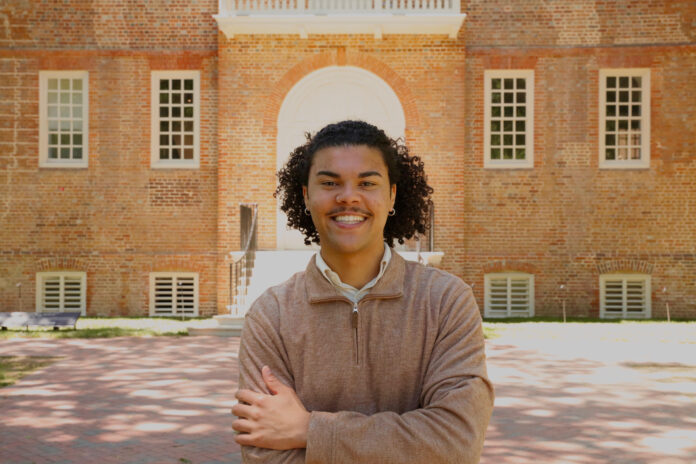
Terrence McDuffie ’27, an Africana studies and sociology double major on the pre-law track at the College of William and Mary, serves as president of the Innocence Club. He is a Posse and James Monroe Scholar, the founder and director of the Posse Scholar Ambassador program and was a City Research Scholar.
McDuffie’s commitments reflect his passion for racial justice and community outreach.
“William and Mary was essentially given to me on a silver platter through Posse, and I’m so grateful for that,” McDuffie said.
When he arrived in Williamsburg, Va., McDuffie was drawn to the College’s Innocence Club due to his interest in criminal defense and knowing a friend in the organization. Now, as president, McDuffie enjoys the task of preparing discussions between members.
“I would make those slides, and then I would facilitate conversations, delegate those slides to exec members to present on, and then facilitate discussion among general body members,” he said.
McDuffie said he merges dialogue about criminal justice with race to provide a broader perspective.
“Overall, my approach was really to talk about wrongful incarceration through the lens of how racism played a role within that,” McDuffie said. “Really, talking about touching base with critical race theory and delving into the history to serve as a context for where we are now with all of that and how it is that Black communities are disproportionately facing wrongful convictions because of this history that is there.”
To fulfill the Innocence Project’s mission to “free the innocent, prevent wrongful convictions, and create fair, compassionate, and equitable systems of justice for everyone,” the Innocence Club directs advocacy, education and fundraising efforts.
“We were raising money for No Kids in Prison, which is a nonprofit organization that advocates keeping kids out of prison and pushing a more rehabilitative approach,” he said. “Ultimately, people are products of their environments, and kids are the most susceptible to that.”
McDuffie also explained how he views the criminal justice issues in the United States.
“People are growing more conscious, but it is just so difficult to find an avenue that could actually work because the system was built to harm people,” he said.
McDuffie’s time as a City Research Scholar with the Village Initiative began after interning with the Local Black Histories Project, jointly run by the initiative. The organization describes itself as “a grassroots, 501c3 organization dedicated to equity and justice in the Williamsburg-James City County Schools and community.” As a part of these efforts, McDuffie helped create the documentary “Displaced from the Birthplace of America.”
The documentary explores the history of the Black business sector and community hub called the Triangle Block, its destruction by the City of Williamsburg in the 1970s and Black citizens’ response to this loss and discrimination.
McDuffie discussed Williamsburg residents’ reactions to the film’s extended trailer.
“So many people always come to us afterwards and say, ‘I had no idea. I’ve been here for all my life. I had no idea that this happened,’” he said. “Even if it’s just one person that’s being like, ‘I’m getting enriched, I’m becoming enlightened from this information,’ the job is done.”
McDuffie explained why he wanted to raise awareness about this topic.
“We have to be respectful of the people who were here before us, who are here right now and who are going to be here after us,” he said. “And there is this isolation in race, class and access.”
Along with conducting archival research, McDuffie especially valued the community work he accomplished, such as speaking with residents to understand their stories of displacement.
“There’s this one woman. Her mom had a business in the Triangle Block, and her home right across the street,” he said. “[The] City bought out the business, destroyed that property, and she’s living across the street, seeing something that a Black woman did in the ’50s and ’60s on her own, being literally taken right in front of her eyes.”
McDuffie described the impact of these conversations.
“While it might not be the first involvement I think of when people ask me what I’m involved in, upon reflection, it is my most impactful, my most meaningful involvement,” he said. “As I’m talking about it, I’m feeling the emotions coming up.”
On campus, McDuffie is also a class of 2027 senator for Student Assembly, a returning Orientation Aide Director and co-outreach chair for International Minimart. As a first-generation student himself, McDuffie hopes to use these efforts to support fellow first-generation students and students of color.
This summer, McDuffie will work alongside his advisor and sociology professor Amy Quark on topics related to the “Displaced” documentary. McDuffie will also intern under Director of Restorative Justice and Diversion Services Rev. Grace Woodward in the Commonwealth Attorney’s Office. His work will center on victims’ rights and combine accountability with rehabilitation for offenders.
“I get to work in a space where we’re presenting alternatives and rehabilitating the people who are committing these acts and hopefully putting them on a path to recognizing, ‘This is the harm that you’ve done. Can you sit here and come to terms with that, focusing on the person that you impacted and then go from there to recognize, grow from there and be put on a better path?’” McDuffie said.
