

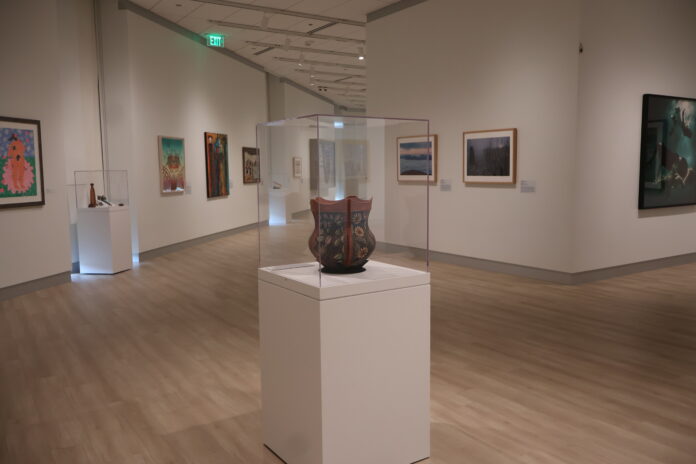
The Muscarelle Museum debuted the exhibit “Expanded Horizons: Native American Creativity at the Intersection of Culture and Art” Saturday, June 28. The exhibit features nearly 60 Native American artworks of varying genre and mediums, including figurative, abstract expressionist and pop art paintings, as well as blown glass sculptures. The exhibit also contains the works of over 35 indigenous artists from across the United States, and now offers docent-led tours at 2 p.m. every Tuesday-Sunday.
Muscarelle docent Harry Chancey, who leads the weekend tours, is among the museum docents who have conducted in-depth research of the artworks to explain them to the public.
“Some museums have scripts, but not here,” Chancey said. “They respect us — we have to go through a certain amount of training, but we all create our own tours. I really enjoy it.”
Chancey’s tour centers on the representation of “tricksters” in Native American mythology and art. In particular, the raven and the coyote are recurring symbols in many pieces of the collection. Indigenous artists use these figures to address, interrogate and confront Western ideals and norms.
One such work is Harry Fonseca’s “Rose on the Half Shell,” which mimics Botticelli’s “The Birth of Venus.” In the painting, a crudely-painted, nude body stands atop an open clam shell. The head of the figure is not, like in Botticelli’s work, that of a beautiful woman. Rather, Fonseca’s Venus is Coyote, a trickster figure found in traditional Maidu oral literature.
“Fonseca is taking the standard trope of the Birth of Venus, and he’s giving it back to us on a half shell,” Chancey said. “We have ‘the trickster’ leading us out of ignorance and into a new way of thinking — expanding what we think about what we know.”
During his tour, Chancey showed the crowd a picture of Margaret Burrough’s “Black Venus,” which is not currently on display, but is part of the Muscarelle’s permanent collection. By reclaiming icons of Western art, these artists are pushing their audience to think beyond their conceptions of traditional beauty.
“This, too, is another way of saying: we see Botticelli’s Venus, and we think there are other ways of seeing beauty standards,” Chancey said.
Chancey’s tour featured several other socially-charged works, including a large, oddly-shaped canvas titled “Autobiograffitipi,” by multimedia artist Tom Poolaw. Chancey challenged his audience to guess what the shape of the canvas might represent. One audience member surmised that the shape was an axe head. It, in fact, was not.
“This is a tipi shape,” Chancey said. “This is what you would cut out of hide if you were in the wild. The purpose of the opening on top is for the smoke to exhaust, and the shape would be supported by poles radiating from the center core. The triangle part would make a triangular tent-flap.”
By painting his “Autobiograffitipi” on a tipi-shaped canvas, Chancey explained that Poolaw is reclaiming Western “art norms” on his own terms, and reflecting them back to the unsuspecting audience.
Poolaw’s canvas is split horizontally in two. The left side is white, decorated with black illustrations and symbols, including his daughter’s birth, song lyrics, his favourite restaurant — The Mont — and a long string of numbers that include basketball scores, passwords and his social security number. This portion of Poolaw’s work is a nod to the traditions of his Kiowa ancestors, who decorated the exteriors of their tipis with war deeds and personal family history.
The other half of the canvas is black, save for an indistinct grey form in the middle — what looks like a wheel on top of a stool. Chancey said this grey piece represents famed conceptual artist Marcel Duchamp’s 1951 “Bicycle Wheel” sculpture. With this inclusion, Poolaw confronts the western conceptual art movement.
“He’s saying, ‘We get conceptual art. You can’t leave us out any longer, we can be part of that world,’” Chancey said.
Chancey explained leading this particular tour was a challenge at the start. Previously at the Muscarelle, he led 38 tours of the “Michelangelo: The Genesis of the Sistine” exhibit and founded the lecture series “Art in the Afternoon,” which featured artists from the Hudson River Art School to Edgar Degas. However, this exhibit was a dramatic shift from his expertise in the Western art canon.
“When I first looked at the pieces, I thought: You don’t know anything about any of this, and you’ve got to do some research,” Chancey said. “So I spent dozens of hours researching and getting to the bottom of the pieces that drew my attention. I learned the meaning behind the works, so that I could help people sort of see the idea of ‘Expanded Horizons.’”
For gallery monitor Gigi Spector ’27, watching the exhibit evolve has been a rich experience.
“I was here when they started setting up,” Spector said. “It was exciting to get new artwork, and to see stuff getting moved around. They weren’t sure which rooms they were going to put certain works in yet, so at first a lot of art was propped on the floor, against the walls.”
Now, working in the finished exhibit, she too learns from the docent tours.
“I definitely learn more about the exhibits, because the stuff that he says is different from the stuff on the plaques,” Spector said.
Spector noted how Chancey’s insights, particularly on the Coyote piece, were interesting.
“It just made me think about the piece a lot more and I really like how he ties a thread throughout the work and focuses on trickster spirits,” Spector said.
Visitors were also impressed by Chancey’s presentation. The half-dozen audience members in attendance applauded at the conclusion of the tour. One couple explained that they had just moved from Montana with a trailer full of indigenous art. With a wink, Chancey asked if they’d consider donating to the collection.
For now, rest assured, there’s plenty to go see. The “Expanded Horizons” exhibit is open during regular museum hours, 10 a.m. to 5 p.m. Tuesday-Saturday and 12 p.m. to 5 p.m. Sunday, until Oct. 13. Visit https://muscarelle.wm.edu/exhibition/expanded-horizons-native-american-creativity-at-the-intersection-of-culture-and-art/ for more details.
