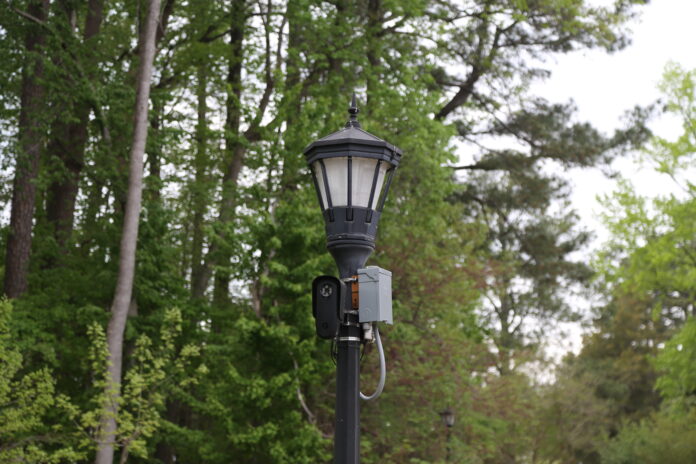
Tuesday, Sept. 15, assistant professor of criminology and Director of the Center for Crime, Equity and Justice Research and Policy at Christopher Newport University Steven Keener hosted a Flock camera teach-in event at the College of William and Mary’s Ewell Recital Hall.
Keener presented his research on Flock cameras, the artificial intelligence-powered automatic license plate readers present on college campuses and communities across the United States.
The event was co-hosted by nine student organizations that have expressed concern about Flock’s proliferation in Williamsburg, Va., with Ella Forlin ’27 and Charlie Goodman ’27 serving as the organizers.
Drawing on data collected primarily from the Hampton Roads area, Keener said his research demonstrates how the placement of ALPRs results in the disproportionate policing of Black and minority communities.
Keener said he found that ALPRs tend to be concentrated in formerly redlined neighborhoods, near public housing and heavily around Norfolk State University’s campus, one of Virginia’s five Historically Black Colleges and Universities.
“We have historically underinvested or disinvested in these communities, and now we’re spending millions of dollars in those same communities to surveil,” Keener said.
Keener said his research is the first of its kind in Virginia to comprehensively evaluate what he sees as a pervasive use of ALPRs in the state.
Keener opened his talk with a call for bipartisan collaboration to prevent these cameras from continuing to spread across Virginia. He said he believed Virginia lawmakers should work to strengthen guardrails on ALPRs.
“While localities are making critical decisions around the future of these cameras, our state lawmakers can also act on this,” he said.
Williamsburg City Council Member Stacy E. Kern-Scheerer, who’s running for reelection, attended the event. She said she wanted to learn more about how ALPR technology works to better address community concerns.
“This was a really valuable talk because I got more information about things I might have heard about but had never really dived into as Keener did this evening,” Kern-Scheerer said.
Williamsburg City Council candidate Eino Korpela ’25 shared a similar desire to respond to student and community concerns about Flock technology.
“I keep hearing over and over again from students and residents that they oppose Flock cameras,” Korpela said. “It’s supposed to promise a feeling of safety, but we continue to hear the fact that it actually feels like an invasion of privacy.”
Keener said during his lecture that outside actors may have obtained access to private ALPR data gathered by localities without permission. He said that federal agencies, such as U.S. Immigration and Customs Enforcement, can indirectly access the Flock data of any locality in the country.
An example of this inadvertent sharing in Virginia happened in July 2025. In this instance, the Richmond Police Department shared its data with the Bureau of Alcohol, Tobacco, Firearms and Explosives, which then shared the information with ICE for immigration enforcement purposes without the department’s permission.
“Because this data is shared [across localities], you only need one portal entry, and you get access to the whole thing,” Keener said. “For example, if Williamsburg is doing everything correctly, following state law and not sharing the data with ICE, but they are sharing it with another locality that’s friendly with ICE, they can access Williamsburg’s data, whether Williamsburg wanted them to or not.”
Keener mentioned several instances of federal officials using ALPR data to monitor attendance at political events, such as at the anti-President Donald Trump No Kings protests. Keener expressed concern regarding ALPR cameras’ potential use leading up to the November midterm elections.
Keener said law enforcement officials using Flock technology can create hotlists for suspects whom they have reasonable suspicion of committing a crime. He said this allows police to receive real-time alerts for their movements each time they pass a camera while driving. Keener said that while state law normally requires ALPR data to be deleted after 21 days, hotlists can bypass this rule.
“The second you’re on a hotlist, all those state guidelines are exempt,” he said.
Keener warned the audience about newer forms of AI surveillance technology outside of Flock. He mentioned Tsunami cameras, a system used by law enforcement officials for surveillance of public housing areas in cities like Richmond, Va.
Keener said he believes successful advocacy efforts must oppose AI surveillance technologies before localities sign contracts with companies. He cited community mobilization in Harrisonburg, Va. led by the mayor and advocates this summer to halt planned Flock camera installations as an example.
“Not only did they get their contract canceled, they now have an ordinance in Harrisonburg that says that any new surveillance tech must go through public input,” Keener said.
Forlin said she is working with other students to organize a “Flock Walk” fun run Sunday, Oct. 18. She said the course will be designed to pass every Flock camera on campus.
Forlin closed the event by encouraging students and community members to get involved in the local anti-surveillance movement in Williamsburg.
“These decisions are being made on the local level, meaning that we have input here; we can change stuff,” Forlin said. “We have a receptive government in Williamsburg, and now you’re equipped with the knowledge to talk with people about this and voice your opposition.”